
Commercial cleaning costs depend on what a building requires, how often service is needed, and the conditions an independently wned janitorial franchise business will need to manage.
Why Two Santa Clarita Buildings Can Need Very Different Cleaning Scopes
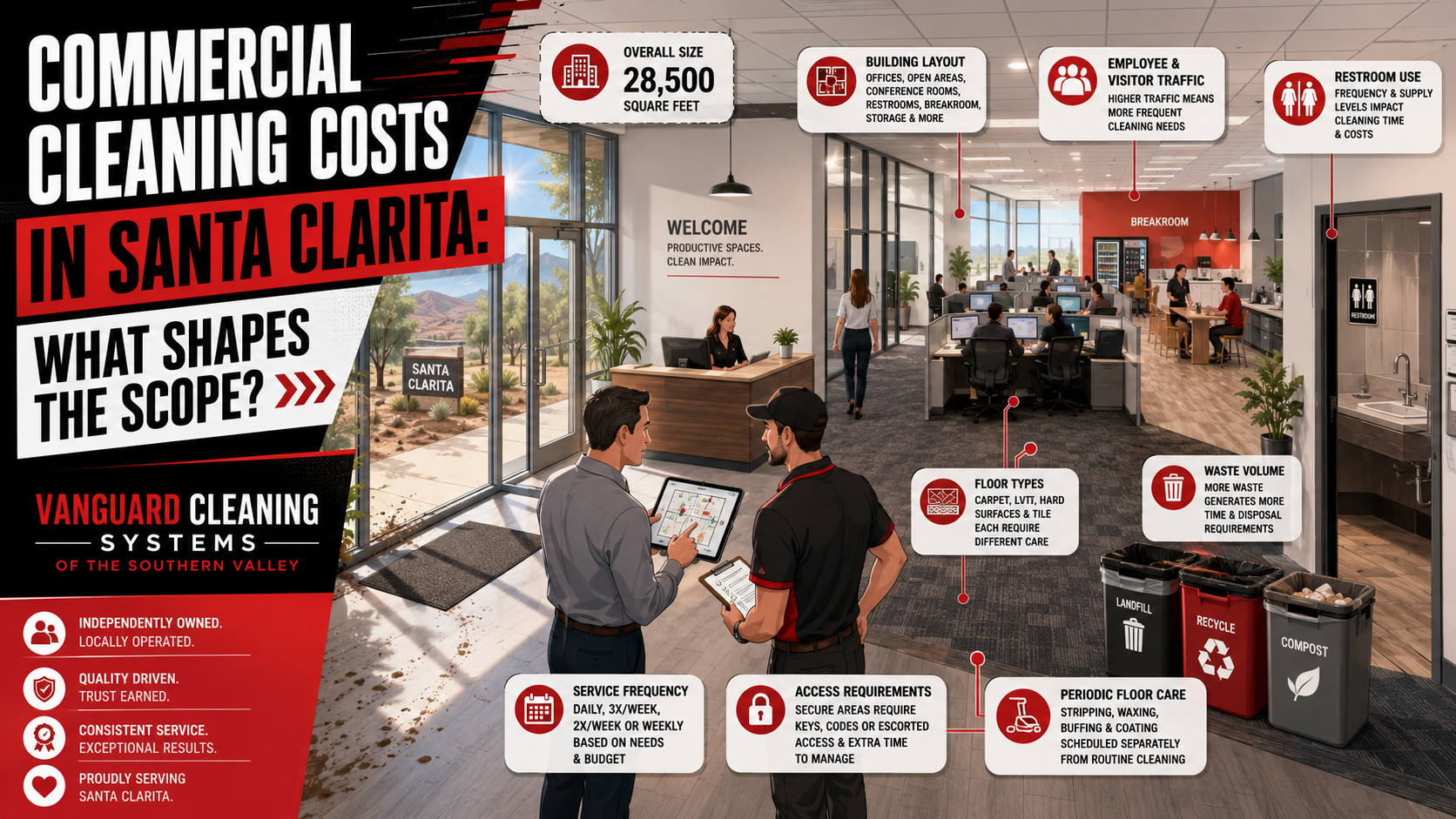
Two commercial buildings can have the same square footage and still require very different janitorial service plans. A quiet office with private workspaces creates different demands than a busy building with shared restrooms, public entrances, breakrooms, and steady visitor traffic. Floor materials, operating hours, security rules, and service frequency can change the workload even further.
That makes square footage useful, but incomplete, when estimating commercial cleaning costs in Santa Clarita. A useful proposal starts with the actual building, its daily use, and the results expected from routine service.
Facilities comparing commercial cleaning services in Santa Clarita can get more value from asking what shapes the scope than searching for one standard price per square foot.
Quick Answer: What Affects Commercial Cleaning Costs in Santa Clarita?
Commercial cleaning costs in Santa Clarita are commonly shaped by:
- Total cleanable square footage
- Building layout
- Service frequency
- Employee and visitor occupancy
- Restroom count and usage
- Breakroom and food-service areas
- Floor types and floor-care needs
- Waste volume
- Access and security requirements
- Cleaning windows
- Supply responsibilities
- Periodic services
- Special-use spaces
- Current building condition
A walkthrough gives the janitorial business an opportunity to see these conditions before developing a proposed scope.
What Is a Commercial Cleaning Cost Estimate?
A commercial cleaning cost estimate is a proposed price based on the work required to maintain a specific facility under an agreed service scope.
The scope defines details such as:
- Areas included in service
- Tasks performed
- Service frequency
- Expected schedule
- Periodic work
- Access requirements
- Responsibilities for supplies
- Areas excluded from routine service
This matters because the phrase "commercial cleaning" can describe very different amounts of work.
One office may need routine trash removal, restroom care, vacuuming, hard-floor care, and breakroom service several evenings each week. Another property may include multiple buildings, high visitor volume, large restrooms, secure work areas, and extensive hard flooring.
Both use commercial cleaning services. Their labor and service needs are quite different.
Vanguard Cleaning Systems of the Southern Valley makes custom commercial cleaning scopes available based on facility needs. Janitorial services are performed by independently owned and operated Vanguard Cleaning Systems janitorial franchise businesses.
How Commercial Cleaning Pricing Works
Commercial cleaning pricing usually begins with an assessment of the work required to complete the proposed scope consistently.
Several pieces of information help establish that workload.
A walkthrough may examine:
- How much of the facility is included
- How spaces are used
- How quickly areas become soiled
- Which tasks are needed each visit
- How much time individual tasks may require
- What equipment may be needed
- Which services occur less frequently
- When work can be performed
- What access procedures apply
The resulting proposal can then connect the required work with a service schedule.
This approach is more useful than assuming every square foot of a commercial building requires the same amount of attention.
A square foot of lightly used storage space does not create the same workload as a square foot inside a busy restroom or breakroom.
1. Cleanable Square Footage Establishes the Starting Point
Square footage is one of the first measurements used when developing a commercial cleaning scope.
Larger facilities generally contain more flooring, surfaces, waste stations, rooms, and walking distance. Those conditions affect the amount of work involved.
The key number, however, is often cleanable square footage.
A building may contain spaces that:
- Are excluded from janitorial service
- Receive service only periodically
- Require limited access
- Are maintained by another provider
- Remain unused for part of the week
- Need a different service frequency
For example, a large warehouse with a small office section could have more total square footage than a multi-floor office building while requiring a very different routine cleaning program.
Square footage helps establish scale. The walkthrough adds context.
2. Building Layout Changes How Work Gets Done
Layout affects productivity.
An open office with long, accessible corridors may allow work to move efficiently from one area to another. A building divided into many offices, suites, stairwells, secure rooms, and separate wings creates additional movement and setup time.
Consider the difference between:
- 20,000 square feet on one open floor
- 20,000 square feet spread across several levels
The second building may involve elevators, stairways, multiple janitorial closets, separate access points, and longer travel between work areas.
Other layout factors may include:
- Number of private offices
- Conference rooms
- Reception areas
- Interior glass
- Cubicles
- Storage areas
- Stairwells
- Elevators
- Multiple entrances
- Separate buildings
Layout can also determine which equipment is practical.
A large open hard-floor area may support efficient machine-based floor care. Small rooms and narrow corridors may require a different approach.
3. Cleaning Frequency Has a Major Effect on Scope
Frequency describes how often tasks or areas receive service.
This may include service:
- Five or more days per week
- Several days per week
- Weekly
- Monthly
- On another planned schedule
The entire building does not necessarily need the same frequency.
A low-use conference room might need less frequent attention than a busy restroom. An entrance may need routine floor attention each service day, while detailed edge work or another periodic task may occur less often.
Frequency should follow building use.
A facility experiencing recurring complaints between service visits may need to reassess its current schedule rather than simply add more tasks to an already crowded visit.
The guide to setting the right cleaning frequency provides another way to separate routine work from weekly and periodic needs.
Why frequency affects cost
Each additional service visit can involve labor, travel through the building, equipment setup, waste handling, floor care, restroom service, and other assigned work.
Frequency also affects the amount of buildup encountered during each visit.
Waiting longer between services may reduce the number of visits, but it can also allow waste, soil, restroom use, and food-area issues to accumulate.
The useful frequency is the one that fits actual conditions.
4. Occupancy Influences How Quickly Areas Need Attention
A building's population can change cleaning demands considerably.
Consider two similar office buildings.
One operates with 25 people working on a hybrid schedule.
The other accommodates 150 people five days per week.
The second building is likely to experience more:
- Restroom use
- Waste
- Food waste
- Floor traffic
- Breakroom activity
- Door and entrance traffic
- Use of shared spaces
Visitor traffic adds another layer.
Medical offices, professional service businesses, dealerships, schools, public-facing facilities, and other properties may have people entering and leaving throughout the day.
More activity generally means surfaces and floors return to a visibly used condition faster.
Occupancy should therefore be considered alongside square footage when estimating workload.
5. Restroom Count and Use Can Change the Proposal
Restrooms can represent a substantial part of a routine janitorial scope.
A restroom includes many individual fixtures and surfaces, including:
- Toilets
- Urinals
- Sinks
- Counters
- Mirrors
- Partitions
- Floors
- Waste containers
- Paper-product dispensers
- Soap dispensers
Usage matters just as much as the number of restrooms.
A small restroom used by hundreds of people during a workday may need more attention than several restrooms serving a lightly occupied building.
A walkthrough can help identify:
- Fixture counts
- Traffic levels
- Supply needs
- Recurring problem areas
- Floor conditions
- Odor concerns
- Service frequency
Restroom needs should be defined clearly in the proposed scope rather than treated as a generic line item.
6. Breakrooms and Food Areas Add Their Own Workload
Breakrooms tend to concentrate activity into a relatively small space.
Employees may use:
- Refrigerators
- Microwaves
- Coffee stations
- Sinks
- Counters
- Tables
- Vending areas
- Waste containers
Food crumbs, beverage spills, packaging, fingerprints, and food waste can build up quickly during busy periods.
A building with several breakrooms may need a different service plan from a similar-size office with one lightly used kitchenette.
The scope should identify which surfaces and tasks are included.
For example, there's a meaningful difference between routine exterior surface care and cleaning the interior of employee refrigerators or appliances. Clearly written responsibilities reduce confusion later.
7. Flooring Can Be One of the Biggest Variables
Flooring type affects both routine work and periodic maintenance.
Santa Clarita commercial properties may contain combinations of:
- Carpet
- Luxury vinyl tile
- Vinyl composition tile
- Ceramic tile
- Concrete
- Stone
- Wood
- Other resilient flooring
Each material responds differently to soil, traffic, moisture, and maintenance methods.
Carpeted areas
Routine carpet care may involve vacuuming and spot attention.
Periodic needs could include deeper carpet care based on traffic, appearance, and the condition of the material.
High-traffic lanes often show wear and soil faster than areas beneath desks or along low-use corridors.
Hard floors
Routine hard-floor service can involve dust control, soil removal, and other maintenance suited to the floor finish.
Periodic work may require separate equipment and additional labor.
The amount of open floor space also matters. Large, accessible areas may support different equipment than small rooms filled with furniture.
Entrances
Entry flooring deserves special attention because outside soil first enters the building there.
Dry conditions, parking areas, landscaping, construction activity, wind, and changing weather can all affect what gets tracked inside.
Effective entrance matting can capture part of that material before it moves deeper into the facility.
8. Waste Volume Matters More Than the Number of Trash Cans
Counting waste containers provides some information.
Knowing how quickly they fill provides much more.
A quiet administrative office may produce light paper waste. A busy breakroom may produce food packaging, cups, containers, and heavier waste throughout the day.
Other facilities may generate large quantities of packaging or routine operational waste.
A walkthrough can identify:
- Number of waste stations
- Average waste volume
- Recycling requirements
- Food-waste locations
- Central collection points
- Distance to disposal areas
- Access to dumpsters
Handling waste across a large property may require considerable walking even when individual containers are small.
This is another reason building use should be reviewed along with total square footage.
9. Access and Security Requirements Can Affect Labor
Some commercial facilities have simple after-hours access.
Others operate under tighter controls.
Requirements may include:
- Keys
- Electronic access cards
- Alarm procedures
- Restricted rooms
- Security check-in
- Locked floors
- Escort requirements
- Access logs
- Specific entry and exit times
A facility operating around the clock may also require cleaning to occur around employees, customers, equipment, or production.
These conditions can change how quickly work can be completed.
A proposal should account for known access procedures so the proposed service window matches real operating conditions.
10. The Available Cleaning Window Matters
A service window is the period when routine work can take place.
A building that closes at 5 p.m. and remains vacant overnight provides different working conditions from a facility operating late into the evening.
Shorter cleaning windows can affect:
- Scheduling
- Task order
- Equipment use
- Access to occupied areas
- Floor-care timing
Some work is easier when an area is vacant.
Conference rooms, offices, entrances, and floors may need to be scheduled around meetings, customers, shifts, or other building activities.
Clearly defining the service window helps both sides understand what can reasonably be completed during each visit.
11. Security-Sensitive Areas Need to Be Identified Early
Some workplaces contain rooms that cannot be entered freely.
Examples may include:
- Server rooms
- Records rooms
- Cash-handling areas
- Laboratories
- Executive offices
- Controlled storage
- Production spaces
These areas may require separate instructions or may be excluded from standard service.
The proposal should document those requirements.
Discovering restrictions after service begins can create gaps in the scope or require schedule changes.
12. Periodic Services Can Change the Total Cleaning Budget
Routine janitorial work is only one part of facility maintenance.
Some services are performed on a periodic basis because they aren't needed during every visit.
Depending on the property, periodic work might include:
- Carpet care
- Detailed floor care
- High dusting
- Interior glass care
- Detailed baseboard work
- Other planned specialty services
These tasks should be identified during the planning process.
A low routine price can appear attractive when important periodic work has simply been left outside the proposal.
When comparing cleaning proposals, check whether each provider is pricing the same work.
13. Current Building Condition Affects the Starting Point
A well-maintained facility and a building with months of accumulated soil don't begin at the same point.
Before routine service begins, a building may have:
- Heavy floor buildup
- Carpet spotting
- Dust along edges and corners
- Neglected breakroom surfaces
- Restroom buildup
- Overflowing storage areas
- Soil around entrances
- Missed detail work
Some facilities may benefit from initial corrective work before moving into a regular service routine.
Separating startup needs from ongoing tasks makes the recurring proposal easier to understand.
It also prevents unusual initial conditions from being confused with normal weekly requirements.
14. Furniture Density Can Slow Down Floor and Surface Care
Two rooms with identical dimensions may take different amounts of time to service.
An open training room provides clear access to the floor.
A room filled with desks, chairs, waste containers, floor mats, cords, and storage takes more movement.
Furniture density can affect:
- Vacuuming
- Hard-floor work
- Waste collection
- Surface access
- Movement through work areas
This becomes more noticeable in large offices with many workstations.
The layout should therefore be viewed in person whenever possible.
15. Daytime Needs Can Change the Service Model
Some buildings require attention while the property is occupied.
This can happen when high traffic causes restrooms, entrances, waste stations, or food areas to need service before an evening cleaning visit.
Depending on the facility, daytime tasks might include:
- Checking restroom supplies
- Responding to spills
- Maintaining entrances
- Removing waste
- Addressing visible floor issues
- Refreshing common areas
A daytime porter arrangement creates a different scope from standard scheduled evening service.
Whether it makes sense depends on building size, traffic, hours, and the problems occurring between regular service visits.
Environmental Factors That Affect Santa Clarita Cleaning Needs
Commercial cleaning needs don't stop at the building entrance.
Outdoor conditions influence what enters with employees, visitors, deliveries, and equipment.
Dry soil and dust
Dry ground and vehicle traffic can contribute to soil around parking lots and exterior walkways.
That material can move indoors on shoes and wheels.
Entrances and nearby flooring may therefore require more attention than interior spaces with little traffic.
Wind
Wind can move dust, leaves, and light debris toward entrances.
Properties with frequently opening exterior doors may experience more material entering the building.
Rain
Even occasional rain can temporarily change floor-care needs.
Moisture mixed with outdoor soil can create visible tracking near entrances.
Mats, entry flooring, and nearby corridors may need additional attention during those periods.
Construction and surrounding property use
Nearby construction, landscaping, roadwork, or heavy vehicle activity can change the amount of dust and debris reaching a facility.
These conditions may be temporary, but they can affect service needs while the activity continues.
Workplace Conditions Matter More Than Generic Pricing Charts
Generic online commercial cleaning price charts may look convenient.
They cannot see the building.
They don't know:
- How many people use the restrooms
- Whether the building has three entrances or twelve
- How much flooring is carpet
- Whether work must occur around a second shift
- How many breakrooms are active
- How much waste the property generates
- Whether access procedures slow movement
- Which periodic services are expected
A facility-specific proposal connects price with an actual scope.
That makes the number easier to evaluate.
Why the Cheapest Proposal May Have a Different Scope
A lower proposal doesn't automatically represent the same service for less money.
It may represent less work.
Differences can appear in:
- Visit frequency
- Areas included
- Restroom tasks
- Breakroom tasks
- Floor-care frequency
- Periodic services
- Supply responsibilities
- Daytime coverage
- Quality-control expectations
This is why proposal comparisons should begin with scope.
Put the task lists beside each other.
Check the frequencies.
Look at exclusions.
Review periodic work.
Then compare pricing.
Without that step, two totals can appear comparable when the services behind them are not.
How to Compare Commercial Cleaning Proposals
A useful proposal should make the service easy to understand.
Look for clear answers to these questions:
Which areas are included?
The proposal should identify the areas receiving service.
How often will service occur?
Confirm both building-wide visit frequency and the frequency of important individual tasks.
What routine work is included?
Restrooms, waste, floors, breakrooms, common areas, offices, and other spaces should be addressed as applicable.
What isn't included?
Exclusions matter.
Knowing them before service begins reduces unexpected requests and pricing questions later.
Which tasks are periodic?
Check how less-frequent work is handled and whether it is included in the recurring proposal or quoted separately.
Who handles supplies?
Clarify responsibilities for paper products, liners, soap, and other facility supplies where applicable.
How are changes handled?
Commercial buildings change.
Headcount can increase. A new department may open. Building hours can shift.
The service arrangement should provide a clear path for reviewing scope changes when conditions change.
Can a Facility Lower Commercial Cleaning Costs Without Cutting Important Work?
Sometimes the scope can be made more efficient by matching frequencies more closely to actual use.
That begins with understanding where the work occurs.
For example, a facility may contain:
- High-traffic areas needing frequent service
- Moderate-use areas needing routine service
- Low-use spaces needing less frequent attention
- Periodic tasks that can be scheduled separately
Applying one frequency to every room can create unnecessary work in one part of a building while leaving another area underserved.
A walkthrough helps identify those differences.
Operational changes may also affect workload. Better entrance matting, organized waste stations, accessible janitorial storage, and clear service windows can make routine work easier to plan.
The goal is a scope that makes sense for the property.
How Often Should Commercial Cleaning Be Scheduled?
There is no single cleaning frequency that fits every Santa Clarita commercial building.
Start with:
- Occupancy
- Visitor traffic
- Restroom use
- Food areas
- Waste production
- Floor traffic
- Operating hours
- Complaint patterns
Then assign frequencies based on actual needs.
A busy restroom may require attention every service day.
A lightly used conference room may not.
Frequency should also be reviewed when building conditions change.
An office returning from hybrid schedules to full occupancy could generate far more restroom traffic and waste without changing its square footage at all.
When Should a Commercial Cleaning Scope Be Reviewed?
Review the scope when the building or its use changes.
Common triggers include:
- Higher headcount
- New operating hours
- Added office space
- Increased customer traffic
- New flooring
- Renovations
- Additional restrooms
- Repeated service complaints
- New security requirements
- Changes to waste volume
The existing agreement may have been well designed for the building when it started.
Conditions can change.
A periodic review keeps the scope tied to current use.
People Also Ask
How much does commercial cleaning cost in Santa Clarita?
Commercial cleaning costs depend on the facility's cleanable square footage, layout, occupancy, frequency, restrooms, flooring, service window, security requirements, periodic work, and other conditions. An onsite walkthrough provides the information needed to build a facility-specific scope.
Is commercial cleaning priced by square foot?
Square footage may be considered when estimating commercial cleaning work, but it is only one variable. Layout, building use, service frequency, floor types, restroom traffic, waste, access, and periodic services can significantly change the required workload.
What should be included in a commercial cleaning quote?
A useful quote should identify the areas being serviced, tasks, frequencies, schedule, periodic work, supply responsibilities, access requirements, exclusions, and proposed price.
Why do commercial cleaning quotes vary so much?
Quotes can vary because providers may be pricing different scopes. One proposal may include more visits, more detailed floor care, periodic work, or additional areas. Compare the work behind the price before comparing totals.
Does cleaning frequency affect commercial cleaning cost?
Yes. More frequent service generally means additional visits and labor. Frequency should be based on building use, traffic, restroom demand, waste, food areas, and the condition expected between visits.
Does office occupancy affect janitorial costs?
Occupancy can influence restroom use, waste, breakroom activity, floor traffic, and use of shared spaces. A heavily occupied office may require more work than a similar-size building with lower occupancy.
Are periodic cleaning services included in routine janitorial pricing?
It depends on the proposal. Some periodic services may be included on a defined schedule, while others may be quoted separately. The scope should clearly state how each service is handled.
Is a walkthrough necessary for a commercial cleaning quote?
A walkthrough gives the janitorial business an opportunity to evaluate the building's actual layout, floor types, restrooms, occupancy patterns, access rules, and current condition. That information can produce a more useful scope than square footage alone.
FAQ
What is the biggest factor in commercial cleaning cost?
There isn't one factor that applies to every property. Total workload is shaped by the combination of size, layout, frequency, traffic, floor types, restrooms, and service requirements.
Can two buildings with the same square footage have different cleaning costs?
Yes. Occupancy, layout, restrooms, flooring, food areas, access procedures, and frequency can create very different workloads.
Should I ask for a price per square foot?
Square-foot pricing can provide limited context, but the underlying scope matters more. Ask what tasks, frequencies, and services are included.
How can I tell whether two proposals are comparable?
Compare areas, tasks, frequencies, exclusions, periodic services, supplies, and schedules before comparing the final prices.
Can the cleaning scope change later?
Yes. A scope can be reviewed when occupancy, hours, building layout, service expectations, or other facility conditions change.
Do restrooms increase janitorial service requirements?
They can. Fixture count, traffic, supply use, floor conditions, and service frequency all affect restroom workload.
Does carpet cost more to maintain than hard flooring?
The service needs differ. Both carpet and hard flooring can require routine and periodic care. The amount, condition, traffic, and type of flooring influence the scope.
What should I prepare before requesting a cleaning proposal?
Helpful information includes square footage, operating hours, occupancy, desired frequency, floor types, restroom counts, access requirements, current concerns, and any periodic services you expect.
A Walkthrough Turns Building Conditions Into a Useful Scope
A commercial cleaning proposal works best when it begins with the property itself.
Square footage provides a starting point. The walkthrough adds the details that determine how the building is actually maintained: traffic, layout, floors, restrooms, food areas, waste, schedules, access, and periodic needs.
Those details give an independently owned janitorial franchise business owner a clearer basis for proposing service around the facility's current conditions.
Facilities considering janitorial services in Santa Clarita can request an onsite walkthrough through Vanguard Cleaning Systems of the Southern Valley.
Each Vanguard Cleaning Systems business is an independently owned and operated franchise.
© 2026 Prestige Worldwide, Inc. dba Vanguard Cleaning Systems of the Southern Valley
References
Álvarez-García, C. (2025). Relevance of meta tags and search engine optimisation (SEO) strategies in web localisation. Íkala, Revista de Lenguaje y Cultura. https://doi.org/10.17533/udea.ikala.356108
Fubel, E., Groll, N. M., Gundlach, P., Han, Q., & Kaiser, M. (2023). Beyond rankings: Exploring the impact of SERP features on organic click-through rates. arXiv. https://doi.org/10.48550/arXiv.2306.01785
Kang, C., Lin, X., Wang, X., Chang, Y., & Tseng, B. L. (2011). Modeling perceived relevance for tail queries without click-through data. arXiv. https://doi.org/10.48550/arXiv.1110.1112
Maxwell, D., Azzopardi, L., & Moshfeghi, Y. (2017). A study of snippet length and informativeness: Behaviour, performance and user experience. Proceedings of the 40th International ACM SIGIR Conference on Research and Development in Information Retrieval. https://doi.org/10.1145/3077136.3080824
Strzelecki, A., & Miklošík, A. (2024). Device-dependent click-through rate estimation in Google organic search results based on clicks and impressions data. Aslib Journal of Information Management, 77, 513–529. https://doi.org/10.1108/AJIM-04-2023-0107
Sweeny, M. (2008). IA column: Information architecture and search optimization: Beginning a beautiful friendship. Bulletin of the American Society for Information Science and Technology, 34, 36–38. https://doi.org/10.1002/bult.2007.1720340111
