
Small cleaning problems can become the issues employees and visitors notice most when they keep showing up in the same places.
Why the Same Office Cleaning Problems Keep Coming Back
An office can look fine during a quick morning walkthrough and feel very different a few hours later.
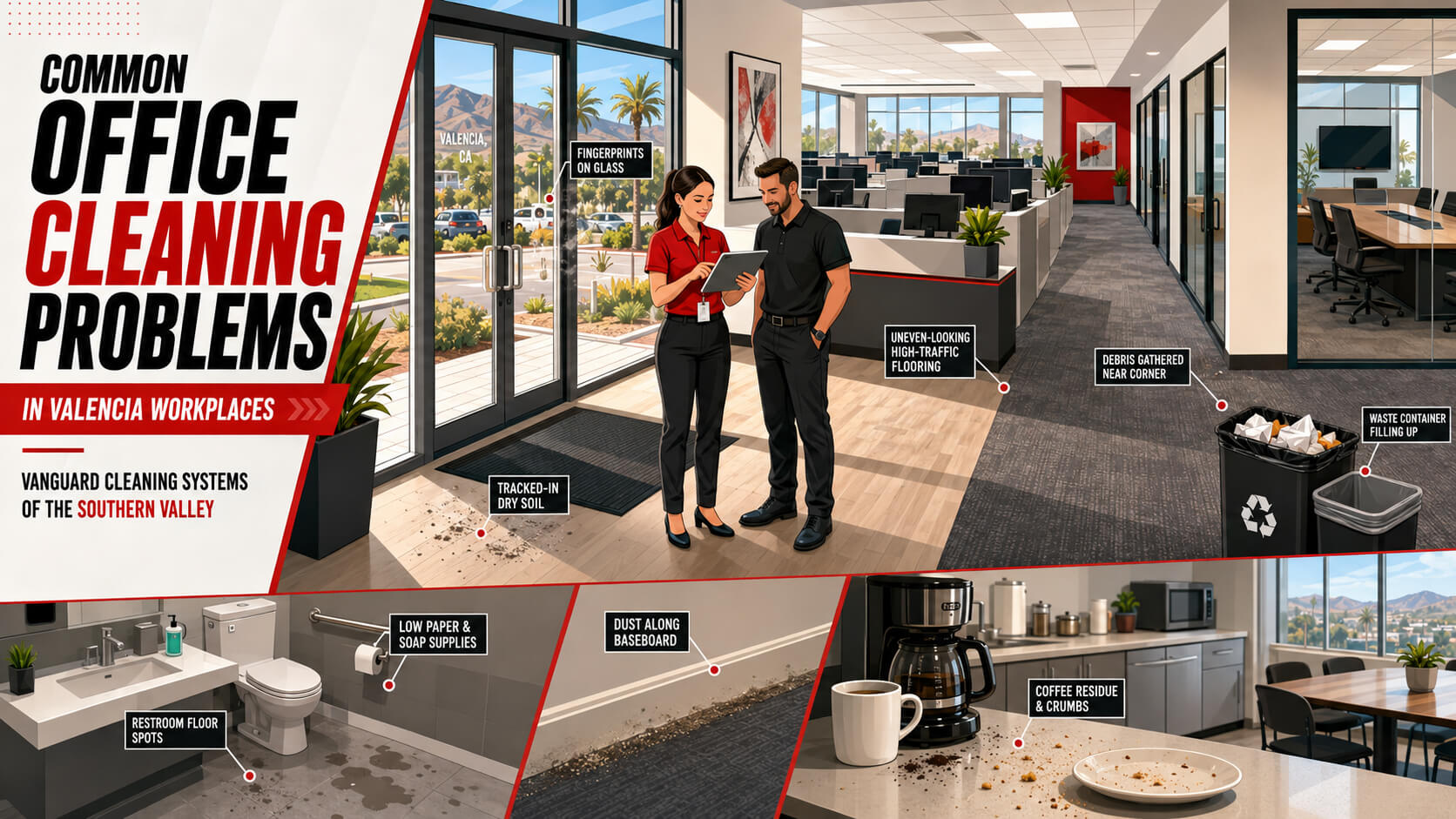
The restroom floor may show spots again. Coffee residue can collect around the breakroom sink. Soil from the parking lot can move past the entry mat and onto nearby flooring. Waste containers that were empty at the start of the day may be full by midafternoon.
Some Valencia workplaces also deal with recurring detail problems. Dust remains along a wall edge. Corners look darker than the center of the floor. Fingerprints return to entry glass. A conference room looks clean until someone pulls out a chair and finds debris beneath the table.
These issues can have several causes. The written scope may be too broad. Service frequency may no longer match building use. A periodic task may need to be scheduled more often. Or conditions may change during the workday after the janitorial business has completed its scheduled service.
The useful question is not simply, "Was the office cleaned?"
A better question is, "Where, when, and how often does the problem return?"
Quick Answer
Common office cleaning problems in Valencia workplaces include recurring restroom issues, breakroom residue, tracked-in entryway soil, missed edges and corners, uneven floor appearance, waste buildup, fingerprints, dust, and cleaning quality that seems to vary between visits.
Before changing a janitorial program, document each problem by:
- Area
- Specific condition
- Time noticed
- Day of the week
- How often it occurs
- Whether it returns shortly after service
- Whether the task appears in the current scope
Those details can help identify whether the solution involves service frequency, clearer task definitions, periodic detail work, daytime attention, or another change to the cleaning scope.
What Are Common Office Cleaning Problems?
Office cleaning problems are recurring conditions that make part of a workplace look, feel, or function below the expected standard.
They may be obvious, such as an overflowing waste container.
Others are easier to miss.
A facility may have:
- Dust along baseboards
- Debris behind doors
- Residue beneath tables
- Fingerprints on glass
- Spots on restroom floors
- Coffee residue on counters
- Soil beneath entry mats
- Dull sections of hard flooring
- Carpet edges that appear darker than open areas
- Waste residue around containers
- Empty restroom supplies
- Marks around door handles
- Dust on vents or ledges
These conditions often develop in predictable places.
High-use rooms change faster than low-use rooms. Food areas create different cleaning needs from conference rooms. Restrooms combine moisture, fixtures, supplies, waste, and frequent foot traffic. Entrances constantly receive soil from outside.
That is why an office cleaning scope usually works better when each area is treated according to its actual use.
Businesses comparing commercial cleaning services in Valencia can use these recurring problems as a starting point for discussing what the facility needs instead of relying only on square footage or a generic task list.
How Office Cleaning Problems Develop
Office cleaning problems tend to build when the work being performed no longer matches what happens inside the building.
A task may still be completed on schedule while the condition of the room changes faster than expected.
For example, an entry may be vacuumed every evening. If dozens of employees and visitors track soil across it during the next business day, the entrance may look worn again long before the next service visit.
The same issue can happen in restrooms.
A restroom may receive a complete evening service. By lunchtime the next day, water may be around the sink, paper may be on the floor, supplies may be low, and waste may be approaching capacity.
The evening task was performed. The room simply changed.
Other problems come from vague task descriptions.
"Vacuum office" leaves several questions unanswered.
Does that include:
- Floor edges?
- Areas beneath movable chairs?
- Spaces behind open doors?
- Corners?
- Carpet near cubicle walls?
- Areas around cords?
- Entry mat edges?
A broad description can lead to different expectations between the facility and the independently owned janitorial franchise business performing the work.
Clearer task descriptions make the work easier to perform, inspect, and discuss.
Restrooms That Keep Generating Complaints
Restrooms are one of the first places where recurring office cleaning problems become obvious.
People use them at close range. They notice the fixtures, floors, supplies, odors, counters, mirrors, waste containers, partitions, and sink area.
Small problems stand out.
Common restroom complaints may include:
- Water or residue around sinks
- Soap buildup near faucets
- Spotted mirrors
- Paper debris on the floor
- Waste containers filling too quickly
- Low soap or paper supplies
- Marks on partitions
- Soil in corners
- Darkened grout lines
- Floor residue
- Odor concerns
- Fingerprints around door hardware
A restroom that receives heavy traffic may require more frequent checks than one used by a small number of employees.
That distinction matters.
If a restroom is fully serviced at night but repeatedly declines by early afternoon, adding more detail work to the evening schedule may not solve the problem. The facility may need a different service time, a daytime check, or another adjustment based on actual use.
The first step is tracking when the problem occurs.
Instead of writing "restroom is always dirty," record something specific:
- Second-floor men's restroom
- Paper towels overflowing from waste container
- Usually noticed between 1:00 and 2:00 p.m.
- Occurred Tuesday, Wednesday, and Thursday
- Evening service is already included
That information gives everyone something useful to review.
It can also help separate cleaning concerns from maintenance issues.
A recurring restroom problem could come from:
- A leaking fixture
- Poor drainage
- A broken dispenser
- Ventilation
- Damaged flooring
- High occupancy
- A supply shortage
- A cleaning-frequency gap
A janitorial inspection can catch some of these concerns, but building maintenance may need to address the root cause.
Breakroom Residue That Returns Every Day
Breakrooms can change faster than almost any other office area.
Coffee, food, shared appliances, sinks, trash, tables, chairs, and constant hand contact create visible residue throughout the day.
Common complaints include:
- Sticky counters
- Coffee drips
- Crumbs beneath tables
- Sink residue
- Wet areas near faucets
- Food debris
- Fingerprints on refrigerator handles
- Grease or residue around microwave controls
- Full trash containers
- Food odors
- Marks on cabinet fronts
- Debris beneath vending or coffee stations
Employees tend to spend more time looking closely at a breakroom than they do a hallway.
They sit down.
They prepare food.
They use appliance handles and counters.
They stand near the sink and waste areas.
That close interaction makes small cleaning problems easier to notice.
The current service scope should clearly state which breakroom tasks belong to the janitorial business and which remain the responsibility of workplace personnel.
Depending on the agreement, janitorial tasks may include:
- Wiping accessible counters
- Cleaning tables
- Cleaning sinks
- Wiping assigned appliance exteriors
- Cleaning microwave interiors
- Emptying designated waste containers
- Replacing liners
- Sweeping or vacuuming
- Mopping hard floors
- Cleaning visible spills
- Checking approved supplies
Employee responsibilities may include:
- Washing personal dishes
- Removing personal food
- Cleaning spills as they happen
- Labeling refrigerator items
- Following refrigerator cleanout policies
- Keeping counters accessible
Without clear expectations, the same issue can return even when the scheduled janitorial work is being completed.
For a deeper look at these patterns, review breakroom issues employees notice.
Entryway Soil That Keeps Moving Into the Office
The entrance works like a collection point for whatever employees and visitors bring in from outside.
Shoes carry:
- Dust
- Fine soil
- Parking-lot debris
- Landscaping material
- Moisture during wet weather
- Small stones
- Pollen
- Leaves
Entry mats catch some of it.
They do not catch everything.
Once soil moves beyond the entrance, normal foot traffic can spread it into:
- Reception areas
- Corridors
- Elevator zones
- Stairwells
- Shared work areas
- Conference rooms
This can make an otherwise well-maintained office look neglected.
Entryway conditions are also highly visible.
Visitors may notice:
- Dirty mats
- Soil around mat edges
- Debris beneath mats
- Fingerprints on glass
- Marks on doors
- Dust near the reception desk
- Traffic lanes on carpet
- Spots on hard flooring
Valencia's dry Southern California conditions can increase the amount of dust and fine soil entering a workplace during parts of the year. Wind, landscaping activity, nearby construction, parking conditions, and foot traffic can all change the workload.
A fixed schedule may need occasional adjustment when outside conditions change.
Facilities can reduce recurring entry issues by reviewing:
- Mat placement
- Mat size
- Vacuum frequency
- Floor spot cleaning
- Glass cleaning
- Soil removal near thresholds
- Periodic carpet care
- Hard-floor maintenance
- Daytime entrance checks
The entrance should be evaluated as a zone rather than a single task.
For more detail, see how entryway conditions and first impressions connect to daily floor and glass care.
Missed Edges, Corners, and Low-Visibility Areas
Some of the most common office cleaning complaints happen outside the main line of sight.
A floor can look clean from the doorway while dust remains along the wall.
A conference room can appear ready for use until someone moves a chair.
A breakroom floor may look good in the center while crumbs collect beside cabinets.
These are common examples of detail areas that need their own place in the scope.
Areas worth checking include:
- Behind doors
- Around door stops
- Beneath movable chairs
- Along baseboards
- Around furniture legs
- Under entry mats
- Beside appliances
- Around waste containers
- Beneath cabinets
- Along cubicle walls
- Near floor transitions
- Around cords
- Vent grilles
- Window ledges
- Door frames
- Partition edges
These areas may not need the same frequency as open flooring.
Some may be weekly tasks.
Others may fit a monthly or rotating detail schedule.
The key is naming them.
A scope that says "vacuum carpet" may leave edge work open to interpretation. A scope that separates open-area vacuuming from scheduled edge and corner detailing creates a clearer standard.
This is also why inspections should include different viewpoints.
Open and close doors.
Move lightweight chairs where appropriate.
Look beneath tables.
Check the floor near walls.
Inspect around waste containers.
Review the spaces next to appliances.
Many hidden cleaning gaps in commercial buildings become visible only when someone looks beyond the main walking path.
Floors That Still Look Dull or Uneven
Floor complaints are not always solved by adding another routine vacuuming or mopping visit.
Different flooring problems require different work.
Carpet may show:
- Traffic lanes
- Spots
- Dark edges
- Flattened fibers
- Soil near entrances
- Residue around workstations
Hard flooring may show:
- Dull traffic paths
- Uneven appearance
- Scuffs
- Soil along edges
- Sticky residue
- Marks beneath chairs
- Changes in finish
- Buildup near entrances
Routine floor cleaning generally focuses on current soil and debris.
Periodic floor care addresses other conditions.
Depending on the floor type and manufacturer requirements, periodic work may involve processes intended to address embedded soil, appearance, finish condition, or wear.
That work should be listed separately in the scope.
If a facility expects every floor problem to be corrected through routine nightly service, frustration can build quickly.
A better review asks:
- What flooring is installed?
- How much traffic does it receive?
- Where does outside soil enter?
- Which areas receive food or drink spills?
- What routine work is included?
- What periodic work is included?
- When was the last periodic service?
- Are manufacturer recommendations being followed?
- Are the complaints about soil, wear, finish, damage, or staining?
Those details matter because some appearance problems are cleaning issues while others involve maintenance, repair, or replacement.
Waste Containers That Fill Before the Next Service
Waste is one of the easiest cleaning problems to measure.
A container is either within a reasonable capacity or it is not.
Recurring overflow can happen when:
- A high-use container is emptied too infrequently
- Lunch periods generate more waste than expected
- A meeting or event changes normal volume
- Packaging creates unusually bulky waste
- Recycling and trash placement no longer match use
- The building's occupancy has increased
- A department has changed how it operates
Breakrooms, copy areas, reception spaces, restrooms, and shared work zones can generate very different volumes.
A cleaning plan should not assume every waste container needs the same schedule.
If one container regularly overflows while nearby containers remain nearly empty, the facility may need to review placement or capacity rather than increase service everywhere.
The area around the container should also be checked.
Waste service can involve more than removing the liner.
The surrounding area may need attention for:
- Spills
- Residue
- Leaking liners
- Marks on nearby walls
- Debris beneath the container
- Odors
- Misplaced waste
If these tasks are expected, they should appear in the scope.
Dust That Returns Soon After Cleaning
Dust complaints can be frustrating because the source is not always obvious.
Dust may enter or develop from:
- Outdoor air
- Foot traffic
- Paper
- Cardboard
- Fabric
- Open doors
- Construction activity
- HVAC conditions
- Ceiling areas
- Storage spaces
- High shelves
- Vents
- Furniture
Cleaning frequency matters, but source control matters too.
If a horizontal surface is clean at 7:00 a.m. and visibly dusty again by noon, increasing evening wiping alone may have limited value.
The facility may also need to look at:
- Air filters
- Door seals
- Construction
- Ventilation
- Open windows
- Supply storage
- Ceiling debris
- Nearby outdoor work
Dust should be tracked by location.
If it keeps returning to the same desk, ledge, vent, or room, the pattern may point toward the source.
Fingerprints and Smudges on Glass and Doors
Glass can show use almost immediately.
An entrance door may be cleaned before opening and have visible fingerprints after the morning rush.
Common problem areas include:
- Main entry glass
- Lobby doors
- Conference room glass
- Interior partitions
- Push plates
- Door handles
- Sidelights
- Glass near reception
Cleaning frequency should match how visible the surface is and how often people touch it.
A large glass entrance serving hundreds of people has different needs from an interior door used a few times a day.
If glass appearance is a recurring complaint, track when the marks become noticeable.
That can show whether the facility needs:
- A different service time
- More frequent spot cleaning
- Daytime attention
- A clearer glass-cleaning task
- Better inspection
Why Cleaning Quality Can Seem Inconsistent
Inconsistent cleaning is one of the broadest complaints a facility can make.
It also needs to be broken into smaller observations.
"Cleaning is inconsistent" might mean:
- One restroom is missed
- Trash is handled differently from day to day
- Carpet edges are sometimes skipped
- Breakroom appliances receive uneven attention
- Supplies are not checked consistently
- Different areas receive different levels of detail
- Periodic tasks are overdue
- Conditions vary based on traffic
- Problems are reported but not tracked
The first goal should be finding the pattern.
Ask:
- Is the same room involved?
- Is the same task involved?
- Does the problem happen on the same days?
- Is it tied to a shift change?
- Does it occur after high-traffic periods?
- Does it happen only when meetings or events take place?
- Is the task clearly written in the scope?
Specific observations are far more useful than a general complaint.
A good service review turns "the office isn't being cleaned well" into something measurable, such as:
"Debris has been found along the west conference-room wall on four of the last six Wednesdays."
Now there is a location, condition, frequency, and pattern to review.
Environmental Factors That Affect Valencia Office Cleaning
Cleaning needs change with the environment around the building.
Valencia workplaces can experience periods of dry weather, wind, dust, landscaping activity, heat, and occasional rain.
These conditions can affect interior areas in different ways.
Dry Soil
Fine outdoor soil can enter on shoes and collect in entrance zones.
It may appear as:
- Light dust on hard floors
- Soil in carpet traffic lanes
- Debris near thresholds
- Dirt around mat edges
Wind
Wind can increase airborne dust and debris around doors, loading areas, and building entrances.
Rain
Wet weather can create:
- Damp entry mats
- Water spots
- Mud
- Soil transfer
- Slippery entrance conditions
Landscaping
Mulch, soil, grass clippings, pollen, and plant debris can move indoors from nearby landscaped areas.
Nearby Construction
Renovation or construction can create a temporary increase in dust and floor soil.
A cleaning scope should have enough flexibility to respond when the building's conditions change.
Workplace Use Has a Bigger Effect Than Square Footage Alone
Two Valencia offices with similar square footage can need very different cleaning programs.
Consider one office with 30 employees who work mostly in private offices.
Now compare it with another office of the same size that has:
- 80 employees
- Shared workstations
- Frequent visitors
- Several conference rooms
- A busy breakroom
- High restroom traffic
- Deliveries throughout the day
The second building will usually change faster.
That can affect:
- Waste
- Floors
- Restrooms
- Supplies
- Glass
- Breakrooms
- Shared spaces
This is why routine janitorial service should be built around the way each facility operates.
Frequency can then be assigned according to use rather than applying the same schedule to every room.
How to Find the Cause of a Recurring Cleaning Problem
Start with documentation.
A simple tracking sheet can make service reviews much more productive.
For each issue, record:
- Date
- Time
- Area
- Specific location
- Condition
- Photo, if appropriate
- Current service frequency
- Whether the task is in the scope
- How soon the issue returned
- Whether it has happened before
Avoid broad descriptions.
Instead of:
"Breakroom was dirty."
Write:
"Coffee residue around the left side of the sink and crumbs beneath the table at 1:15 p.m."
Instead of:
"Restrooms aren't being maintained."
Write:
"Second-floor restroom paper towel waste was above container capacity by 2:00 p.m. three days this week."
Instead of:
"Floors look bad."
Write:
"Dark soil visible along the carpet edge between reception and the first conference room."
The more specific the record becomes, the easier it is to find the right adjustment.
Compare the Problem With the Current Cleaning Scope
Once patterns have been documented, compare them with the written service agreement.
Look for the exact task.
Ask:
- Is the task included?
- Is the area named?
- How often is it scheduled?
- Does the wording match the expected result?
- Is the problem part of routine service?
- Is it a periodic task?
- Does it require daytime attention?
- Is it a maintenance issue?
- Is someone else responsible?
Sometimes the problem is simple.
A facility expects a task that was never included.
Other times, the task is listed but the frequency needs to change.
And sometimes the problem involves the way the building is being used during the day.
The goal is to make changes based on evidence instead of guessing.
Should You Add More Cleaning Frequency?
More frequency can help when a room changes faster than the current schedule can handle.
It is not always necessary throughout the entire office.
One restroom may need an additional check.
The breakroom may need attention after lunch.
The entrance may need a short daytime service during a period of heavy traffic.
A waste station may need a second collection.
Targeted changes can address the problem without adding unnecessary work in low-use spaces.
Review the pattern first.
When Periodic Detail Work Is the Better Fix
Some cleaning complaints come from buildup that develops gradually.
Examples include:
- Carpet edges
- Baseboards
- Chair legs
- Door frames
- Vents
- Partition edges
- Areas beneath mats
- Appliance sides
- Floor corners
- High ledges
These may not need daily service.
A rotating detail schedule may make more sense.
For example, a facility could divide detail work across several weeks so lower-frequency tasks are still completed on a predictable schedule.
The written scope should identify those tasks clearly.
Inspections Should Match the Complaint
An inspection is most useful when it checks the problem that was reported.
If the complaint involves debris behind a conference-room door, inspecting only the center of the carpet misses the issue.
If the concern is breakroom residue after lunch, an inspection at 7:00 a.m. may not show the pattern.
Inspection timing matters.
So does inspection location.
For recurring problems, review the area when the problem normally appears.
That provides a more accurate picture of what is happening.
What Facility Managers Can Do Before Reviewing Janitorial Service
Build a short record over several normal workdays.
Avoid waiting until a long list of frustrations has accumulated.
Track recurring issues as they happen.
Useful categories include:
- Restrooms
- Breakrooms
- Entrances
- Floors
- Waste
- Glass
- Dust
- Detail areas
- Supplies
Then look for clusters.
You may find that most complaints come from only two rooms.
You may see that issues happen after lunch.
You may notice that Mondays are fine but Wednesday through Friday are different because more employees are in the office.
Those patterns give you a stronger basis for reviewing the current scope.
People Also Ask
What are the most common office cleaning problems?
Common problems include restroom residue, full waste containers, breakroom spills, fingerprints on glass, tracked-in soil, dust, missed corners, dirty floor edges, and inconsistent detail work.
Recurring problems should be tracked by location and time so the facility can determine whether the issue involves service frequency, scope wording, building use, or a periodic task.
Why does my office still look dirty after cleaning?
The most visible surfaces may have been serviced while edges, blocked areas, high-use rooms, or periodic tasks still need attention.
The problem can also return during the workday after service has been completed.
Check when the condition appears and whether that task is included in the current scope.
How often should an office in Valencia be cleaned?
Frequency depends on occupancy, visitor traffic, operating hours, restroom use, food activity, flooring, waste volume, and how quickly each area changes.
High-use spaces generally need more frequent attention than private offices or lightly used rooms.
Why do restroom cleaning problems keep returning?
Restrooms change throughout the day because of repeated use.
Waste fills, supplies decrease, water reaches counters and floors, and fixtures receive constant contact.
If problems consistently appear several hours before the next service visit, the facility may need to review service timing or frequency.
Why does my office entrance get dirty so quickly?
Entrances receive soil from shoes, parking areas, landscaping, wind, and weather.
Busy entryways may need more frequent vacuuming, mat care, spot cleaning, and glass attention than interior areas.
What causes inconsistent janitorial service?
Possible causes include unclear task descriptions, missed tasks, changing occupancy, insufficient frequency, poor communication, overdue periodic work, or different expectations about what the scope includes.
Documenting the exact issue makes the cause easier to identify.
Should I change cleaning providers because of recurring problems?
Start by documenting the problems and comparing them with the current scope.
Determine whether the task is included, whether the service frequency matches use, and whether the issue has been clearly reported.
That information can help guide the next decision.
How can I tell if my office cleaning scope needs to change?
Look for repeat complaints in the same areas.
If a restroom, breakroom, entrance, waste station, or floor area regularly declines before the next scheduled service, the current frequency or task description may no longer match building use.
FAQ
What should I document when reporting an office cleaning problem?
Record the date, time, area, specific condition, and how often it has happened.
Photos can also help when appropriate.
Are missed corners a sign that the entire cleaning program is failing?
Not necessarily.
The issue may involve a specific detail task, unclear scope wording, access problems, or a frequency that needs adjustment.
Can employee traffic change cleaning needs?
Yes.
More employees and visitors can increase restroom use, waste, floor soil, breakroom activity, and contact with shared surfaces.
Can cleaning frequency vary by room?
Yes.
A busy restroom may need more attention than a lightly used private office.
Frequency should reflect actual use.
Should breakroom appliances be included in office cleaning?
They can be, but the scope should specify which appliances and which surfaces are included.
Interior refrigerator cleaning, dishes, and personal food handling should be addressed separately.
Are floor stains always a janitorial issue?
No.
Some conditions involve wear, damaged finish, permanent staining, flooring defects, or maintenance needs.
The type of problem should be identified before changing routine service.
What is the best way to review repeated complaints?
Track each problem by area, time, and frequency, then compare the pattern with the written cleaning scope.
This makes it easier to identify a focused adjustment.
Turn Repeated Complaints Into Useful Information
Recurring office cleaning problems are easier to solve when they are documented instead of grouped together as a general complaint.
For several days, record:
- Where the problem appears
- What the specific condition is
- When it appears
- How often it returns
- Whether the task is part of the existing service scope
That record can help show whether a Valencia workplace needs a change in frequency, clearer task wording, periodic detail work, daytime service, or attention to a maintenance issue.
Vanguard Cleaning Systems of the Southern Valley works with businesses to discuss janitorial needs and connect them with independently owned and operated Vanguard janitorial franchise businesses.
If recurring problems are making it difficult to judge whether your current program still fits the way your building operates, you can review your current cleaning scope and use your notes to guide the conversation.
References
Arbogast, J. W., Moore-Schiltz, L., Jarvis, W. R., Harpster-Hagen, A., Hughes, J., & Parker, A. (2016). Impact of a comprehensive workplace hand hygiene program on employer health care insurance claims and costs, absenteeism, and employee perceptions and practices. Journal of Occupational and Environmental Medicine, 58(6), e231-e240. https://doi.org/10.1097/JOM.0000000000000738
Dancer, S. J. (2023). Hospital cleaning: Past, present, and future. Antimicrobial Resistance & Infection Control, 12, 80. https://doi.org/10.1186/s13756-023-01275-3
Fontana, R., Buratto, M., Caproni, A., Nordi, C., Pappadà, M., Bandera, B., Vogli, L., Buffone, C., & Marconi, P. (2024). Evaluating cleaning services in civil environments: Microbiological and life cycle analysis comparing conventional and sustainable methods. Sustainability, 16(2), 487. https://doi.org/10.3390/su16020487
Mohammed, M. O. A. (2023). Surface microbial contamination and air quality before and after regular cleaning procedures. Atmosphere, 14(2), 352. https://doi.org/10.3390/atmos14020352
Raw, G. J., Roys, M. S., & Whitehead, C. (1993). Sick building syndrome: Cleanliness is next to healthiness. Indoor Air, 3(4), 237-245. https://doi.org/10.1111/j.1600-0668.1993.00004.x
