
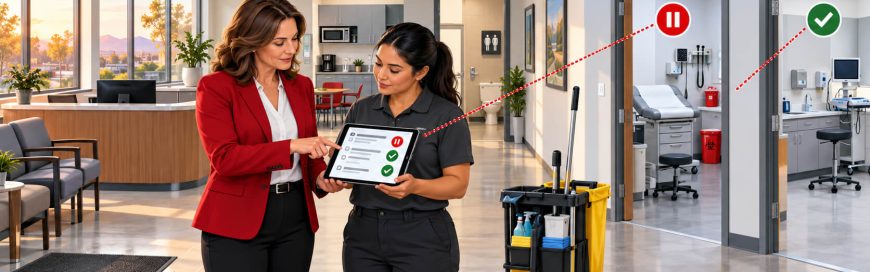
A medical office cleaning checklist needs a named task owner and a clear handoff before anyone marks a room complete.
The Gap Between the Last Appointment and the Evening Visit
An exam room can be empty while used equipment still needs attention. The evening cleaning visit may begin before every room has been released. Someone might refill the restroom supplies while another person assumes that task belongs to the next shift. These gaps become easier to track when the checklist records who handles the work and when it can begin.
Medical office cleaning responsibilities depend on the services provided, the room involved, and the practice’s approved procedures. A waiting room needs a different assignment from a procedure room. Even within one exam room, the floor, patient-contact equipment, and waste containers can follow separate instructions.
The broader medical office cleaning scope in Bakersfield establishes which areas belong in a service plan. Task ownership adds the working details: who prepares the room, who performs each duty, and who reviews an exception. Keep that information available to everyone involved in the handoff.
Quick Answer: Who Handles Medical Office Cleaning Tasks?
Assign routine facility cleaning to the approved janitorial provider within its written scope. The practice assigns clinical equipment care, between-patient duties, and room-use approval to personnel with the required training. Medical waste follows the practice’s designated handling arrangement. Each task needs an owner, an access condition, and a completion or exception record.
- List each surface or item separately when responsibility changes.
- Name the person or service assigned to the task.
- Define when the room is available for that work.
- Record completion with the room, time, and task owner.
- Send blocked work to an identified contact.
- Keep clinical clearance distinct from the evening cleaning record.
The table below is a planning example. Adapt its assignments to the practice’s procedures, device instructions, exposure controls, and service agreement before use. The practice’s qualified clinical reviewer should approve the boundaries.
What Is a Medical Office Cleaning Responsibility Checklist?
A medical office cleaning responsibility checklist is a task list that records ownership and handoffs for the spaces used by a practice. Each entry identifies the work, the assigned party, and the condition that allows the work to start. It also shows how completion or a problem is reported.
A useful checklist makes room-level differences visible. “Exam room cleaned” leaves several questions open. Separate entries for approved environmental surfaces, clinical equipment, floor care, and waste handling let the practice review those duties individually.
Use room names that match signs and the floor plan. Include a procedure reference where a task follows a controlled instruction. Keep the current version available at the point of work so an old checklist cannot quietly become the working standard.
How Task Assignment and Room Handoffs Work
Begin with the practice’s approved room list and service scope. Walk each area with representatives who understand clinical use and contracted cleaning duties. Identify every task that changes hands during the day.
Assign one accountable owner to each task, with a named backup where coverage is needed. Other people may help, but the record should make clear who confirms that the duty has been handled. Write the owner as a role or service that can be matched to the current shift roster.
Define the access condition beside the task. In a waiting room, that might be the end of public use. In a clinical area, an authorized person must release the room for the specified work after dealing with clinical materials and known hazards under facility procedures.
Finally, decide where the record goes. A shared service log can document routine tasks, while equipment care and waste movements follow their approved records. The closing handoff should show any remaining hold and the person responsible for resolving it.
Medical Office Cleaning Task-Assignment Table
Suggested assignments only: “Janitorial provider” means personnel approved for the specific task, with verified training and the required controls. “Clinical designee” means the practice’s authorized person for the stated duty. Task timing, product use, and methods come from applicable guidance and the practice’s approved instructions.
| Area and task | Suggested owner | When work can begin | Completion or exception report |
|---|---|---|---|
| Waiting area: entrance mats, floors, reachable nonclinical surfaces, ordinary waste | Janitorial provider under the approved scope; practice assigns occupied-hour checks. | Public use has ended, or the practice approves a safe work zone during opening hours. | Area, tasks completed, and time in service log; report blocked seating areas or unexpected hazards. |
| Reception: approved counters, floors, and ordinary waste | Janitorial provider for accessible surfaces; reception staff secure records and prepare counters. | Records and personal items are secured; assigned surfaces are available. | Record accessible areas completed; identify surfaces held for privacy or access. |
| Staff offices: reachable surfaces, floor care, ordinary waste | Janitorial provider; practice personnel handle protected documents and devices excluded from scope. | Staff release the space and clear agreed surfaces. | Room-level record; note locked offices, obstructed desks, or changed access. |
| Staff breakroom: counters, tables, sink, floors, appliance exteriors | Janitorial provider within scope; practice assigns dishes, stored food, and appliance interiors separately. | Food preparation has ended and the assigned surfaces are clear. | Task log; report food or belongings blocking work and any supply shortage. |
| Restrooms: approved fixture and surface care, floors, ordinary waste | Janitorial provider; practice names a person for checks between visits. | Room is vacant and approved access controls are in place. | Record room and completion time; report leaks, blocked fixtures, or unexpected contamination. |
| Restrooms: soap and paper refills | Party assigned in the supply agreement; practice appoints a daytime backup. | Compatible supplies and dispenser access are available. | Record refills and low stock; send empty-stock or dispenser faults to the supply contact. |
| Approved exam room: floors and specifically listed environmental surfaces | Janitorial provider only for approved, trained duties; clinical designee clears the room. | Room is released for those tasks; clinical items are secured and any special precautions are communicated. | Record completion of assigned tasks; flag withheld areas and unresolved holds to the clinical contact. |
| Exam room: between-patient surface care and turnover duties | Practice-designated personnel, or another specifically authorized and trained service. | After the patient leaves, following the room’s approved turnover procedure. | Practice turnover record; unresolved exceptions go to the authorized clinical decision-maker. |
| Patient-contact devices: cuffs, meters, probes, and other reusable equipment | Practice-designated personnel or an explicitly authorized equipment-care service. | At the point required by device instructions and practice procedure, including between uses where required. | Approved device-care record; report missing instructions, damage, or incomplete processing. |
| Procedure, laboratory, medication, or instrument-processing areas | Practice-designated personnel; specialist services only under a separately approved scope. | After the practice authorizes access under the area’s specific procedure. | Area-specific records; escalate access or clinical holds through the practice’s approved chain. |
| Sharps and other regulated medical waste | Practice-designated trained handlers and the approved waste service. | At the point specified by the waste procedure; required containers and controls are available. | Waste records required by the arrangement; immediately escalate container damage or misplaced sharps. |
| Unexpected blood or body-fluid contamination | Designated trained responder under the applicable exposure-control and spill procedure. | Prompt response after discovery, with the necessary area controls and protective equipment. | Urgent report to the designated contact; record response and any remaining access hold. |
| Room acceptance for the next clinical session | Practice-authorized clinical designee. | Assigned environmental tasks and required clinical work have been checked; holds are resolved. | Practice readiness status; keep unresolved rooms out of use according to facility procedure. |
Review every row before adding it to a live checklist. A location inside an exam room does not automatically make an item part of the janitorial contract. The practice determines the authorized duties and verifies the people performing them.
Keep Routine Janitorial Work Within Its Approved Boundaries
Routine janitorial work often includes floor care, reachable environmental surfaces, ordinary waste, and agreed restroom or staff-space duties. In a medical office, those assignments need instructions suited to the setting. The practice must define the required environmental treatment for each clinical area, including approved antimicrobial surface treatment where indicated.
Use products according to their labels and follow surface and device compatibility instructions. Any required contact time, protective equipment, and disposal steps belong in the approved procedure. A broad task label such as “wipe counters” leaves the method unclear.
Before approving clinical-area duties, confirm:
- The exact surfaces included in the contract.
- The current procedure that governs the task.
- Training and demonstrated ability for the assigned personnel.
- Available supplies and required protective equipment.
- The room-release and urgent-reporting process.
- The person who reviews results and exceptions.
Review the commercial cleaning agreement alongside the practice’s procedures. Each should use compatible room names and task descriptions. Record any requested work that needs a separate authorization before it begins.
Assign Clinical Equipment Care Item by Item
Patient-contact equipment needs its own assignment. A device can move between rooms or remain on a cart while the surrounding floor is cleaned. Record the equipment owner and the required care point even when the item is portable.
Reusable devices follow the manufacturer’s instructions and the practice’s approved processing procedure. These duties can involve specific products, steps, and checks. Instrument processing and sterilization stay with personnel authorized and equipped for those tasks.
For each device or device group, record:
- The item name and where it is normally used.
- The current manufacturer instructions available to staff.
- The assigned handler and backup.
- The event that triggers care.
- Where used items go while awaiting processing.
- How processed items are identified and stored.
- The record required before another use.
Clarify boundary cases during the walkthrough. A mobile cart may have a work surface, handles, attached devices, and stored clinical supplies. The approved task list should identify those parts individually when their care differs.
If equipment instructions are unavailable, send the issue to the practice’s clinical lead before assigning the work. Record that item as awaiting direction. The cleaning visit can continue in other approved areas while the equipment question is resolved.
Give Regulated Waste a Separate Owner and Route
California medical waste is governed by specific generator and handling requirements. The practice needs a designated arrangement for classifying, containing, storing, and transferring the waste it produces. A routine ordinary-waste collection task should identify the containers covered by that task.
The practice’s waste contact should explain which waste streams are present. Sharps, pharmaceutical waste, and other regulated materials require appropriate handling pathways. Record the duties assigned to onsite personnel and those assigned to the approved waste service.
- Identify container locations and the waste stream assigned to each.
- Name the trained person who checks and replaces containers.
- State the approved storage and collection route.
- Confirm who arranges pickups and keeps records.
- Identify the contact for damaged containers or a missed pickup.
Cal/OSHA requires controls for sharps and regulated waste. Sharps containers must be managed to avoid overfilling; opening or emptying them in a way that exposes workers to injury is prohibited. Personnel who discover a misplaced sharp should follow the facility’s response procedure and notify the designated handler.
Keep uncertain waste in the exception process. The authorized waste contact decides the appropriate handling before an ordinary-waste task proceeds. If an exposure occurs, activate the applicable exposure-response process promptly.
Define When a Room Becomes Available
A closed door gives little information about the room behind it. The practice needs a release signal that shows which work is authorized. Choose a method that fits existing operations, such as a secure electronic room board or an approved physical indicator.
Use clear status names. The following are suggested workflow labels for local approval:
- Occupied: Work waits unless a specific occupied-room task is approved.
- Awaiting clinical clearance: The designated clinical person still needs to prepare or assess the room.
- Available for assigned cleaning: The listed tasks can begin under the approved procedure.
- Assigned cleaning complete: The cleaning owner has recorded completion and any exceptions.
- Practice hold: An identified issue needs resolution before the room returns to use.
- Accepted for clinical use: The practice’s authorized person has completed its readiness checks.
These labels organize the handoff. The facility must define what each status requires and who may change it. A cleaning completion entry describes the assigned cleaning work; clinical acceptance requires the practice’s own checks.
Include special instructions without exposing patient information. The service provider needs the approved precautions and access limits relevant to the work. Keep diagnoses and other confidential details within the practice’s authorized systems.
Record Completed Work and Exceptions Separately
A blocked task needs a visible record. Marking an entire room complete while one assigned surface remains inaccessible can create a false handoff. Use separate fields for work performed and work awaiting action.
The service record should include:
- Date and room identifier.
- Task or approved task group.
- Assigned owner and completion time.
- Procedure version where required.
- Exception and time reported.
- Recipient and acknowledgment.
- Agreed follow-up, responsible person, and status.
Keep descriptions concrete. “Exam room 4 floor task pending, room occupied at service arrival” gives the next person a useful starting point. A follow-up field can record when access was granted and whether the visit returned to that room.
Use immediate reporting for urgent hazards under the practice’s procedure. The end-of-day log can preserve the record, while the designated responder receives the active alert. Identify a backup contact for periods when the usual person is unavailable.
For routine access or supply problems, agree on a response window. If the issue stays open, show who carries it into the next shift. Close the entry only after the agreed correction or decision is recorded.
End-of-Day Medical Office Handoff Checklist
Use this sequence as an editable handoff template. The practice approves the clinical steps and assigns the people involved. Record the date and current procedure version at the top.
Before the Janitorial Visit Begins
- Confirm the room list. Mark late appointments, occupied rooms, restricted areas, and changes to the normal service route.
- Complete clinical preparation. Authorized personnel handle used devices, specimens, instruments, medications, and other clinical materials under the relevant procedures.
- Resolve or report hazards. Activate the approved response for spills, misplaced sharps, or other conditions requiring special attention.
- Secure information. Place records and protected materials in their approved locations; clear only the surfaces assigned for service.
- Release eligible rooms. The authorized person records which rooms are available and which tasks are approved.
- Confirm access and supplies. Check required keys, storage access, approved products, and the working service window.
During the Assigned Cleaning Work
- Check the release status. Begin only the duties authorized for the available room.
- Follow the task procedure. Use the approved sequence, products, tools, and required controls.
- Record completion by area. Enter the assigned tasks performed and the time.
- Report exceptions as they arise. Identify the blocked task and notify the appropriate contact.
- Update any hold. Leave the status clear for the person who will review the room.
Before the Next Clinical Session
- Review the service record. Confirm completed work and outstanding exceptions.
- Verify clinical duties. The practice checks equipment status, supplies, and other clinical readiness requirements.
- Resolve open items. Record the corrective action or keep the affected area on the required hold.
- Accept eligible rooms. The authorized person updates the status for clinical use.
- Assign remaining follow-up. Give each open item an owner and an agreed next action.
Keep the list available in the format people already use. A checklist that requires duplicate entry into several systems can be difficult to maintain. Agree on one authoritative room status and clearly identify any separate equipment or waste record.
Environmental Factors That Change the Assignments
Appointment Patterns and Late Closing
Match the handoff to the actual closing pattern. If a room stays occupied beyond the normal start time, record it separately and agree on the follow-up visit or approved alternate arrangement. Update the plan when operating hours change.
Room Use and Patient Contact
The clinical lead sets requirements according to the care delivered and the surfaces involved. A procedure room needs its own approved instructions. Keep the assignment table current when a room’s function changes.
Shared Restrooms and Landlord Duties
Confirm who services shared building areas. A lease or separate property agreement may cover part of the restroom or corridor work. Record the boundary and the contact who addresses a concern outside the practice’s contract.
Floor Materials and Entrance Conditions
Inspect the actual entrance route at a Bakersfield property. Record tracked soil, mat condition, and the floor materials receiving it. Set routine and periodic floor duties using the observed conditions and the surface maker’s instructions.
Storage, Access, and Supply Availability
A locked stockroom can block a refill even when supplies are onsite. Assign storage access and ordering separately. Report missing approved products before attempting a task that depends on them.
Check the Handoff Against Daily Workplace Use
Test the approved checklist during a normal closing period. Follow one room from clinical release through the cleaning record to the practice’s next-session acceptance. Note where someone waits for access or cannot identify the next owner.
Review the first exceptions together. Repeated blocked desks may need a better preparation step. A late-used room may need a different service window. Record the change beside the affected task and update the working version.
When reviewing Bakersfield janitorial services, bring the responsibility table to the walkthrough. Discuss the approved facility tasks and the conditions needed to perform them. Refer clinical decisions to the practice’s authorized reviewer.
Use Quality Checks That Match the Assigned Tasks
Hospital research using fluorescent markers has shown that checks of specific surfaces can reveal missed work and support feedback. A multicenter study also found variation between the objects assessed. Those findings support reviewing individual duties instead of relying on a room-wide completion tick.
Any marker-based or other technical audit in a medical office needs practice approval. Define the method, surfaces, reviewer, and response to a finding. Visual checks can document visible conditions, while clinical requirements may call for additional assessment under facility procedures.
Research on environmental cleaning bundles has combined training, technique, product use, auditing, and communication. That supports treating the handoff as part of a wider program. The responsibility table by itself has not been tested as a method for reducing infections.
Much of the cited research comes from inpatient hospitals. Its findings about monitoring and work organization can inform planning, while outpatient duties remain governed by applicable guidance and local procedures. A clean appearance alone cannot establish that required clinical processing has been completed.
People Also Ask
What should a medical office cleaning checklist include?
Include each area, task owner, approved procedure, task timing, access condition, and reporting method. Give equipment care and regulated waste separate entries. Add the person authorized to accept clinical rooms for use.
Who is responsible for cleaning medical equipment?
The practice assigns that duty to authorized personnel who follow the device maker’s instructions and the approved procedure. Shared equipment needs a named owner and a clear care point between uses where required.
Can a janitorial provider clean exam rooms?
It can perform specifically approved duties when personnel have the required training, supplies, and controls. The practice must define the surfaces and tasks covered, release the room for that work, and retain clinical oversight.
Who handles medical waste in a doctor’s office?
The practice establishes an approved arrangement with designated trained handlers and its waste service. Record onsite duties, container checks, storage, pickup, and required records separately from ordinary waste collection.
Who decides when an exam room is ready for another patient?
The practice’s authorized person determines readiness under its clinical procedures. The cleaning record shows completion of assigned cleaning tasks and any exceptions for that person to review.
Frequently Asked Questions
Should one person own every task in a room?
Assign an owner to each task. Clinical duties, equipment care, and contracted environmental work can have different owners within the same room.
What if a room is still occupied when cleaning begins?
Record the blocked work and notify the agreed contact. Follow the approved alternate timing or return arrangement.
How should an unexpected sharp be reported?
Follow the facility’s immediate response procedure, keep others away as directed, and notify the designated trained handler. Activate the exposure process if an injury occurs.
Does an evening visit cover between-patient duties?
Between-patient duties need their own timing and assignment. The evening scope should show which work occurs after clinical release.
Can task owners use photos to report a concern?
Use photos only through an approved process that protects patient information. A room identifier and written description may provide enough detail.
Who reviews changes to the clinical boundaries?
The practice’s qualified clinical reviewer approves those changes. Update the procedure and affected task entries before revised duties begin.
How often should the responsibility table be reviewed?
Review it when care activities, devices, room use, service hours, or waste arrangements change. Include it in the practice’s scheduled procedure review.
What should happen when an exception remains open overnight?
Assign an owner and record the next action. Keep the relevant hold visible until the authorized person resolves it.
Bring the Responsibility Table to a Facility Walkthrough
Prepare the room list and ask the practice’s clinical reviewer to mark the approved service boundaries. Identify the people who release rooms, handle equipment, and respond to waste or spill concerns. Those decisions give a walkthrough a clear basis for discussing routine facility work.
Vanguard Cleaning Systems of the Southern Valley can help coordinate a discussion of the routine cleaning scope with an independently owned janitorial franchise business. Request a medical office facility walkthrough with the responsibility table and access notes ready.
Each Vanguard Cleaning Systems business is independently owned and operated.
References
Carling, P. C., Briggs, J. L., Perkins, J., & Highlander, D. (2006). Improved cleaning of patient rooms using a new targeting method. Clinical Infectious Diseases, 42(3), 385–388. https://doi.org/10.1086/499361
Carling, P. C., Parry, M. F., von Beheren, S. M., & Healthcare Environmental Hygiene Study Group. (2008). Identifying opportunities to enhance environmental cleaning in 23 acute care hospitals. Infection Control & Hospital Epidemiology, 29(1), 1–7. https://doi.org/10.1086/524329
Dancer, S. J. (2014). Controlling hospital-acquired infection: Focus on the role of the environment and new technologies for decontamination. Clinical Microbiology Reviews, 27(4), 665–690. https://doi.org/10.1128/CMR.00020-14
Han, J. H., Sullivan, N., Leas, B. F., Pegues, D. A., Kaczmarek, J. L., & Umscheid, C. A. (2015). Cleaning hospital room surfaces to prevent health care-associated infections: A technical brief. Annals of Internal Medicine, 163(8), 598–607. https://doi.org/10.7326/M15-1192
Mitchell, B. G., Hall, L., White, N., Barnett, A. G., Halton, K., Paterson, D. L., Riley, T. V., Gardner, A., Page, K., Farrington, A., Gericke, C. A., & Graves, N. (2019). An environmental cleaning bundle and health-care-associated infections in hospitals (REACH): A multicentre, randomised trial. The Lancet Infectious Diseases, 19(4), 410–418. https://doi.org/10.1016/S1473-3099(18)30714-X
