
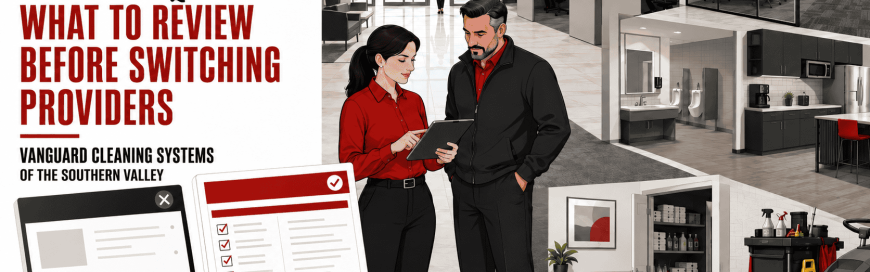
A lower janitorial quote can look attractive, but the real value depends on the tasks, service frequencies, communication, and accountability included in the proposal.
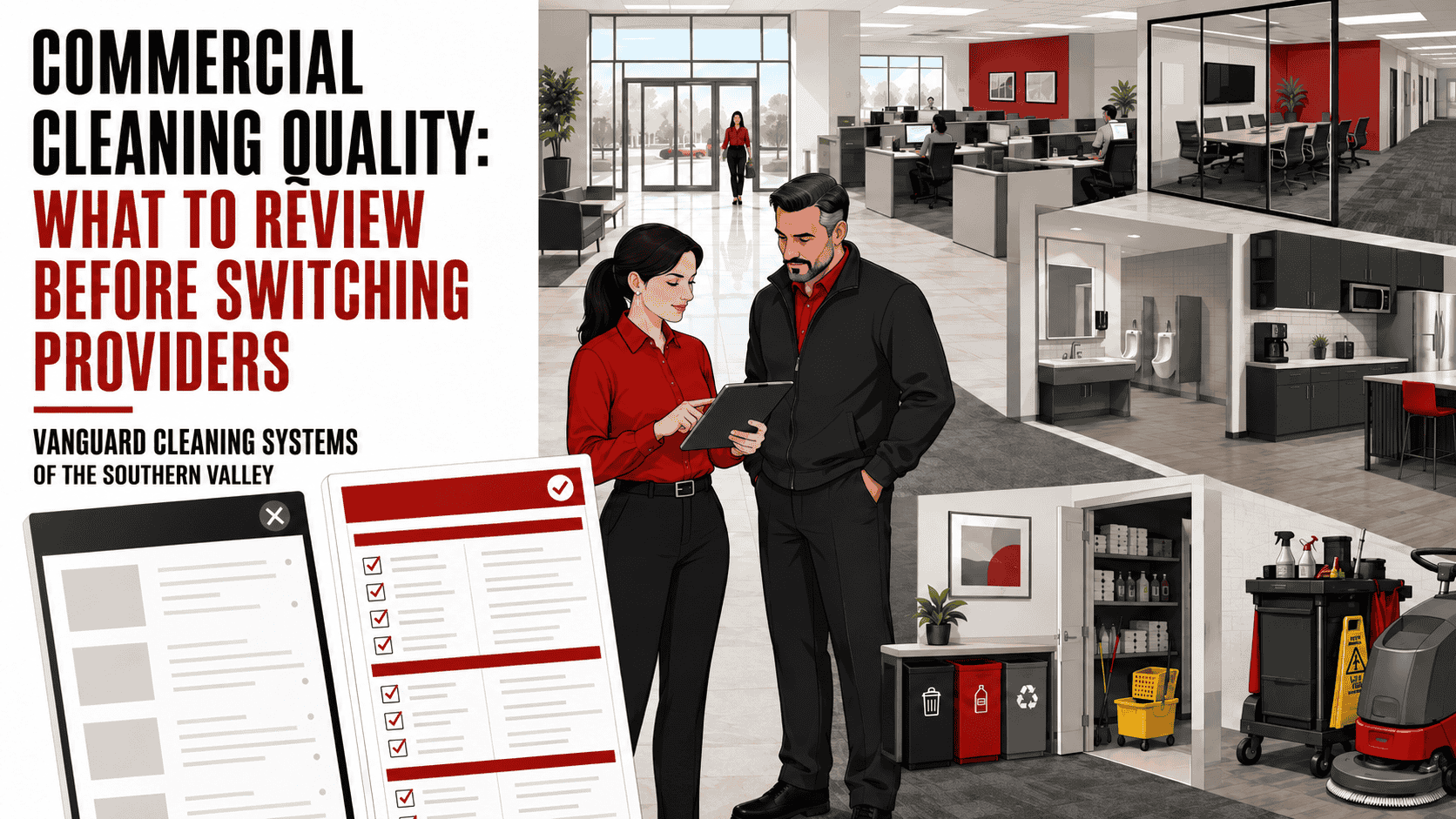
The Real Reason Cleaning Contracts Fall Short
Switching commercial cleaning providers is rarely a simple price decision.
Most businesses start looking for another provider after dealing with recurring problems. Restroom supplies run out. Breakroom surfaces get skipped. Floors look worn shortly after service. Messages go unanswered. Complaints are corrected once, then appear again a week later.
These problems often point to a weak or unclear scope of work rather than one isolated mistake. A proposal may list general services such as “office cleaning” or “restroom care,” but those broad terms do not explain what will be done, how often it will happen, or how results will be reviewed.
That is why two commercial cleaning proposals with similar-looking service descriptions can produce very different outcomes.
Quick Answer
Before switching commercial cleaning providers, compare each proposal based on:
- The detailed scope of work
- Task frequencies
- Communication procedures
- Complaint response
- Quality inspections
- Supply responsibilities
- Restroom and breakroom standards
- Local service coverage
- Business ownership structure
- Walkthrough quality
Do not compare the monthly price until you confirm that each company is bidding on the same work.
What Is a Commercial Cleaning Company Checklist?
A commercial cleaning company checklist is an evaluation tool businesses can use when reviewing a current provider or comparing new janitorial proposals.
It goes beyond asking whether a company cleans offices, restrooms, or floors. It helps clarify the exact tasks, service schedules, responsibilities, and quality-control procedures included in the agreement.
A useful checklist should answer questions such as:
- Which areas are included?
- What tasks will be performed in each area?
- How often will each task be completed?
- Which services cost extra?
- Who supplies restroom and breakroom products?
- How are missed tasks reported?
- Who responds when a problem occurs?
- How will service quality be measured?
Without these details, the business may believe it is purchasing one level of service while the provider has priced a much smaller scope.
How Commercial Cleaning Service Agreements Work
A commercial cleaning agreement typically begins with a site walkthrough. During the walkthrough, the building representative and prospective provider review the property, discuss expectations, and identify the work needed.
The provider then develops a proposed scope based on factors such as:
- Building size
- Number of occupants
- Hours of operation
- Foot traffic
- Flooring materials
- Restroom count
- Breakroom use
- Waste volume
- Security requirements
- Requested service frequency
- Special facility concerns
The written proposal should translate the walkthrough into clear tasks and schedules.
For example, “clean the restrooms” is too broad. A stronger scope may identify fixture care, floor cleaning, mirror care, dispenser checks, waste removal, supply restocking, and the number of weekly service visits.
That level of detail gives both sides a common standard. It also makes it easier to determine whether a complaint reflects a missed task, an unrealistic service frequency, a supply problem, or a task that was never included.
Why the Lowest Quote May Not Be the Best Value
A lower proposal does not always mean the provider operates more efficiently. It may mean fewer tasks, fewer service visits, shorter service windows, or more exclusions.
One proposal may include five service days per week. Another may include three.
One company may include routine floor-detail work. Another may price it separately.
One may monitor restroom supplies. Another may only refill products left in a storage area.
The monthly totals cannot be fairly compared until the scope differences are identified.
Price still matters. Businesses have budgets and purchasing requirements. But a useful comparison should look at the cost of receiving the required outcome, not simply the smallest number at the bottom of the proposal.
A low bid becomes expensive when internal employees must report the same problems repeatedly, managers spend time following up, or separate vendors must be hired for work that was assumed to be included.
Review the Scope of Work Line by Line
Scope clarity is one of the strongest signs of a well-planned janitorial agreement.
The scope should name the building areas included in service and list the tasks expected in those spaces. It should also identify how often the work will be performed.
Daily or Routine Tasks
Depending on the building, routine tasks may include:
- Emptying waste containers
- Replacing liners when needed
- Cleaning restroom fixtures
- Checking soap and paper products
- Cleaning breakroom counters
- Caring for sinks and drinking fountains
- Vacuuming high-traffic carpet
- Dust-mopping hard floors
- Damp-mopping designated flooring
- Cleaning entrance glass
- Addressing visible fingerprints
- Returning movable items to their proper positions
The term “daily” also needs clarification. It may mean every business day, every scheduled service day, or only Monday through Friday when the building is open.
Weekly Detail Tasks
Weekly work may include:
- Cleaning lower-traffic carpet
- Dusting accessible horizontal surfaces
- Wiping partition edges
- Cleaning chair bases
- Addressing corners and edges
- Wiping cabinet fronts
- Cleaning interior office glass
- Removing buildup around waste containers
- Detailing areas beneath accessible furniture
Monthly or Periodic Tasks
Periodic work may include:
- High dusting
- Baseboard care
- Vent-area dust removal
- Carpet extraction
- Hard-floor maintenance
- Interior window cleaning
- Upholstery care
- Detailed wall-spot cleaning
- Grout or tile-detail services
Do not assume periodic services are included in the regular monthly fee. Ask which tasks are part of the base agreement and which require separate approval.
The commercial cleaning services page provides more information about the types of building areas and service needs that may be addressed through a customized janitorial program.
Compare Task Frequencies, Not Just Task Names
Two proposals may both list vacuuming, restroom care, and waste removal. The service frequencies may still be very different.
A high-traffic lobby may need attention every scheduled service day. A small private office may not.
A heavily used restroom may require several checks during the business day, while a low-use restroom may remain presentable with evening service.
A shared breakroom serving 100 people requires a different plan than a kitchenette used by six employees.
Ask each provider to identify the frequency for every major task. Look for phrases such as:
- Each service visit
- Three times per week
- Weekly
- Twice monthly
- Monthly
- Quarterly
- Upon request
- Priced separately
Terms such as “as needed” should also be defined. One person may interpret “as needed” as every time visible soil appears. Another may interpret it as a task performed only after the customer submits a request.
For a broader example of how tasks can be divided by schedule, review the daily, weekly, and monthly janitorial services checklist.
Examine the Communication Process
Even a detailed cleaning scope cannot anticipate every situation.
Buildings change. Employee attendance increases. Construction creates extra dust. A department begins working later hours. A restroom develops a recurring plumbing issue. A special event creates more waste than usual.
The provider needs a practical communication process for handling these changes.
Ask:
- Who is the main service contact?
- Is there a secondary contact?
- How should routine concerns be reported?
- How are urgent issues handled?
- Are service requests documented?
- Are inspection results shared?
- How are scope changes approved?
- How often are account reviews conducted?
A general email address may work for routine requests, but the business should still know who has responsibility for the account.
Communication should also work in both directions. A provider should have a way to report building concerns such as:
- Leaks
- Damaged dispensers
- Blocked access
- Low supply inventory
- Unusual waste
- Floor damage
- Security problems
- Areas that require approval before added work is performed
Strong communication reduces the risk that small issues turn into repeated complaints.
Ask How Complaints Are Tracked and Resolved
Every commercial cleaning provider may receive an occasional complaint. The better comparison is how the company handles it.
A good complaint process should make it easy to report the problem, assign responsibility, confirm the correction, and reduce the chance of recurrence.
Ask prospective providers:
- How quickly are complaints acknowledged?
- Who investigates the issue?
- How is the correction documented?
- Will someone confirm that the problem was addressed?
- How are repeat problems escalated?
- Are recurring complaints reviewed for scope changes?
- Are inspections increased after a service problem?
A complaint about one waste container may be a missed task.
Repeated complaints about overflowing waste may mean the service frequency is too low, the container is too small, or the building’s waste volume has changed.
The goal should not be to blame one person. The goal should be to identify the reason the expected result was not achieved.
That distinction matters when comparing providers. A company that simply corrects each complaint may provide temporary relief. A company that looks for the pattern may help create a more stable service plan.
Clarify Quality-Control Inspections
Quality cannot be managed well when nobody defines what satisfactory service looks like.
Ask how the proposed provider inspects work and how often reviews occur.
A quality-control process may include:
- Scheduled inspections
- Unannounced inspections
- Digital checklists
- Area-specific scoring
- Customer feedback
- Photos when appropriate
- Corrective-action records
- Follow-up inspections
- Periodic account reviews
Inspection frequency should reflect the building’s size, use, and complexity.
A small office may not require the same review process as a large medical, industrial, educational, or multi-building property. Still, the proposal should explain how performance will be checked.
Also ask whether the business will receive inspection results. Internal records are useful, but shared findings create greater visibility and make future discussions more specific.
Instead of saying, “The restrooms have not looked good,” the parties can review fixture condition, floor appearance, odor concerns, supply levels, and the exact areas where the standard was not met.
Define Supply Management Responsibilities
Restroom and breakroom complaints often involve supplies rather than cleaning quality alone.
A restroom may be orderly and well maintained but still create frustration when soap, toilet tissue, or paper towels are unavailable.
The proposal should explain who purchases, stores, monitors, and restocks consumable products.
Common products include:
- Toilet tissue
- Paper towels
- Hand soap
- Waste liners
- Seat covers
- Facial tissue
- Air-care products
- Breakroom paper goods
Ask:
- Who owns the inventory?
- Who places supply orders?
- Are products billed separately?
- Is there a markup or delivery fee?
- Where will supplies be stored?
- Who monitors stock levels?
- What happens when storage is inaccessible?
- How are shortages reported?
- Is emergency delivery available?
- Are brand or dispenser requirements documented?
Supply duties should not be left to assumption.
A provider may agree to restock dispensers but expect the customer to purchase and store all products. Another may offer a managed supply program. Both approaches can work when the responsibilities are clear.
Set Measurable Restroom Standards
Restrooms are among the most noticed areas in a commercial building. They are also among the most common sources of complaints.
A restroom scope should address more than fixtures and floors. It should account for supplies, waste, mirrors, touchpoints, partitions, odors, corners, edges, and the level of use.
Review whether the proposal includes:
- Toilet and urinal care
- Sink and counter care
- Faucet and fixture wiping
- Mirror cleaning
- Floor cleaning
- Waste removal
- Dispenser checks
- Supply restocking
- Partition care
- Door and handle wiping
- Corner and edge detail
- Odor-source review
- Reporting leaks or damage
Restroom standards should also reflect the building schedule.
A restroom that is serviced only after business hours may look acceptable in the morning but decline by midafternoon. In that case, the issue may not be the evening work. The building may need a daytime check or a different service frequency.
Learn more about common scope considerations on the commercial restroom cleaning page.
Spell Out Breakroom Expectations
Breakrooms combine food, drinks, shared appliances, waste, and frequent hand contact. They can decline quickly when responsibilities are vague.
One common source of disagreement is the difference between janitorial work and employee housekeeping.
For example, the service may include cleaning the exterior of a refrigerator but not removing expired employee food. It may include wiping the outside of a microwave but not cleaning heavy food buildup inside it. Dishes left in a sink may prevent access to the basin.
The agreement should clarify responsibility for:
- Counters
- Tables
- Chair surfaces
- Sink basins
- Faucets
- Cabinet fronts
- Appliance exteriors
- Microwave interiors
- Refrigerator exteriors
- Refrigerator interiors
- Coffee stations
- Vending areas
- Floors
- Waste containers
- Recycling
- Food disposal
- Employee dishes
- Shared product restocking
Building representatives should also identify any appliance cleaning restrictions. Some equipment may need to be unplugged, cooled, emptied, or serviced only after approval.
The breakroom and kitchen cleaning guide offers additional points to consider when setting expectations for shared food areas.
Consider the Building’s Operating Environment
Commercial cleaning quality is affected by how the building is used.
A standard scope copied from another property may not fit the current location.
Occupancy
More people usually create more restroom use, waste, fingerprints, spills, and floor traffic. Hybrid work schedules can also create uneven demand throughout the week.
Operating Hours
A building operating from 8:00 a.m. to 5:00 p.m. has different needs than a site with evening shifts, weekend operations, or around-the-clock access.
Flooring
Carpet, polished concrete, ceramic tile, luxury vinyl tile, vinyl composition tile, rubber flooring, and natural stone require different care methods.
Weather and Outdoor Conditions
Rain, wind, dust, pollen, landscaping work, and nearby construction can affect entrance areas and floors.
Building Layout
Long corridors, multiple floors, detached buildings, secure zones, and limited storage can affect service time and equipment access.
Employee Habits
Food at desks, crowded breakrooms, open waste containers, overflowing recycling, and items stored on the floor can make routine service more difficult.
Special Events
Meetings, training sessions, public events, and seasonal activity may create temporary service needs that are not covered by the normal schedule.
A strong proposal should reflect these conditions rather than relying only on square footage.
Review Local Service Coverage
Local service coverage matters when a company operates one large property or several locations across a region.
Ask whether the prospective provider can support every required location and whether the account structure will remain consistent.
Questions may include:
- Are local contacts available in each service area?
- Can one proposal cover multiple facilities?
- Will each building receive a separate scope?
- How are account concerns coordinated?
- Who approves location-level changes?
- Can reports be reviewed across all facilities?
- How are service standards kept consistent?
Vanguard Cleaning Systems of the Southern Valley supports commercial cleaning program development across several Southern Valley markets, including:
Businesses with multiple properties should avoid assuming every site needs an identical scope. Consistent quality standards are useful, but service frequencies and tasks may need to vary based on local occupancy, layout, and use.
Understand the Franchise Business Ownership Structure
Business ownership structure is another factor worth reviewing before changing providers.
A commercial cleaning company may be:
- A locally owned independent business
- A regional company with employees
- A national corporate operation
- A franchised system
- A regional franchisor supporting independently owned janitorial businesses
No single model automatically guarantees better service. The important questions involve responsibility, communication, decision-making authority, and accountability.
Vanguard Cleaning Systems of the Southern Valley and Vanguard janitorial franchise businesses are separate, independently owned businesses.
Vanguard Cleaning Systems of the Southern Valley licenses independently owned and operated janitorial franchise businesses. The independently owned janitorial franchise business performs the contracted commercial cleaning services.
When comparing providers, ask:
- Which legal business will perform the service?
- Who signs the service agreement?
- Who manages day-to-day cleaning activity?
- Who handles customer communication?
- Who responds to service concerns?
- Who carries the required insurance?
- Who has authority to change the scope?
- How is local accountability maintained?
These questions help prevent confusion after the agreement begins.
Expect a Detailed Facility Walkthrough
A proposal prepared without a meaningful walkthrough may overlook important building conditions.
The walkthrough is where expectations become specific.
A thorough walkthrough should review:
- Approximate cleanable square footage
- Building access
- Service hours
- Alarm procedures
- Key or badge requirements
- Restroom count
- Breakroom use
- Waste locations
- Flooring materials
- Carpeted areas
- Entrance conditions
- High-traffic zones
- Private or restricted areas
- Storage space
- Supply locations
- Loading and equipment access
- Special surfaces
- Periodic service needs
- Known complaint areas
The building representative should be candid about existing problems.
Show the prospective provider where complaints occur. Explain which tasks are frequently missed. Point out the restroom that runs out of paper products, the entrance that collects soil, or the breakroom that becomes difficult to maintain after lunch.
A provider cannot build a useful scope around conditions that were never discussed.
Who Should Attend the Walkthrough?
The walkthrough should include someone who understands the building’s daily operations.
That may be a:
- Facility representative
- Property manager
- Office manager
- Operations manager
- Building engineer
- Purchasing representative
- Security representative
For complex facilities, more than one person may need to participate.
The person approving the contract may know the budget, while another employee knows the building’s actual service problems. Both views matter.
Ask What Is Excluded
Exclusions are as important as included services.
A proposal may exclude:
- Exterior windows
- High glass
- Pressure washing
- Carpet extraction
- Floor refinishing
- Construction cleanup
- Biohazard response
- Pest control
- Appliance interiors
- Employee dishes
- Removal of heavy items
- Ceiling or high-access work
- Hazardous waste
- Outdoor areas
- Snow or weather-related services
- Supplies and consumable products
An exclusion is not necessarily a problem. The problem occurs when the business expects the service but the provider did not price it.
Ask for exclusions in writing. Also request pricing or an approval process for additional work that may be needed later.
Review Security and Access Procedures
Commercial cleaners often work after employees leave. That makes building access and security part of the service evaluation.
Discuss:
- Keys and access cards
- Alarm codes
- Restricted rooms
- Visitor logs
- Door-locking procedures
- Lighting requirements
- Loading areas
- Confidential workspaces
- Employee belongings
- Photography restrictions
- Incident reporting
- Lost access credentials
The cleaning scope should identify areas that are off-limits or require special permission.
Businesses should also explain building-specific safety rules during the walkthrough. A proposal cannot accurately account for access limits if they are introduced only after service begins.
Confirm Insurance and Contract Requirements
Before approving a provider, request the business documentation required by your organization.
This may include:
- Certificate of insurance
- General liability coverage
- Workers’ compensation information
- Business license information
- Vendor forms
- Tax documentation
- Confidentiality agreements
- Background-screening requirements
- Safety documentation
- Site-specific compliance forms
Requirements vary by business, property type, contract, and industry. The purchasing or legal department may need to review the agreement before it is signed.
Do not rely on verbal statements about coverage or qualifications. Request the required records and confirm that the named businesses match the parties identified in the agreement.
Watch for Red Flags in a Cleaning Proposal
Several signs may indicate that a proposal needs more review.
Vague Service Language
Phrases such as “general cleaning” or “complete janitorial care” provide little information without task lists and frequencies.
No Written Exclusions
A proposal that does not explain exclusions can create misunderstandings about periodic and specialty services.
No Complaint Procedure
The customer should know whom to contact and what happens after a problem is reported.
No Supply Plan
Restocking responsibilities should be clear before service begins.
A Quote Without a Walkthrough
A price based only on square footage may not reflect the building’s layout, flooring, occupancy, or access requirements.
Unrealistic Promises
Be cautious when a provider promises perfect service, zero complaints, or results that cannot be reasonably guaranteed.
Pressure to Sign Quickly
Businesses should have enough time to compare scope, pricing, terms, and documentation.
Unclear Business Identity
The proposal should identify the legal business entering the agreement and explain who will perform and manage the service.
How to Compare Commercial Cleaning Proposals
Create a side-by-side comparison rather than reviewing each proposal separately.
Use the same categories for every provider:
- Monthly price
- Service days
- Estimated service window
- Included areas
- Routine tasks
- Weekly details
- Periodic work
- Restroom duties
- Breakroom duties
- Floor care
- Supply responsibilities
- Inspection process
- Complaint response
- Local contact
- Exclusions
- Added-service pricing
- Contract term
- Cancellation terms
- Insurance documents
- Business performing the work
This makes scope gaps easier to see.
A proposal that costs more may include additional service days, better supply management, more floor care, or stronger inspection procedures. A less expensive proposal may still be the better fit, but the decision will be based on clear differences rather than assumptions.
Should You Give the Current Provider a Chance to Correct Problems?
Changing providers can create disruption. Before switching, determine whether the current problems can be corrected through a scope review.
Consider asking:
- Is the task included in the current agreement?
- Is the current frequency high enough?
- Has the complaint been clearly documented?
- Has the provider had a reasonable opportunity to respond?
- Is the issue caused by a building repair or supply shortage?
- Have occupancy or operating hours changed?
- Does the contract need to be updated?
A provider cannot be expected to perform work that was never included. At the same time, repeated failure to complete agreed tasks may justify a change.
Document the problems, review the agreement, and request a corrective plan. If conditions do not improve, the business will have clearer information to use when comparing replacement providers.
People Also Ask
How do I choose a commercial cleaning company?
Start with a facility walkthrough and request a written scope that lists specific tasks, frequencies, exclusions, supply duties, inspection procedures, and complaint-response steps. Compare providers based on the full scope rather than price alone.
What questions should I ask a janitorial company?
Ask who will perform the work, who manages the account, how quality is inspected, how complaints are resolved, which supplies are included, what services cost extra, and how the proposed schedule was determined.
What should be included in a commercial cleaning contract?
A commercial cleaning contract should identify the service areas, task frequencies, schedule, pricing, responsibilities, exclusions, supply terms, access rules, quality standards, complaint process, added-service procedures, and cancellation terms.
Why do commercial cleaning quotes vary so much?
Quotes vary because providers may use different service frequencies, staffing assumptions, task lists, supply responsibilities, floor-care schedules, equipment plans, and quality-control procedures. The proposals may not cover the same work.
Should I choose the cheapest janitorial service?
The cheapest proposal may be suitable when it covers the required scope and provides adequate accountability. It should not be selected until its tasks, frequencies, exclusions, and service procedures have been compared with the other bids.
How often should commercial cleaning be performed?
Frequency depends on occupancy, operating hours, building size, restroom use, floor traffic, waste volume, business activity, and customer expectations. Some areas may need daily attention while lower-use spaces may need less frequent service.
Is a walkthrough necessary before receiving a cleaning quote?
A walkthrough is strongly recommended. It helps the provider evaluate flooring, traffic, restrooms, access, waste, storage, security rules, special surfaces, and known problem areas before developing the scope.
What are the signs of a poor commercial cleaning provider?
Common signs include recurring missed tasks, slow complaint response, unclear communication, supply shortages, inconsistent restroom conditions, weak inspection procedures, and a scope that does not match the building’s actual use.
Frequently Asked Questions
How long should a commercial cleaning walkthrough take?
The time depends on the building’s size and complexity. The walkthrough should be long enough to review all service areas, access procedures, flooring, restrooms, breakrooms, supply storage, waste locations, and known concerns.
Should every task be listed in the proposal?
Major routine and periodic tasks should be documented. Very broad descriptions make it difficult to compare providers or determine whether an issue falls within the agreement.
Are restroom products normally included?
Not always. Some agreements include managed supplies, while others require the customer to purchase products. The proposal should identify who orders, pays for, stores, monitors, and restocks each item.
Who cleans the inside of office appliances?
That depends on the agreement. Appliance interiors, employee dishes, and expired food removal may be excluded unless they are specifically added to the scope.
Can a cleaning scope be changed after service begins?
Yes. Building use and service needs can change. Any adjustment should be documented along with new frequencies, responsibilities, and pricing.
What is the difference between routine and periodic cleaning?
Routine cleaning occurs during normal service visits. Periodic work is completed on a less frequent schedule, such as monthly, quarterly, semiannually, or by request.
How can a business measure janitorial quality?
Use area-specific standards, documented inspections, complaint records, response times, supply checks, and periodic account reviews. Measurements should connect directly to the written scope.
What happens if two providers recommend different schedules?
Ask each company to explain the assumptions behind its recommendation. Compare occupancy, service time, building use, requested outcomes, and task frequencies before deciding which plan is more realistic.
Compare the Scope Before You Switch
A commercial cleaning proposal should do more than provide a monthly price.
It should show how the provider understands the building, which work is included, how often each task will be performed, how concerns will be resolved, and who will be accountable for the service relationship.
Start with the areas that create the most complaints. Review restroom standards, breakroom expectations, floor care, waste removal, supply management, communication, and inspections.
Then compare exclusions and periodic services.
A lower price may represent a good value. It may also represent a smaller scope. The difference only becomes clear when the proposals are reviewed side by side.
Businesses considering a change can contact Vanguard Cleaning Systems of the Southern Valley to discuss building conditions and commercial cleaning program needs.
A business may also request a commercial cleaning quote based on its property, operating schedule, and requested scope.
Each Vanguard Cleaning Systems® business is an independently owned and operated franchise.
© 2026 Prestige Worldwide, Inc. dba Vanguard Cleaning Systems of the Southern Valley.
References
Ameyaw-Amoah, K., Agyekum, K., & Adinyira, E. (2018). Design of sustainable outsourcing services for facilities management: Critical success factors. Sustainability, 10(7), 2292. https://doi.org/10.3390/su10072292
Gajjar, D., Smithwick, J., & Sullivan, K. (2018). Improving janitorial contract performance with facility management performance scorecards. Journal of Facility Management Education and Research, 2(1), 26–34. https://doi.org/10.22361/jfmer/94925
Ikediashi, D. I., Ogunlana, S. O., & Odesola, I. A. (2015). Service quality and user satisfaction of outsourced facilities management services in Nigeria’s public hospitals. Built Environment Project and Asset Management, 5(4), 363–379. https://doi.org/10.1108/BEPAM-03-2014-0024
Mohamed, A., Mohammed, A. H., & Abdullah, M. N. (2015). Service level agreements: Governance in outsourcing facility management. Jurnal Teknologi, 73(5). https://doi.org/10.11113/jt.v73.4313
Demand and supply of facilities management outsourcing services. (2016). Journal of Facilities Management. https://doi.org/10.1108/JFM-07-2015-0024
Impact of outsourcing on cleaning service quality: A study of Harta Maintenance Sdn Bhd. (2026). Journal of Facilities Management. https://doi.org/10.1108/JFM-11-2024-0145
