
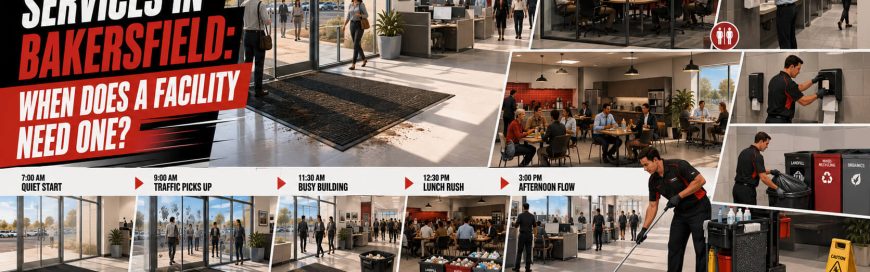
A facility may need a day porter when restrooms, entrances, breakrooms, waste areas, or shared spaces repeatedly need attention long before evening janitorial service begins.
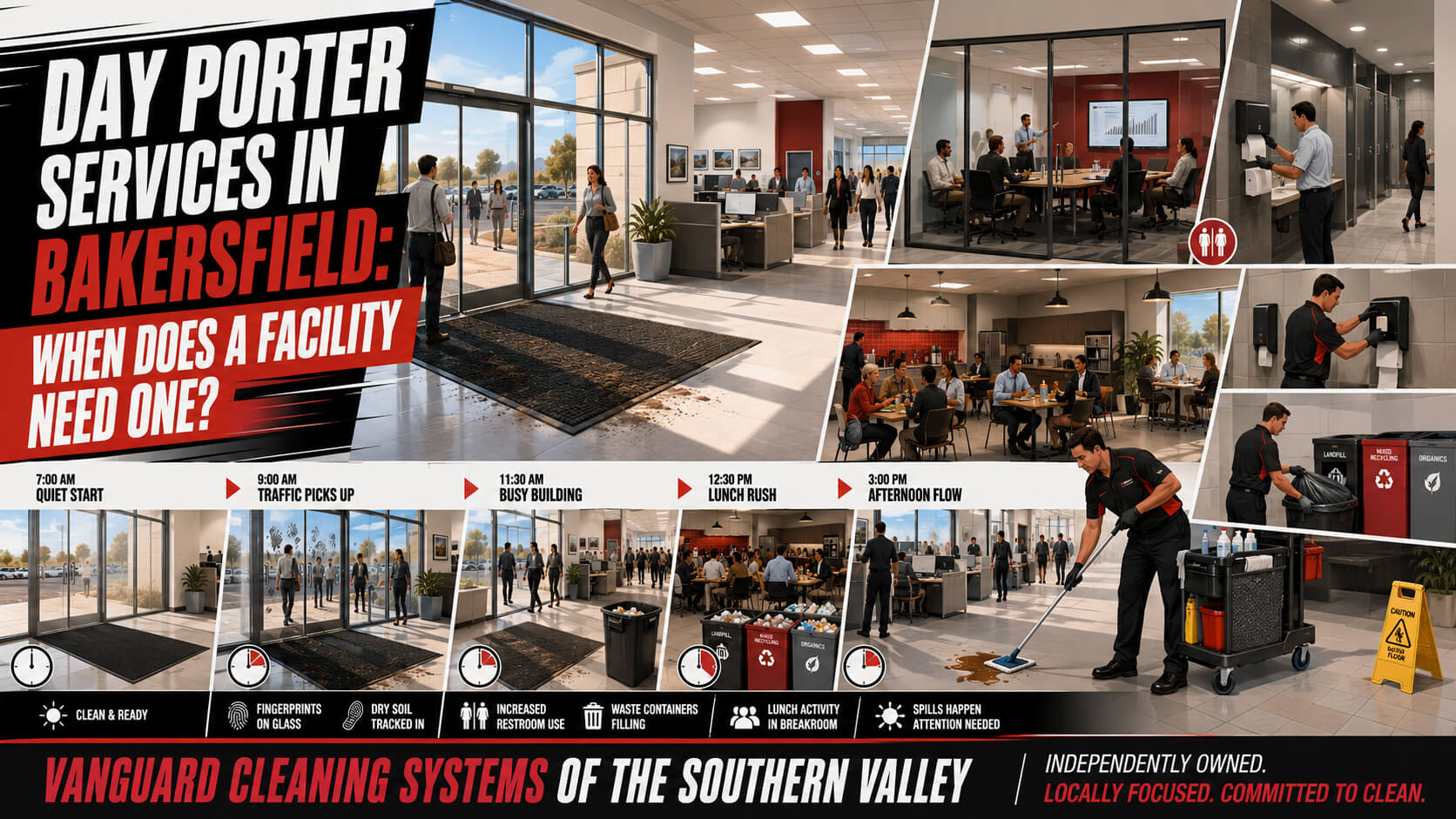
When a Clean Morning Doesn't Last Until Closing
A commercial building can look clean when employees arrive and show very different conditions by lunchtime. Restrooms see steady use. Food and drink spills happen. Waste containers fill. Dust and soil enter through busy doors. Breakrooms change quickly once people begin preparing meals and coffee.
These issues don't always mean the existing janitorial service is failing. Sometimes the building simply generates more daytime cleaning needs than an evening schedule can address.
Day porter service fills that gap by providing cleaning and facility support while the building is occupied. The amount of service can vary widely. Some properties may need a few hours around their busiest periods, while others may benefit from coverage throughout the workday.
The best way to decide is to watch what happens inside the facility between scheduled janitorial visits.
Quick Answer: When Does a Facility Need a Day Porter?
A facility may benefit from day porter service when cleaning problems regularly develop during operating hours and can't reasonably wait until the next scheduled janitorial visit.
Common signs include:
- Restroom supplies run low during the day.
- Waste containers fill before closing.
- Breakrooms need attention after meal periods.
- Entrances collect visible soil or debris.
- Lobby glass quickly shows fingerprints and marks.
- Spills require faster attention.
- Common spaces lose their clean appearance by midday.
- Employees repeatedly handle cleaning issues themselves.
- Meetings, visitors, or events create extra daytime demand.
- Complaints occur even though evening janitorial service is being completed.
The question isn't simply whether a facility receives regular cleaning. The more useful question is whether its existing schedule matches the way the building is actually used.
What Is a Day Porter?
A day porter is a person who handles ongoing cleaning and light facility-support needs while a commercial building is occupied.
Unlike a scheduled evening visit that can reset larger portions of a facility after employees or visitors leave, porter service focuses heavily on changing conditions throughout the day.
Typical responsibilities may include:
- Checking restrooms
- Restocking soap and paper supplies
- Emptying waste containers as needed
- Cleaning spills
- Spot-cleaning entrance floors
- Maintaining lobby appearance
- Wiping marks from glass doors
- Addressing breakroom messes
- Checking shared spaces
- Responding to service requests
- Reporting building maintenance concerns
The exact scope depends on the facility.
A small office may only need help around lunch and the afternoon. A busy commercial property may have enough traffic to support coverage during most operating hours.
For companies reviewing their broader Bakersfield janitorial service options, porter coverage can be evaluated alongside the building's scheduled janitorial program.
What Does a Day Porter Do During the Workday?
The work changes as the building changes.
A porter might begin the morning by checking an entrance after employees arrive. Later, the focus may move to restrooms. Lunch can shift attention toward breakrooms and waste. Afternoon meetings may increase traffic through reception areas and conference spaces.
That makes daytime service different from a rigid checklist completed once.
A useful porter scope identifies:
- Areas that change quickly
- Times when traffic peaks
- Supplies that frequently run low
- Areas that generate complaints
- Conditions requiring a fast response
- Spaces that remain visible to customers or visitors
The service schedule can then be built around actual demand.
Entrance and lobby attention
Entrances handle almost every person who enters a building.
Shoes carry outdoor soil and debris across thresholds. Glass doors collect fingerprints. Entry mats capture material throughout the day. Wind and foot traffic can also move debris into vestibules and lobby areas.
Daytime tasks may include:
- Checking entrance mats
- Removing visible debris
- Spot-cleaning hard floors
- Cleaning glass doors
- Addressing marks around handles
- Checking thresholds
- Monitoring the lobby
- Responding to wet flooring when necessary
Facilities experiencing recurring entrance issues can also review strategies for keeping entrances presentable during business hours.
Restroom checks
Restrooms are one of the clearest examples of why daytime service may become necessary.
A restroom can be fully stocked when a building opens and need attention several hours later.
Daytime duties may include:
- Checking soap
- Replenishing paper supplies
- Emptying waste
- Removing visible debris
- Checking sink areas
- Addressing water on floors
- Spot-cleaning fixtures
- Responding to reported problems
High occupancy can increase how quickly conditions change.
A business with 20 employees will often have a different daytime restroom pattern from a facility with hundreds of employees, visitors, customers, students, patients, or tenants passing through the building.
Facilities that experience recurring restroom concerns can evaluate ongoing restroom care as part of a broader janitorial plan.
Breakroom support
Breakrooms often change quickly during a few predictable periods.
Morning coffee creates one period of use. Lunch can create another. Afternoon snacks and drinks add additional activity.
Common daytime issues include:
- Food crumbs
- Coffee spills
- Waste
- Full trash containers
- Counter messes
- Sink buildup
- Marks on appliance exteriors
- Food debris on floors
- Tables that need attention
A breakroom that looks good at 8:00 a.m. can look very different at 1:00 p.m.
That makes meal periods useful when deciding whether porter coverage is necessary.
Facilities seeing repeated problems can also review common daytime breakroom concerns and compare them with the conditions employees actually experience.
Waste removal
Waste volume isn't always evenly distributed throughout the workday.
A breakroom container may fill quickly after lunch. Shipping areas may generate packaging waste at certain hours. Reception areas may remain quiet most of the day.
Porter service allows waste removal to follow those patterns instead of relying solely on one scheduled collection.
The goal is to identify containers that routinely become full before scheduled evening service begins.
Spill response
Spills don't follow janitorial schedules.
Coffee can hit the floor ten minutes after opening. Water may collect near a sink during lunch. Rain can be tracked through an entrance before an evening janitorial visit is scheduled.
Fast response is particularly important when a spill affects a walking surface.
A daytime porter gives a facility a defined process for handling these situations instead of leaving employees to decide who should respond.
Day Porter vs. Evening Janitorial Service
Day porter and evening janitorial services usually solve different problems.
Daytime service focuses on changing conditions while people are using the facility.
Evening service can address scheduled cleaning that is easier to complete when occupancy is lower.
Day porter duties may focus on:
- Restroom monitoring
- Supply replenishment
- Spill response
- Waste removal
- Entrance appearance
- Lobby touch-ups
- Breakroom recovery
- Glass spot-cleaning
- Common-area checks
- Daytime service requests
Evening janitorial service may focus on:
- Scheduled floor cleaning
- Carpet care
- Restroom cleaning
- Waste removal
- Office cleaning
- Common-area cleaning
- Breakroom cleaning
- Dusting
- Detailed scheduled tasks
One doesn't automatically replace the other.
For many facilities, the better approach is to determine which tasks need to happen while people are present and which can be handled during the regular scheduled service period.
Businesses comparing service arrangements can review available commercial cleaning services and build a scope based on occupancy, traffic, facility layout, and operating hours.
8 Signs Your Bakersfield Facility May Need Day Porter Service
Building type alone doesn't answer the question.
Look for repeated patterns.
1. Restrooms Need Attention Before the Workday Ends
A restroom shouldn't require employees to wait until the next day for commonly used supplies.
Track when supplies run low.
If the same problem occurs several times each week, the service schedule may need an adjustment.
Look for:
- Empty soap dispensers
- Low paper supplies
- Full waste containers
- Water around sinks
- Visible debris
- Recurring employee complaints
The timing matters.
If problems consistently appear at 2:00 p.m., scheduling additional service at 4:30 p.m. may still miss the period when it's needed most.
2. Your Entrance Looks Different by Midday
Bakersfield's dry conditions can make outdoor soil an ongoing entrance concern, especially at properties with frequent foot traffic.
Watch the area shortly after opening, around lunch, and later in the afternoon.
Look at:
- Entry mats
- Thresholds
- Hard flooring
- Glass doors
- Corners
- Reception areas
A gradual decline every day indicates a predictable service need.
Rather than adding random cleaning visits, service can be timed around when conditions tend to change.
3. The Breakroom Needs a Reset After Lunch
Lunch is one of the easiest periods to monitor.
Check the breakroom before employees begin eating.
Then check again after lunch.
Look for changes around:
- Tables
- Counters
- Sinks
- Coffee stations
- Refrigerators
- Microwaves
- Waste containers
- Floors
A predictable decline gives the facility a defined window for daytime attention.
4. Trash Containers Fill Before Evening Service
A building may produce far more waste at certain times or in certain areas.
Monitor which containers become full first.
Typical locations can include:
- Breakrooms
- Reception areas
- Copy rooms
- Shipping areas
- Restrooms
- Shared work areas
If employees regularly compress waste, move bags, or search for another container, the waste schedule may not match actual use.
5. Employees Are Handling Cleaning Problems
Office employees sometimes step in because the problem needs immediate attention.
Someone wipes up a spill.
Another employee changes a trash bag.
A manager finds more paper towels.
Reception cleans fingerprints from a glass door before visitors arrive.
Occasional small tasks happen in almost every workplace. A pattern is different.
Track how often employees are pulled into recurring cleaning duties.
The amount of time involved may seem small in isolation. Repeated interruptions throughout a week can point to a daytime service gap.
6. Visitors Use the Building Throughout the Day
Some workplaces experience most traffic when employees arrive and leave.
Others remain active all day.
Examples can include:
- Medical offices
- Multi-tenant buildings
- Professional offices
- Educational facilities
- Retail properties
- Public-facing buildings
- Distribution facilities with active office areas
A building that continually receives visitors may need more frequent attention around entrances, restrooms, reception areas, and other shared spaces.
The facility type provides context. Actual traffic should determine the service level.
7. Meetings and Events Create Temporary Cleaning Needs
Some facilities are quiet most of the week but become much busier during:
- Training sessions
- Client meetings
- Conferences
- Employee meetings
- Recruiting events
- Community events
These periods can increase restroom use, food waste, lobby traffic, and conference-room cleanup.
That doesn't always justify full-day coverage.
A porter schedule can instead focus on the periods when additional support is needed.
8. Complaints Occur Before the Next Cleaning Visit
Complaints provide useful timing data.
Record:
- What happened
- Where it happened
- When it was reported
- How often it occurs
- How long the condition remained
Patterns may emerge quickly.
Several unrelated complaints might turn out to happen during the same two-hour window.
At that point, the issue may be scheduling rather than overall service quality.
What Does a Typical Day Porter Schedule Look Like?
There is no single schedule that fits every commercial building.
A better schedule follows traffic and building use.
Partial-day porter coverage
Partial-day coverage can work when cleaning demand is concentrated into a predictable window.
Examples include:
- Morning arrival periods
- Lunch hours
- Afternoon visitor traffic
- Shift changes
- Scheduled events
A building may need several hours of support rather than continuous coverage.
Full-day porter coverage
Buildings with steady traffic may require more consistent attention.
Full-day service may make sense where:
- Restrooms receive constant use.
- Visitors arrive throughout the day.
- Common areas stay busy.
- Waste accumulates quickly.
- Several shared spaces need monitoring.
- Spills require prompt response.
- Multiple peak periods occur.
Peak-time scheduling
Some facilities fall between the two.
The porter may focus heavily on restrooms after morning traffic, move toward breakrooms around lunch, and return to entrances or common spaces in the afternoon.
The schedule follows demand.
That can be more useful than distributing the same tasks evenly across every hour.
Which Bakersfield Facilities May Benefit From Day Porter Service?
Many types of commercial facilities can use porter services.
Need is more closely tied to building activity than an industry label.
Large offices
Larger employee populations can create more restroom use, waste, breakroom activity, and entrance traffic.
Multi-tenant properties
Shared lobbies, restrooms, elevators, hallways, and entrances can experience traffic from several businesses at once.
Medical and professional offices
A steady flow of appointments may keep waiting areas, entrances, and restrooms active throughout the workday.
Distribution and industrial properties
Administrative offices, employee entrances, breakrooms, restrooms, and common spaces can remain active across shifts.
Educational facilities
Student, employee, and visitor traffic can place steady demand on common areas and restrooms.
Public-facing properties
Buildings that regularly receive customers or visitors may place greater importance on lobby, restroom, entrance, and reception conditions during operating hours.
The common factor is repeated daytime demand.
How Bakersfield Conditions Can Affect Daytime Cleaning Needs
Local conditions can influence what enters a building.
Bakersfield has a dry climate for much of the year. Outdoor soil and debris can be carried through entrances as people arrive and leave.
Buildings with:
- Large parking areas
- Frequent deliveries
- Heavy employee traffic
- Public entrances
- Multiple exterior doors
may notice entrance conditions changing faster than lower-traffic facilities.
Entry mats help capture material near the door, but mats themselves also need attention as they collect soil.
Weather can change the problem.
Dry periods may increase tracked-in dust and soil. Wet weather may introduce moisture around entrances.
The service plan should respond to the building instead of assuming the same entrance routine works every day of the year.
How Day Porter and Evening Janitorial Services Work Together
Think of the facility as moving through different conditions during the day.
Morning starts with the results of the previous scheduled service.
Then people arrive.
Restrooms begin seeing use. Entrance traffic increases. Coffee is prepared. Waste starts accumulating.
Lunch creates another shift.
The afternoon may bring meetings, visitors, deliveries, or additional employee traffic.
Evening service can then reset the building for the next workday.
A porter can address the conditions that develop between those larger scheduled service periods.
For example:
Morning
- Check entrances after arrival traffic
- Review restrooms
- Address visible issues in common spaces
Midday
- Check restrooms again
- Address breakroom conditions
- Remove waste where needed
- Respond to spills
Afternoon
- Recheck common spaces
- Restock supplies
- Address entrance or lobby concerns
- Prepare high-use areas for the remainder of the day
Evening
- Complete the broader scheduled janitorial scope
The exact arrangement depends on the building and the janitorial scope agreed upon with the independently owned janitorial franchise business providing the service.
How Much Day Porter Service Does a Facility Need?
Start with observation before choosing hours.
A simple one-week review can reveal useful patterns.
Record the following:
What area changes?
Be specific.
Instead of writing "restroom problem," note the actual condition.
Examples:
- Paper towels run out.
- Waste fills.
- Water appears around the sink.
- Entrance floor becomes visibly soiled.
- Breakroom trash fills after lunch.
What time does it happen?
Timing helps determine coverage.
If the issue appears every day between noon and 2:00 p.m., that information is more useful than simply knowing the area needs more attention.
How often does it happen?
One unusual event may not justify a schedule change.
A problem occurring four days each week deserves a closer look.
How long does it remain?
Some issues resolve quickly because an employee steps in.
Others remain for hours.
Both situations matter.
Employee intervention can hide the fact that a facility has a recurring service gap.
Who handles it now?
Identify whether the task falls to:
- Office employees
- Managers
- Reception
- Maintenance employees
- Building management
Recurring cleaning duties can pull those employees away from their normal responsibilities.
What would solve the problem?
The answer may be:
- One extra restroom check
- A two-hour lunch period visit
- Morning and afternoon rounds
- Partial-day porter coverage
- Full-day porter coverage
- A change to the existing janitorial scope
Service should match the problem.
Five Questions to Ask Before Adding Day Porter Service
A simple review can help narrow the decision.
When do conditions begin to decline?
Walk the building at different times.
Morning conditions alone don't show what employees and visitors experience for the rest of the day.
Which areas change the fastest?
Focus on areas with frequent use.
These often include:
- Restrooms
- Entrances
- Breakrooms
- Lobbies
- Waste stations
- Shared rooms
Are the problems predictable?
Predictable problems are easier to schedule around.
If restroom supplies frequently run low at 3:00 p.m., that creates a clear service window.
Are employees repeatedly stepping in?
Keep track for a week.
A few minutes here and there can hide a recurring facility-management problem.
Can the problem reasonably wait for evening service?
Some tasks can.
Others need faster attention.
That distinction is one of the clearest ways to decide whether daytime support is worthwhile.
Building a Day Porter Scope Around Actual Facility Use
A useful scope starts with the building.
Review:
- Operating hours
- Employee count
- Visitor traffic
- Restroom use
- Breakroom activity
- Entrance traffic
- Waste volume
- Floor types
- Meeting schedules
- Delivery activity
- Known complaint periods
Then compare those conditions with the existing janitorial schedule.
The goal is to identify gaps.
For example, a facility may already have a strong evening program but need a restroom check and breakroom reset after lunch.
Another property may need regular entrance, restroom, and waste monitoring throughout the day.
Both facilities use porter service differently.
That flexibility is one reason daytime coverage should be based on observed building conditions rather than a standard package.
Workplace Relevance: Cleaning While the Building Is Active
Occupied buildings are always changing.
People move between rooms. They enter from outside. They use restrooms. They eat. They drink coffee. They throw items away. They hold meetings.
A cleaning schedule built only around closing time may overlook what the facility looks like during the hours when people actually experience it.
Day porter service provides another scheduling option.
The goal is to place attention where the building needs it and when that need occurs.
For Bakersfield businesses reviewing commercial cleaning services, observing daytime conditions can provide a clearer starting point than choosing service frequency from a generic checklist.
People Also Ask
What does a day porter do?
A day porter handles ongoing cleaning and light facility-support needs while a commercial building is occupied. Tasks may include restroom checks, restocking supplies, waste removal, spill response, entrance attention, breakroom cleanup, and monitoring shared spaces.
What is the difference between a day porter and a janitor?
Day porter service typically focuses on changing conditions during operating hours. Scheduled janitorial service can include broader recurring tasks completed during periods of lower occupancy or after the building closes.
Does a day porter clean restrooms?
Restroom monitoring is a common day porter responsibility. The assigned scope may include checking supplies, emptying waste, removing visible debris, spot-cleaning fixtures, and responding to issues that arise during the day.
How many hours does a day porter work?
Hours depend on the property. Some facilities need help during a short peak period, while others require partial-day or full-business-day coverage.
What types of businesses use day porters?
Offices, multi-tenant buildings, medical offices, retail properties, educational facilities, distribution properties, and other high-traffic commercial buildings may use porter service. Traffic and building use matter more than the industry name alone.
Can a day porter work with an evening janitorial service?
Yes. Daytime porter coverage and scheduled evening service can address different cleaning needs within the same facility.
When should a business consider day porter service?
Consider daytime coverage when the same restrooms, entrances, breakrooms, waste areas, or shared spaces repeatedly need attention before the next scheduled janitorial visit.
Are day porter services only for large buildings?
No. A smaller facility with heavy visitor traffic or frequent daytime cleaning needs may have a stronger case for porter coverage than a larger building with low occupancy.
Frequently Asked Questions
Is day porter service the same as full-time cleaning?
No. Coverage can range from a limited period to most of the business day, depending on the agreed service scope.
Can porter service be scheduled around lunch?
Yes. If lunch creates a predictable spike in breakroom, restroom, or waste activity, daytime service can be planned around that period.
Can a day porter respond to spills?
Spill response can be included within the agreed porter scope.
Can a porter restock restroom supplies?
Yes. Monitoring and replenishing commonly used restroom supplies are frequent porter tasks.
How do I know whether I need daytime or evening service?
Record when cleaning issues occur. Problems that consistently develop and require attention during operating hours can point toward daytime coverage. Tasks that can reasonably wait until the building is less occupied may fit the evening schedule.
Should a porter follow the same schedule every day?
The service scope can reflect recurring building-use patterns. Facilities with changing events, occupancy, or operating schedules may require different coverage arrangements.
How can I estimate the amount of porter service needed?
Track problem areas for several days. Record the location, time, frequency, and current response. Those patterns can help identify the hours and tasks that need coverage.
Identify When Your Facility Needs Attention
Before changing the cleaning program, walk through the building at several points during a normal workday.
Check it:
- After employees arrive
- Before lunch
- After lunch
- During afternoon traffic
- Near closing
Notice what changes.
Pay particular attention to entrances, restrooms, breakrooms, waste areas, and shared spaces.
Record the time.
A pattern may show that the building doesn't need additional service everywhere. It may need focused attention in two or three areas during a specific part of the day.
Vanguard Cleaning Systems of the Southern Valley can help businesses discuss daytime service needs and evaluate how those needs fit within a janitorial program performed by an independently owned janitorial franchise business.
The most useful starting point is simple: identify the times and areas where conditions decline during operating hours.
References
Berglund, M., Johansson, I., & Qvist, J. (2023). Compendium of physical ergonomics exposures to hand, shoulder, and low back during routine janitorial activities. International Journal of Industrial Ergonomics, 96, 103544. https://doi.org/10.1016/j.ergon.2023.103544
Gormley, M., Aspray, T. J., & Kelly, D. A. (2021). Transmission of COVID-19 and other infectious diseases in public washrooms: A systematic review. Science of the Total Environment, 803, 149932. https://doi.org/10.1016/j.scitotenv.2021.149932
Lavy, S., Garcia, J. A., & Dixit, M. K. (2017). Measuring the productivity of facilities management. Journal of Facilities Management, 15(3), 244–261. https://doi.org/10.1108/JFM-04-2016-0013
Maddalena, R. L., McKone, T. E., Hsieh, D. P. H., & Nazaroff, W. W. (2012). Volatile organic compounds in small- and medium-sized commercial buildings in California. Environmental Science & Technology, 46(6), 3637–3644. https://doi.org/10.1021/es202132u
Wargocki, P., Lagercrantz, L., Witterseh, T., Sundell, J., Wyon, D. P., & Fanger, P. O. (2002). Subjective perceptions, symptom intensity and performance: A comparison of two independent studies, both changing similarly the pollution load in an office. Indoor Air, 12(2), 74–80. https://doi.org/10.1034/j.1600-0668.2002.01101.x
