

The best janitorial proposal is the one that clearly connects your building's conditions with specific tasks, schedules, responsibilities, and follow-up procedures.
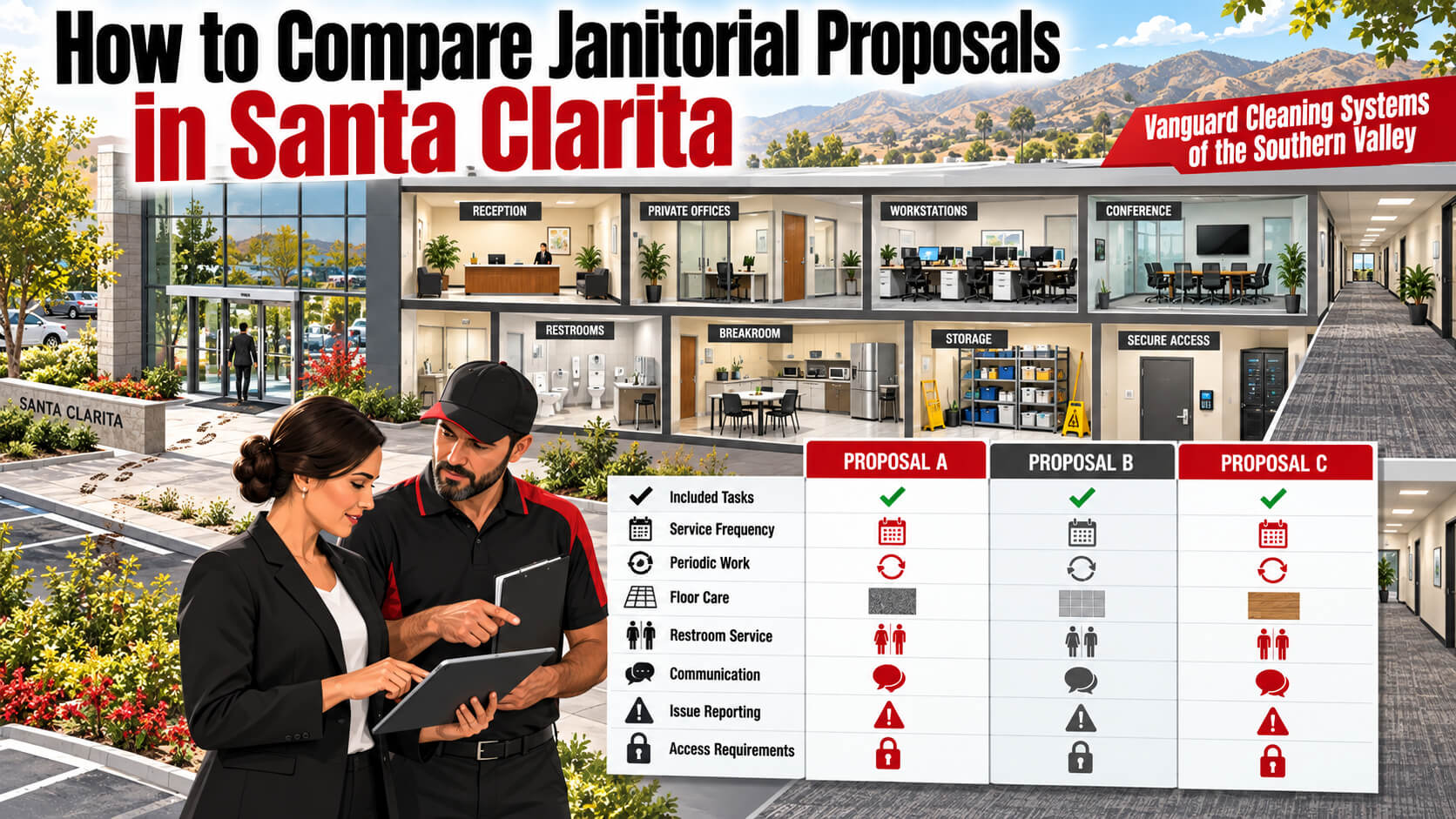
A Proposal Only Helps When the Scope Matches the Building
Two janitorial proposals can show similar monthly totals while describing very different services. One may include daily restroom care, detailed floor schedules, and planned quality reviews. Another may use broad phrases that leave the frequency and level of work open to interpretation.
Those differences become clearer when each proposal is compared with the way the property operates. A busy Santa Clarita office with public entrances, shared restrooms, carpeted corridors, and evening meetings creates a different workload from a low-traffic building of the same size. The comparison needs to account for those conditions.
Clear proposals also make service easier to manage after work begins. Each side can see which areas are included, when tasks occur, who handles supplies, and how concerns are reported. That gives routine conversations a shared starting point.
Businesses reviewing commercial cleaning services in Santa Clarita should begin with the scope behind each number. The total becomes more useful once the work, timing, and responsibilities are placed beside it.
Quick Answer: How Should You Compare Janitorial Proposals?
Compare janitorial proposals line by line against actual building conditions. Confirm that every company is pricing the same areas, tasks, frequencies, periodic work, floor-care duties, restroom expectations, communication process, issue-reporting method, and access requirements. Then review exclusions, startup work, supply responsibilities, and the process for changing the scope.
Use the following order:
- Confirm the same rooms and buildings are included.
- Compare each task and its exact frequency.
- Separate routine work from periodic services.
- Match floor care to each floor material and traffic pattern.
- Define restroom tasks, supplies, and daytime checks.
- Review communication and issue-reporting procedures.
- Confirm keys, alarms, restricted areas, and service windows.
- Identify exclusions and extra-charge conditions.
- Compare totals after the scopes have been aligned.
What Is a Commercial Janitorial Proposal?
A commercial janitorial proposal is a written offer describing the service planned for a specific property. It usually combines a scope of work, service schedule, operating terms, responsibilities, and proposed price.
A useful proposal should make these points easy to find:
- Buildings, rooms, and areas included
- Routine tasks
- Frequency for each task or area
- Service days and working hours
- Periodic services
- Floor-care responsibilities
- Restroom expectations
- Supply and equipment responsibilities
- Access and security procedures
- Quality reviews and inspections
- Issue-reporting steps
- Exclusions and separately priced work
- Terms for making changes
The document gives both sides a reference point. Broad statements such as “general office cleaning” or “floors as needed” leave room for conflicting expectations. A defined task paired with a frequency is much easier to evaluate.
Learn more about the building variables behind what affects commercial cleaning costs in Santa Clarita. Those same variables should appear in the proposal comparison.
How Comparing Janitorial Proposals Works
A fair comparison requires a common baseline. Give each company the same building information and service goals. Then place the proposals into a comparison sheet that uses one row for each area or task.
Start with a current floor plan or room list. Add employee count, visitor traffic, operating hours, floor types, restroom fixtures, breakroom use, waste volume, secure rooms, current service concerns, and any periodic work you expect. Each bidder can then respond to the same set of conditions.
When proposals arrive, translate broad language into specific answers. For example, “restroom service five days per week” identifies visit frequency but says little about fixtures, floors, supplies, detail work, or daytime checks. Ask for the task list that supports the phrase.
The final review should answer two questions:
- Does the scope fit the building as it is used today?
- Can both sides tell whether the agreed work was completed?
Research on facilities management performance supports the use of measurable indicators and an active process for managing results. A proposal should provide enough detail for that process to work after the agreement begins.
Prepare One Building Brief for Every Proposal
Proposal quality improves when every company receives the same accurate information. A short building brief helps keep the responses comparable and reduces assumptions.
Include:
- Cleanable square footage
- A room list or floor plan
- Normal employee count by weekday
- Estimated visitor volume
- Operating hours and shifts
- Restroom and fixture counts
- Breakrooms and food-service areas
- Floor materials by area
- Waste and recycling locations
- Restricted or sensitive rooms
- Available janitorial storage
- Required service windows
- Known problem areas
- Expected periodic services
Describe the condition expected between visits. An entrance that must remain presentable throughout public hours may need a daytime check. A private conference room used twice per week may follow a lighter schedule.
Give bidders a chance to walk the property. Photos and floor plans are helpful, though they may miss furniture density, walking distance, access delays, worn flooring, supply storage, and the path waste takes to the dumpster.
1. Compare the Included Areas and Tasks
Begin with the physical scope. Check that each proposal includes the same buildings, floors, suites, and rooms. A missing storage wing or second-floor breakroom can change both workload and total price.
List the main service areas:
- Entrances and lobbies
- Private offices
- Open work areas
- Conference and training rooms
- Restrooms
- Breakrooms and kitchenettes
- Corridors and stairs
- Elevators
- Copy and mail rooms
- Storage areas
- Warehouses or shop offices
- Exterior-facing entry areas
Within each area, compare the individual tasks. “Clean lobby” could include hard-floor care, carpet vacuuming, mat care, interior entrance glass, furniture dusting, waste removal, and spot attention. Ask the proposal to state which tasks are included.
Look for Task-Level Detail
Task-level detail helps you spot missing work before service begins. It also keeps small differences from hiding inside general headings.
Check whether proposals address:
- Waste removal and liner replacement
- Dusting of reachable surfaces
- Vacuuming and edge work
- Hard-floor care
- Interior glass
- Breakroom counters, tables, and sinks
- Restroom fixtures, mirrors, partitions, and floors
- Entrance mats
- High and low detail areas
- Reporting leaks, damage, and other building concerns
A detailed proposal may still allow room for reasonable service judgment. The core expectations should remain clear enough that someone unfamiliar with the sales conversation can understand them.
2. Compare Service Frequency by Task
Building-wide visit frequency gives only part of the schedule. A proposal for five visits per week may assign some tasks daily, others weekly, and detail work monthly. Another five-day proposal may place nearly every task under a broad “as needed” label.
Create separate columns for:
- Each service day
- Two or three times per week
- Weekly
- Monthly
- Quarterly or seasonal
- On request
Then place each task into its stated frequency. This makes a light proposal visible even when its cover page looks similar to the others.
Match Frequency to How Areas Are Used
Restrooms, food areas, waste stations, entrances, and high-traffic floors often change faster than private offices. A proposal should account for those differences. Applying the same frequency to every room can place too much work in quiet spaces while busy areas decline between visits.
Ask what happens on high-occupancy days, during events, or when business hours extend. The answer may involve a planned daytime check, an adjusted weekday schedule, or a process for requesting temporary service.
3. Separate Routine Work From Periodic Work
Periodic work occurs on a planned cycle outside the normal visit list. It may require added labor, different equipment, or a longer service window.
Examples include:
- Carpet extraction
- Detailed hard-floor care
- High dusting
- Interior glass projects
- Detailed baseboard work
- Upholstery care
- Deep restroom detail work
- Post-event service
For each item, confirm the area, method, planned frequency, timing, and pricing treatment. Some proposals include selected periodic services in the recurring total. Others price them separately when scheduled.
A low recurring total can leave substantial periodic needs outside the agreement. Record those items in a separate annual planning column so the full service picture remains visible.
Check the First-Service Condition
A building with heavy floor buildup, neglected edges, carpet spots, or restroom scale may need initial corrective work. The proposal should identify that starting work separately from the recurring scope.
This distinction gives routine service a clear baseline. It also prevents a one-time condition from being spread across general wording that neither side can track.
4. Compare Floor-Care Responsibilities
Floor care often creates major differences between janitorial proposals. Start by mapping every floor material and its square footage. Carpet, resilient flooring, ceramic tile, stone, sealed concrete, wood, and specialty surfaces have different routine and periodic needs.
For carpeted areas, ask about:
- Vacuuming frequency by traffic level
- Edge and corner work
- Spot-reporting procedures
- Entrance and corridor priorities
- Planned carpet extraction
- Furniture movement limits
For hard flooring, ask about:
- Routine soil removal
- Damp floor care
- Edges and corners
- Entry tracking
- Residue or haze concerns
- Finish and restoration responsibilities
- Equipment suited to the floor material
Confirm who decides when periodic floor work is due. Appearance reviews, traffic, weather, manufacturer guidance, and current floor condition can all shape the timing.
Check Entrance and Mat Care
Santa Clarita properties often face dry soil, landscaping debris, and light windblown dust around entrances. That material can travel onto lobby flooring and along busy paths. Rain can create a different mix of moisture and tracked soil.
The proposal should state who maintains entrance mats, how often the entry receives attention, and whether daytime spot care is included. A strong interior floor plan begins where people enter the building.
5. Compare Restroom Expectations
Restrooms need more detail than a single line reading “clean and restock.” Compare the number of rooms, fixture count, traffic, operating hours, floor type, dispenser capacity, and peak-use periods.
The routine scope may include:
- Toilets and urinals
- Sinks and counters
- Mirrors
- Partitions
- Waste containers
- Floors and edges
- Soap and paper supplies
- Visible wall and door marks
- Reporting leaks, clogs, or damaged fixtures
Confirm whether the client or service provider purchases consumable supplies. If the provider supplies them, check how product type, dispenser fit, usage, storage, and billing are handled.
Define Daytime Checks
A full evening service may support a lightly used restroom through the next workday. Busy public or multi-shift restrooms may require daytime checks for supplies, waste, water, visible soil, and fixture availability.
Ask whether those checks are included, how many occur, when they happen, and which tasks are performed. A check tied to the building's busiest period gives more useful coverage than a vague promise of occasional attention.
6. Compare Communication Procedures
Communication affects how quickly small concerns are understood and resolved. A proposal should identify the main contacts on both sides, the normal communication channel, and the expected rhythm for service reviews.
Look for clear answers:
- Who receives routine questions?
- Who handles urgent issues?
- How are scope questions documented?
- When are walkthroughs or review meetings held?
- Who approves added work?
- How are schedule changes communicated?
- Who should be contacted after normal hours?
Communication should fit the property. A small office may use one main contact and a simple email process. A large or multi-tenant property may need several contacts, escalation steps, and scheduled reviews.
Ask Who Owns the Follow-Up
Acknowledging a concern is the first step. The process should also show who reviews it, when a correction is expected, and how completion is confirmed.
Research on facilities outsourcing relationships points to the importance of the working relationship between the client and service provider. The proposal should describe enough of that relationship to show how routine decisions will be handled.
7. Compare Issue Reporting and Quality Review
Service concerns are easier to solve when they include the area, condition, time found, and requested result. A general message such as “the building was missed” gives little direction. A report stating that paper waste was found beside the second-floor copy room at 8:00 a.m. is easier to investigate.
Ask each company how it handles:
- Routine service feedback
- Urgent requests
- Time-stamped issue records
- Photos where useful
- Repeat problems
- Walkthrough findings
- Scope questions
- Confirmation after a correction
A clear janitorial quality control process connects reporting with follow-up. It can also reveal whether a problem comes from a missed task, an unclear scope, insufficient frequency, restricted access, or a building-maintenance issue.
Look for Measurable Review Points
Useful review points may include completed tasks, repeat concerns by area, response time, open items, inspection findings, and changes in building use. Choose measures that relate to the scope and can lead to a clear action.
A long list of scores can create extra paperwork without improving the building. A small set of meaningful measures, reviewed consistently, gives both sides a practical basis for adjustment.
8. Compare Access and Security Requirements
Access rules affect scheduling, labor, and the ability to complete the scope. Give every bidder the same information about keys, alarm codes, access cards, escorts, locked floors, restricted rooms, and sign-in procedures.
Confirm:
- Permitted entry and exit times
- Alarm steps
- Key and access-card handling
- Restricted rooms
- Areas requiring an escort
- Occupied spaces during service
- Loading and parking instructions
- Dumpster and recycling access
- Emergency contacts
Short service windows deserve close review. Some floor tasks, conference-room work, or entrance care may be difficult while employees and visitors remain present. Ask how the proposed schedule fits the available window.
Document rooms that are excluded because access is unavailable. This prevents a locked records room or server room from becoming a recurring complaint.
9. Review Supplies, Equipment, and Storage
Janitorial proposals may handle supplies in different ways. Separate consumable facility products, such as soap and paper goods, from the products and equipment used to perform the contracted work.
Ask:
- Who purchases each type of supply?
- Where will stock be stored?
- Who monitors inventory levels?
- How are emergency shortages handled?
- Which equipment will remain onsite?
- Does the building provide power, water, or charging space?
- Are any products restricted by building policy?
Limited storage can affect the service plan. A distant or crowded janitorial closet adds travel and setup time. A walkthrough should confirm that the proposed equipment and stock will fit the available space.
10. Identify Exclusions and Change Procedures
Exclusions matter as much as included work. They show where a routine request could become a separate service or require written approval.
Common items to clarify include:
- Interior appliance cleaning
- Personal desk surfaces
- Exterior windows
- High-access work
- Large furniture movement
- Post-construction conditions
- Event setup or cleanup
- Special waste
- Work outside the normal schedule
Then review how the agreement changes when the building changes. Added staff, longer hours, new space, another restroom, or a return to full occupancy can increase workload. The proposal should provide a clear path for reviewing those changes and approving a revised scope.
A Janitorial Proposal Comparison Checklist
Use one row for every comparison point and one column for each proposal.
| Comparison Point | What to Record |
|---|---|
| Included areas | Buildings, floors, rooms, exterior-facing areas, and exclusions |
| Routine tasks | Exact work assigned in each type of room |
| Frequency | Days per week and task-level schedules |
| Periodic work | Task, area, timing, and whether the price is included |
| Floor care | Methods and frequencies by floor material and traffic |
| Restrooms | Fixtures, supplies, floors, detail work, and daytime checks |
| Communication | Contacts, channels, review schedule, and approval steps |
| Issue reporting | Submission, response, follow-up, and repeat-issue review |
| Access | Service window, keys, alarms, restricted rooms, and escorts |
| Supplies | Purchasing, storage, inventory checks, and billing |
| Startup work | Initial corrective tasks and separate pricing |
| Scope changes | Review and approval process when building needs change |
Add a notes column for questions and a status column showing whether the item is confirmed. This keeps unanswered details visible during follow-up.
Environmental Factors That Affect Santa Clarita Proposals
Outdoor conditions can change the amount and type of work inside a commercial property. Proposals should account for the routes where soil enters and the seasons when those routes need more attention.
Dry Soil and Wind
Dry ground, parking areas, landscaping, nearby roads, and light wind can bring dust and grit toward building entrances. Properties with frequently opening doors may see this material move into lobbies and high-traffic corridors.
Compare entrance-mat care, lobby floor frequency, interior glass attention, and the plan for temporary increases in tracked soil.
Rain and Entry Moisture
Rain can mix with outdoor soil and leave visible tracking near doors. Smooth flooring may also need quicker attention when moisture enters. Ask how the proposal handles weather-related checks and short-term floor needs.
Construction and Landscaping
Nearby construction, tenant improvements, roadwork, and active landscaping can raise dust or debris for days or months. The recurring proposal should explain how unusual conditions are reported and when added service requires approval.
Building Heat and Operating Hours
Hot weather can change entrance traffic, breakroom use, and the time people spend indoors. Buildings that open early or close late may also need service while occupied. The proposal should match the actual operating calendar.
Why Proposal Detail Matters in Daily Workplace Use
Proposal language eventually becomes a work schedule. If a busy restroom has no stated check frequency, onsite staff may begin refilling supplies. If periodic floor work is omitted, traffic lanes can decline while both sides assume the other is responsible.
Clear responsibilities reduce those gaps. They also make it easier to tell whether the building has changed since the proposal was written. A rise in headcount or visitor traffic can be matched with a scope review instead of a cycle of repeated complaints.
Quick inspections can miss edges, corners, low surfaces, and spaces outside the usual walking path. Compare the proposal with these areas missed during quick inspections so the review includes less-visible parts of the building.
Strong commercial janitorial services begin with a scope that fits the property. The written proposal should carry that understanding into the service schedule and ongoing review process.
Questions to Ask Before Choosing a Proposal
- Which areas and tasks are excluded?
- Which tasks occur during every visit?
- How are weekly and monthly tasks tracked?
- Which periodic services are included in the recurring total?
- How will each floor material be maintained?
- Are daytime restroom or entrance checks included?
- Who provides restroom and breakroom supplies?
- How are routine concerns submitted?
- What happens when the same concern returns?
- Who performs inspections or service reviews?
- How does the proposed schedule fit the building's access window?
- What work requires separate approval?
- How can the scope change when occupancy or hours change?
Record the answers in writing. Sales conversations can add useful context, while the written scope remains the clearest point of reference after service begins.
People Also Ask
What should a commercial cleaning proposal include?
It should identify service areas, tasks, task frequencies, periodic work, floor care, restroom duties, supplies, service hours, access rules, quality reviews, issue reporting, exclusions, and price.
How do you compare commercial cleaning companies?
Give each company the same building information, request a walkthrough, and compare the written scopes line by line. Review price after confirming that the proposed work is comparable.
What is a janitorial proposal checklist?
It is a list of service areas, tasks, frequencies, responsibilities, and operating terms used to compare proposals on the same basis. It helps expose missing or unclear items.
Why do janitorial proposals have different prices?
Companies may estimate different tasks, frequencies, labor needs, periodic services, supply duties, or access conditions. A difference in totals often points to a difference in scope.
Should the lowest janitorial proposal be selected?
Select the proposal that provides the best fit between scope, building conditions, service management, and total cost. A lower total may cover a lighter set of tasks or frequencies.
Are floor-care services included in janitorial proposals?
Routine floor work may be included, while carpet extraction and other periodic services may follow a separate schedule or price. The proposal should state how each task is handled.
How often should a janitorial scope be reviewed?
Review it when occupancy, operating hours, floor materials, building layout, access rules, or complaint patterns change. A scheduled annual review can also confirm that the scope still fits.
Frequently Asked Questions
Do all bidders need the same walkthrough?
Each company should see the same service areas and receive the same building facts. Use a written building brief to keep the process consistent.
What does “as needed” mean in a proposal?
Ask the bidder to define the condition that triggers the task, who makes that decision, and whether added approval or pricing applies.
How can I compare task frequency?
List every task in a spreadsheet or table, then record its frequency under each proposal. Separate per-visit, weekly, monthly, and periodic work.
What if one proposal combines several tasks?
Ask for a task-level breakdown. The goal is to confirm what occurs in each area and how often it happens.
Should quality inspections appear in the proposal?
Yes. The proposal should explain who conducts reviews, what is checked, how findings are recorded, and how follow-up is confirmed.
How should recurring service concerns be handled?
Record the area, condition, time, frequency, and prior correction. The service review can then address the task, timing, access, scope, or building condition behind the pattern.
What access details should be shared?
Share service windows, keys, alarms, access cards, restricted rooms, escort rules, occupied areas, parking, and waste-removal routes.
Can the proposal change after service begins?
Yes. The agreement should explain how both sides review and approve changes in space, occupancy, hours, tasks, or frequency.
Compare the Work Behind Each Total
Compare proposals line by line against actual building conditions rather than comparing totals alone. Use the walkthrough, building brief, and comparison checklist to align rooms, tasks, schedules, periodic services, floors, restrooms, communication, issue reporting, and access.
Vanguard Cleaning Systems of the Southern Valley can help review a Santa Clarita property and connect its operating conditions with a proposed service scope. Janitorial services are provided by independently owned and operated janitorial franchise businesses. To begin with the building itself, request a facility walkthrough.
References
Amaratunga, D., & Baldry, D. (2002). Moving from performance measurement to performance management. Facilities, 20(5/6), 217–223. https://doi.org/10.1108/02632770210426701
Haugen, T. B., & Klungseth, N. J. (2017). In-house or outsourcing FM services in the public sector: A review of 25 years research and development. Journal of Facilities Management, 15(3), 262–284. https://doi.org/10.1108/JFM-06-2016-0022
Lavy, S., Garcia, J. A., & Dixit, M. K. (2014). KPIs for facility's performance assessment, Part I: Identification and categorization of core indicators. Facilities, 32(5/6), 256–274. https://doi.org/10.1108/F-09-2012-0066
Lok, K. L., & Baldry, D. (2015). Facilities management outsourcing relationships in the higher education institutes. Facilities, 33(13/14), 819–848. https://doi.org/10.1108/F-05-2014-0043
