
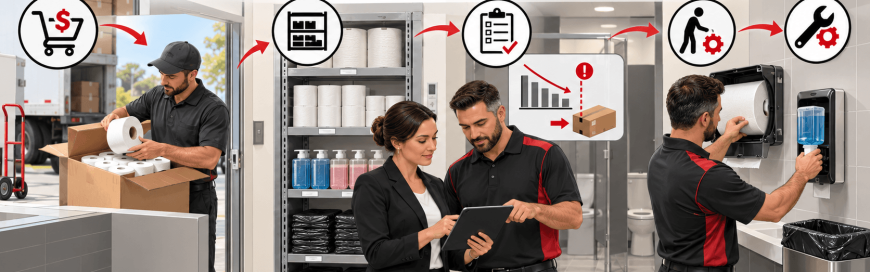
Restroom supplies stay available when purchasing, storage, and dispenser refills each have a named owner and a clear handoff.

An empty dispenser can start with a missed order days earlier
A restroom can run out of paper towels while unopened cases sit behind a locked door. The next shipment may arrive with a refill that doesn't fit the installed dispenser. Someone can report low soap at night, with the purchase request still waiting for approval the following afternoon. Each problem begins at a different step, so the supply plan needs to follow the product from the order through its use.
Clear janitorial supply responsibilities help make those steps visible. The agreement should name who buys each item and who can approve a substitute. It should also identify the person who receives deliveries, controls storage access, and refills dispensers during the hours the building is open.
Quick answer: Who orders, stores, and restocks restroom supplies?
The written service agreement should assign purchasing, delivery checks, storage, inventory counts, and dispenser refills separately. A building may buy its own consumables while an independently owned janitorial franchise business handles scheduled restocking. Another agreement may include supply purchasing, with defined charges and approval limits.
For each product, record the compatible refill, counting unit, reorder trigger, and backup contact. Keep purchasing costs separate from restocking labor and dispenser repairs so the scope and invoice can be checked.
What is restroom supply management?
Restroom supply management is the process of keeping approved consumables available from purchase through dispenser use. It includes selecting compatible products, receiving deliveries, storing stock, checking quantities, and arranging refills before supplies run out.
Commercial restroom restocking is the task of placing approved supplies into the dispensers or locations where they are used. Restocking may be part of routine cleaning or a separate daytime visit, depending on the agreement.
Typical items include toilet tissue, hand soap, paper towels, and waste liners. Add other products provided at the site, such as menstrual supplies, with their own storage and refill instructions.
A written restroom cleaning scope should identify the included supply checks. The purchasing arrangement needs enough detail to show how those supplies reach the building and who pays for them.
How it works: Follow each supply from purchase to refill
Create one product record for each approved item. Use the supplier's product number and the dispenser information so someone covering an absence can identify the correct replacement.
Choose the product and approve purchases
Name the person who can approve an order and set a backup for absences. Record any spending limit, supplier restriction, or requirement to obtain approval before replacing a product.
Confirm whether the quoted price includes freight, tax, and any handling or purchasing charge. Record the order number and expected delivery date where the person checking stock can find them.
Receive the delivery and check it
Compare the shipment with the approved order before adding it to usable stock. Check the item number, case quantity, and condition of the packaging.
Report shortages, damaged goods, or substitutions to the assigned purchasing contact. Mark affected items as awaiting a decision so they aren't counted as available refills while a return or compatibility question remains open.
Move accepted supplies into assigned storage
Record where accepted stock is placed. A delivery left in a receiving area needs a handoff to the person who controls the supply room.
Update the inventory when the goods become available for use. If a delivery serves several buildings, record each building's allocation rather than treating the entire shipment as stock for one location.
Refill dispensers and report exceptions
Assign refill checks around the building's hours and patterns of use. The person completing the visit needs access to the correct stock and any approved dispenser key.
Record a dispenser that cannot be refilled, a stock shortage, or a fault that prevents dispensing. Name who receives the report and when follow-up is due.
Sample responsibility sheet for restroom supplies
Adaptable sample: Complete this sheet for the actual agreement. The assignments below describe decisions to make; they do not establish who performs them at a particular building.
Building: __________ Effective date: __________
Supply contact: __________ Backup contact: __________
Storage location and access method: __________
| Task | Assigned person or business | Required record or handoff |
|---|---|---|
| Approve products and substitutes | __________ | Approved item list and dispenser match |
| Check stock and flag reorder needs | __________ | Quantity, date, item number, and open orders |
| Approve spending | __________ | Approval limit and backup authorization |
| Place orders | __________ | Order confirmation and expected usable delivery date |
| Receive and inspect deliveries | __________ | Accepted quantity, shortages, damage, or substitutions |
| Store and rotate supplies | __________ | Storage location and updated count |
| Refill during scheduled service | __________ | Room checks, items used, and exceptions |
| Cover needs between service visits | __________ | Daytime coverage hours and reporting method |
| Arrange dispenser maintenance | __________ | Fault report, repair contact, and return-to-use check |
| Handle urgent shortages | __________ | Approved temporary supply and purchase authority |
Add a short instruction beside each assignment explaining what happens during an absence. Keep the current sheet with the service scope and supply records.
Define how a low-stock report becomes an order
Set a reporting method that reaches the purchasing contact. A note on a cleaning checklist needs an assigned recipient and a response time if it is expected to trigger a purchase.
Close the handoff when the order confirmation is recorded. Until then, the shortage remains open and needs follow-up under the agreed process.
Confirm dispenser compatibility before ordering
Keep a dispenser list by room. Similar-looking refills can have different dimensions, feed systems, or cartridge fittings.
- Record the dispenser manufacturer and model.
- List the approved refill product number.
- Note the roll size, fold type, or cartridge format.
- Record the case quantity and the unit used for counts.
- Identify required keys or approved battery types where relevant.
- Keep manufacturer loading and care instructions available.
Check a substitute before placing a larger order
Have the assigned contact verify compatibility against the manufacturer's information. Where a sample is available, confirm that it loads and dispenses correctly before accepting a wider substitution.
Update the product record when a change is approved. Include any change to case size or refill capacity, because the old usage history may need adjustment.
Use the correct soap-refill method
Follow the installed system's instructions. Sealed cartridges and open refillable reservoirs need different handling procedures. Avoid adding soap to a partly empty reservoir, mixing formulations, or improvising a refill for a sealed system.
Research has documented bacterial transfer after use of contaminated bulk soap. That finding supports careful refill practices and dispenser care. It does not establish that a particular building's soap is contaminated.
Organize storage so counted stock is available
Choose an assigned area that follows product storage instructions and site rules. Keep supplies protected from moisture, contamination, and damage.
Label shelves by product and counting unit
Use the approved item number on the shelf label. Add the count unit, such as rolls, packs, or cartridges, and the conversion from a full case.
Keep incompatible refills in separate labeled locations. Stock awaiting return or approval should also have a distinct location and status.
Include stock kept outside the main closet
List small storage cabinets and service carts in the count plan. Moving a case from the main closet to a local cabinet is a transfer within the building's reserve stock.
Record those transfers so the same supply is neither lost from the count nor counted twice. The worked example below counts usable unopened reserve stock across all assigned locations.
Keep access current across service hours
Confirm who can unlock storage during each service period. Include the backup arrangement for a missing key or unavailable contact.
Rotate stock according to its condition and manufacturer guidance, including expiry dates where provided. Keep storage routes and required access clear when new cases arrive.
Establish a reorder point using observed use
A reorder point is the stock level that prompts a purchase. Set it using the product's observed use and the time needed to make replacement stock available.
Use the same unit throughout the calculation. A count in rolls needs usage and reserve figures in rolls, even when the supplier sells cases.
Measure stock issued for restocking
Track opening reserve stock, accepted receipts, and closing reserve stock over a representative period. Record returns, damage, and transfers separately so they can be reconciled.
Stock issued = opening reserve + accepted receipts − closing reserve, after correcting for separately recorded changes.
Divide the issued quantity by the operating days covered. Stock issued is a practical estimate of refill demand. It can differ from what occupants consume when partially used supplies remain in dispensers or service methods change.
Measure the time until replacements are usable
Include internal approval, supplier processing, delivery, and receiving. The relevant finish time is when accepted supplies are accessible for restocking.
Keep the calendar consistent. If usage is measured per operating day, count the operating days that need coverage before the replacement becomes usable. Account separately for weekend use, holidays, and delivery cutoffs.
Choose and record a reserve allowance
Safety stock is extra inventory held for variation in demand or delivery. Choose an initial allowance from observed conditions and review it after late deliveries or shortages.
Basic reorder point = average daily use × replenishment lead time + safety stock.
The basic calculation assumes the trigger is detected when reached. When stock is checked at intervals, allow for the demand that can occur before the next review.
Worked inventory example with transparent calculations
Illustrative example only: All quantities below are invented to demonstrate the method. They are not a consumption benchmark, purchasing recommendation, or record of a customer's building.
Assume a building operates five days per week and uses one approved paper towel roll. Each case contains 12 rolls. The count includes usable unopened rolls in the main closet, local cabinets, and service carts, excluding rolls already installed in dispensers.
Step 1: Calculate average daily demand
| Record for the observation period | Quantity |
|---|---|
| Opening reserve stock | 72 rolls |
| Accepted deliveries | 96 rolls |
| Closing reserve stock | 48 rolls |
| Damage, returns, or transfers to other buildings | None in this example |
| Operating days observed | 20 days |
Rolls issued: 72 + 96 − 48 = 120 rolls.
Average daily demand: 120 ÷ 20 = 6 rolls per operating day.
This example assumes dispenser loading levels and restocking practices were broadly stable over the period. Compare several periods before relying on the average for changing traffic.
Step 2: Calculate the reorder trigger
Assume replacement stock takes four operating days to become usable. Choose an illustrative reserve of three operating days, equal to 18 rolls.
Basic reorder point: (6 × 4) + 18 = 42 rolls.
The building checks stock once each operating day. Add one operating day of demand to cover the interval between checks.
Daily-review allowance: 6 × 1 = 6 rolls.
Practical trigger for this example: 42 + 6 = 48 rolls.
At a daily review, an available reserve of 48 rolls with no incoming order prompts the assigned purchasing action. The extra six rolls cover a possible one-day delay in noticing that stock has crossed the trigger, under the example's steady-demand assumption.
Step 3: Decide how much to order
Set the order quantity separately from the trigger. For this example, choose an illustrative target of 84 rolls, equal to 14 operating days of average demand. Confirm that the storage area can hold the expected delivery.
Quantity needed: 84 target rolls − 48 rolls on hand = 36 rolls.
Cases to order: 36 ÷ 12 = 3 cases.
With steady demand of six rolls per day, four operating days use 24 rolls. The expected reserve just before delivery is 48 − 24 = 24 rolls. Receiving 36 rolls then brings the reserve to 60 rolls.
The 84-roll target describes stock on hand plus the new order when the order is placed. Use during delivery time explains the lower physical count on arrival.
Step 4: Record the incoming order
After ordering, record 48 rolls on hand and 36 rolls confirmed on order. Together, they represent 84 rolls for purchasing review, assuming the shipment will arrive within the needed window.
At the next daily check, 42 rolls on hand plus the same 36-roll order equals 78 rolls. Check the existing delivery before placing another order for the same need.
Incoming stock cannot refill today's dispenser. Follow up on a late shipment and compare the remaining usable stock with demand until its revised arrival.
Change the allowance when the review schedule changes
A weekly count needs a larger review allowance than this daily example. With five operating days between checks, the comparable planning level is (6 × 4) + (6 × 5) + 18 = 72 rolls.
Review the ordering method and target together before changing the count interval. Demand spikes and missed checks can exhaust a reserve faster than the average suggests.
Keep the inventory record beside the order record
A simple shared sheet can hold the information needed for the next decision. Update it after receiving stock and at each scheduled count, using the same product number and unit.
| Inventory field | Worked-example entry |
|---|---|
| Approved product | Paper towel roll, example item PT-01 |
| Count unit and case conversion | Rolls; 12 per case |
| Usable reserve at order placement | 48 rolls across assigned storage locations |
| Daily-review reorder trigger | 48 rolls |
| New confirmed order | 36 rolls, or 3 cases |
| Expected availability | Four operating days after order placement |
| Last update and person responsible | Enter actual date, time, and name |
Keep the delivery confirmation with that entry. If the supplier changes the date or quantity, update the record before the next purchasing review.
Assign a response when stock runs short
Have the assigned contact check all approved storage locations and the status of incoming stock. Confirm whether an available compatible refill can be moved from another location, with that transfer recorded.
Use the agreed approval process for an urgent purchase or temporary arrangement. Report the affected dispenser and when supplies will become available. After the immediate shortage is addressed, compare the count, usage, and delivery record to identify which part of the plan needs adjustment.
Keep supply costs separate from labor and dispenser maintenance
Ask the written scope to show what each charge covers. A proposal can include refill labor while the building pays for consumables through its own supplier.
| Cost category | What to define | Question to resolve |
|---|---|---|
| Consumable purchases | Approved products, quantities, freight, tax, and agreed purchasing charges | Who orders and pays? |
| Restocking labor | Included checks, refill visits, and service hours | What happens between scheduled visits? |
| Inventory administration | Counts, order preparation, receiving, and records | Which tasks are included in the quoted service? |
| Dispenser maintenance | Fault diagnosis, parts, batteries where applicable, repairs, and replacement | Who owns the equipment and approves work? |
| Urgent requests | Extra trips, expedited delivery, and temporary supplies | Who can authorize the cost? |
Confirm equipment ownership when dispensers come with a supply arrangement. Record installation, repair, and end-of-agreement terms before approving a change.
Workplace conditions that change supply availability
Review inventory and refill timing when use changes. A building-wide count can remain adequate while one busy restroom needs attention between visits.
Traffic and operating hours
Visitors, extra shifts, training sessions, and events can change demand. Record those dates beside the usage history so unusually busy periods are understood.
Connect supply checks with the building's restroom cleaning frequency in Bakersfield. An added check needs an assigned person and coverage hours in the scope.
Dispenser capacity and faults
A dispenser that empties before the next visit may need a different check schedule or an approved equipment review. Repeated jams also need a maintenance report.
Record the room and dispenser model when reporting a fault. Test the approved refill after the issue is addressed before closing the report.
Product changes and deliveries
Changing roll length, cartridge capacity, or case size affects comparisons. Start a new usage note when the approved product changes and update the order conversion.
Track actual delivery performance. Repeated delays call for review of the lead-time assumption, reserve stock, or purchasing arrangement.
People also ask about restroom supply responsibilities
Are restroom supplies included in janitorial service?
They are included when the written agreement says so. Confirm consumable purchasing, refill labor, stock counts, and repairs separately.
How do you calculate a restroom supply reorder point?
Multiply observed average daily use by replenishment lead time, then add safety stock. Include an allowance for the time between inventory reviews and check existing orders before purchasing.
Who should refill commercial restroom dispensers?
Assign refills to the person or business named in the service plan. Give that assignment defined hours, compatible stock, storage access, and a method for reporting faults.
How much reserve stock should a building keep?
Choose reserve stock using observed demand, delivery variation, review intervals, and available storage. The worked example's three-day reserve is an assumption for demonstration.
Frequently asked questions
Should cases or individual refills be counted?
Choose a base unit for each item and record the case conversion. Rolls, packs, or cartridges make partial cases easier to reconcile.
What if the correct product is unavailable?
Use the assigned approval process for a substitute. Confirm compatibility and handling instructions before accepting it for use.
Does a full soap cartridge mean the dispenser is ready?
Check that the installed cartridge dispenses correctly. Report a failed pump, sensor, or other fault to the maintenance contact.
What belongs in a shortage report?
Record the product, usable quantity, affected room, report time, and existing order status. Name the person handling the next action.
Who should review the supply plan?
Have someone who manages supply orders review the counts, approval steps, delivery assumptions, and calculations. Include the person responsible for refills when confirming room access and dispenser details.
Put the supply handoffs into the service scope
Bring the approved product list, storage map, and current order record to a discussion about janitorial services in Bakersfield. Use the responsibility sheet to assign each step and its backup.
Contact Vanguard Cleaning Systems of the Southern Valley to discuss a restroom service scope with an independently owned janitorial franchise business. Confirm the supply purchasing and refill arrangement as part of that discussion.
Cleaning services are performed by independently owned and operated janitorial franchise businesses.
References
Oracle. (n.d.). Planning and replenishment. In Oracle Inventory user's guide. https://docs.oracle.com/cd/E26401_01/doc.122/e48820/T291651T292324.htm
Oracle. (n.d.). Policy assignment sets. https://docs.oracle.com/en/cloud/saas/supply-chain-and-manufacturing/25d/faurp/policy-assignment-sets.html
Tork. (n.d.). Tork PeakServe Continuous paper hand towel dispenser black H5 (552528). https://www.torkglobal.com/us/en/product/paper-hand-towels/dispensers/continuous-hand-towel-dispensers/552528
Zapka, C. A., Campbell, E. J., Maxwell, S. L., Gerba, C. P., Dolan, M. J., Arbogast, J. W., & Macinga, D. R. (2011). Bacterial hand contamination and transfer after use of contaminated bulk-soap-refillable dispensers. Applied and Environmental Microbiology, 77(9), 2898–2904. https://doi.org/10.1128/AEM.02632-10
