
A building can look clean during a quick walkthrough while small, overlooked areas continue to cause complaints.
Why a Clean-Looking Building Can Still Feel Neglected
Most commercial cleaning problems aren’t dramatic. There may not be a large spill in the lobby, an overflowing waste container in the hallway, or obvious debris across the floor.
Instead, people notice smaller signs during the normal workday.
They see dust when they close a conference room door. They notice crumbs beneath a breakroom table while moving a chair. They spot dark lines along the baseboards, residue around a waste container, or dust collecting near an air vent.
Each problem may seem minor on its own. But together, they can make the entire building feel poorly maintained.
A quick walkthrough tends to focus on open floors, countertops, sinks, mirrors, and other surfaces that are easy to see. The areas behind doors, under furniture, beside appliances, beneath entry mats, and along wall edges may receive less attention.
That is why a building can pass a general visual inspection and still generate repeated office cleaning complaints.
Quick Answer
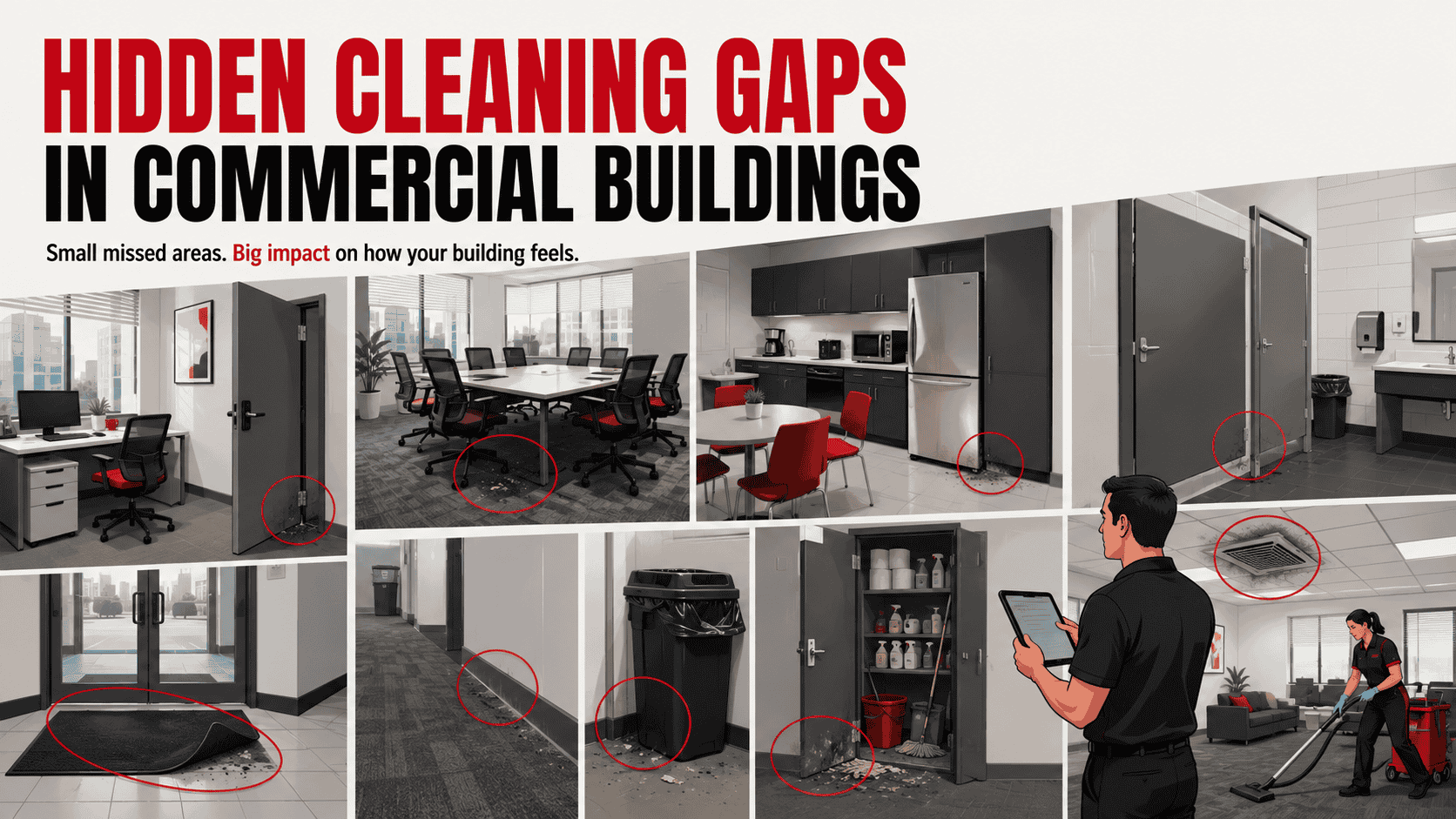
Hidden cleaning gaps are areas that are easy to miss during routine service or a quick inspection. Common examples include spaces behind doors, beneath furniture, around baseboards, beside breakroom appliances, under entry mats, across restroom partitions, around waste containers, inside supply closets, and near HVAC vents.
These areas matter because people judge a building through close, repeated contact with individual rooms and surfaces. A detailed commercial cleaning scope should identify each area, assign an appropriate cleaning frequency, and include a way to verify that the work was completed.
What Are Hidden Cleaning Gaps?
Hidden cleaning gaps are surfaces, edges, corners, fixtures, or storage areas that fall outside the most visible cleaning path.
They are not always completely hidden. In many cases, they become visible only when someone:
- Closes or opens a door
- Pulls out a chair
- Moves an entry mat
- Uses a restroom partition
- Stands near a waste container
- Looks toward a ceiling vent
- Reaches beside a breakroom appliance
- Opens a janitorial supply closet
These gaps often develop because the cleaning scope emphasizes broad tasks rather than specific locations.
For example, “vacuum conference room” may not clearly require moving chairs, reaching beneath the table, cleaning around electrical cords, or detailing the floor edges. “Empty trash” may not include wiping the container, checking for liner leaks, cleaning the floor beneath it, or removing residue from the nearby wall.
The task may technically be complete while the area still looks neglected.
A stronger commercial cleaning program separates general tasks from detail work. It also adjusts the cleaning frequency based on traffic, room use, food activity, moisture, flooring, and occupant complaints.
How Hidden Cleaning Gaps Develop
Dust, soil, crumbs, moisture, residue, and debris do not collect evenly throughout a building.
Air movement pushes fine particles toward walls, vents, furnishings, and corners. Foot traffic carries outdoor soil into entryways and corridors. Furniture blocks normal vacuum paths. Doors hide sections of flooring. Food activity creates buildup around appliances and waste stations.
Cleaning frequency also affects where problems appear.
A surface cleaned every day may remain presentable while an adjacent edge scheduled once a month develops visible buildup. High-use rooms can exceed the assumptions written into an older janitorial scope. Seasonal dust, rain, pollen, and increased traffic can also make a previously adequate schedule less effective.
Several conditions commonly create hidden gaps:
- Broad task descriptions with little detail
- Limited time assigned to each room
- Furniture or equipment blocking access
- Infrequent edge and corner work
- Weak inspection procedures
- Changes in occupancy or building use
- Unclear responsibility for special areas
- Service schedules that no longer match actual traffic
- Different expectations between occupants and service providers
The solution is not simply to add more cleaning everywhere. It is to identify where buildup occurs, determine why it is happening, and adjust the scope around real building conditions.
Nine Hidden Cleaning Gaps That Affect Commercial Buildings
1. Behind Doors
An open door can hide several square feet of flooring and wall space.
Dust, hair, paper scraps, soil, and other debris may collect within the door’s swing path. The hinge side can also develop buildup because it is difficult to reach with standard tools while the door remains in one position.
This problem is common in:
- Private offices
- Conference rooms
- Restrooms
- Supply rooms
- Breakrooms
- Storage rooms
- Interior entryways
Door surfaces also require attention. Fingerprints, smudges, marks, and residue often appear near handles, push plates, edges, and lower panels.
A complete door-area task should include:
- Repositioning the door
- Cleaning the entire floor beneath its swing
- Vacuuming or wiping along the wall edge
- Checking the hinge side
- Wiping handles and push plates
- Removing marks from the door face
- Checking the upper door frame for dust
Inspectors should view the area with the door both open and closed. Otherwise, the same section may remain hidden during every inspection.
2. Under Tables and Desks
Open sections of carpet or hard flooring usually receive regular attention. Spaces beneath desks and tables can be more difficult.
Chair legs, personal items, electrical cords, floor outlets, storage boxes, and computer equipment may limit access. In occupied offices, cleaners may also avoid moving belongings to reduce the risk of damage or disruption.
Over time, the area can collect:
- Food crumbs
- Paper scraps
- Dust
- Hair
- Soil
- Staples
- Packaging
- Small office supplies
Conference rooms are especially vulnerable. The tabletop may look polished while the carpet beneath it contains crumbs, tracked-in soil, or debris around chair positions.
The cleaning scope should explain what can be moved safely and what should remain in place. It should also distinguish between routine open-floor cleaning and scheduled detail work beneath furniture.
Useful requirements may include:
- Vacuuming reachable areas during routine service
- Moving lightweight chairs when practical
- Cleaning table and desk legs
- Detailing around cords and floor outlets
- Reporting areas blocked by personal items
- Scheduling deeper work when rooms are unoccupied
- Checking beneath conference tables during inspections
A room should not be judged only from the doorway. The view from a seated position often reveals problems that a standing walkthrough misses.
3. Around Baseboards and Floor Edges
Baseboards frame the room. When they are dusty, marked, or surrounded by dark soil lines, the entire floor can look less clean.
Standard vacuuming and mopping often focus on the middle of the floor. Equipment may stop short of the wall, leaving a narrow strip of dust and debris around the perimeter.
Carpeted areas may develop visible filtration lines or edge buildup. Hard floors can collect soil in corners, along grout lines, and where the flooring meets the wall.
Problem areas often include:
- Hallway edges
- Conference rooms
- Reception areas
- Behind office doors
- Beneath cabinets
- Around restroom walls
- Breakroom toe-kicks
- Areas behind waste containers
Baseboard work may involve more than dust removal. Scuffs, dried residue, spills, adhesive, and mop splash can require different tools or products.
A practical schedule may include:
- Routine edge vacuuming
- Weekly corner checks
- Periodic baseboard wiping
- Spot removal for visible marks
- Detail work behind movable furniture
- Inspection under cabinets and built-in counters
Baseboard buildup is often a sign that the normal cleaning path is too narrow. It may also show that periodic detail work has been delayed or left out of the scope.
4. Breakroom Corners and Appliance Edges
Breakrooms bring together food, moisture, shared appliances, waste, and frequent surface contact. As a result, small cleaning gaps can become noticeable quickly.
The countertops may be wiped every day while the areas beside or beneath appliances receive less attention.
Common problem spots include:
- Beside refrigerators
- Behind coffee machines
- Beneath microwaves
- Around vending machines
- Under cabinets
- Along cabinet toe-kicks
- Behind waste containers
- Near water dispensers
- Around table legs
- Beneath seating
Crumbs and liquid residue can move into narrow spaces during normal use. Coffee splashes may reach walls or cabinet sides. Food packaging can fall behind furniture. Leaks from waste liners can leave residue beneath the container.
Odors are often traced to these less-visible areas rather than the main countertop.
A useful breakroom cleaning plan should separate daily tasks from periodic detail work.
Daily tasks may include:
- Wiping accessible counters and tables
- Cleaning sink areas
- Removing waste
- Spot cleaning appliance exteriors
- Removing visible crumbs and spills
- Cleaning the floor around tables and counters
Periodic tasks may include:
- Moving lightweight appliances where appropriate
- Cleaning appliance sides and surrounding walls
- Detailing cabinet fronts and toe-kicks
- Cleaning beneath waste containers
- Reaching behind movable furniture
- Checking corners for food debris
- Inspecting for leaks or moisture
The service scope should also clarify who is responsible for the inside of refrigerators, microwaves, cabinets, and other employee-use appliances. Unclear responsibility is a common reason those areas remain neglected.
5. Entry Mats and the Flooring Beneath Them
Entry mats are designed to capture soil and moisture before it spreads through the building. But the mat itself must be maintained.
An overloaded mat can become a visible dirt reservoir. Worn edges, staining, trapped moisture, and loose soil can make the entrance look poorly managed.
The flooring beneath the mat may also be missed because the mat remains in place during routine cleaning.
Common concerns include:
- Soil collecting around the edges
- Debris trapped beneath the mat
- Moisture remaining under the backing
- Stains developing on the surrounding floor
- Corners curling upward
- Fine dust moving into nearby corridors
- Odors caused by damp materials
An entryway inspection should include both the visible surface and the area beneath it.
Tasks may include:
- Vacuuming the mat
- Cleaning the floor around its edges
- Lifting the mat to remove trapped debris
- Checking for moisture
- Rotating or replacing worn mats
- Scheduling periodic extraction
- Inspecting nearby glass and door tracks
- Adjusting frequency during rain or high-dust periods
Entry conditions change throughout the year. Buildings in Bakersfield, Fresno, Visalia, Valencia, Lancaster, Palmdale, and surrounding communities may experience periods of wind, dry soil, pollen, rain, and heavy outdoor dust.
A fixed schedule may not keep up with those changes. Entry cleaning should respond to current conditions rather than remain unchanged all year.
6. Restroom Partitions
Restroom inspections often focus on toilets, urinals, sinks, mirrors, supplies, and floors. Partition walls and doors may receive less attention.
Yet occupants view and touch these surfaces at close range.
Potential problem areas include:
- Partition faces
- Lower panels
- Upper edges
- Door latches
- Hinges
- Coat hooks
- Support posts
- Areas near toilets
- Splash zones
- Wall sections beside fixtures
Dust can settle along the top edges. Fingerprints and residue may appear around locks and handles. Lower panels can collect splashes, marks, and floor-care residue.
The problem is not always visible from the restroom entrance. Someone must enter each stall and look at the surfaces from the user’s point of view.
A detailed restroom cleaning program should include partitions as a named task rather than assuming they are covered under general fixture cleaning.
A partition checklist may include:
- Wiping door handles and locks
- Cleaning visible marks from panel faces
- Checking upper edges for dust
- Cleaning hinges and support hardware
- Inspecting lower sections for residue
- Checking walls around fixtures
- Removing buildup from corners
- Reporting damaged or loose hardware
Restroom complaints can quickly affect confidence in the rest of the building. Even a small missed area may cause occupants to question whether other surfaces receive enough attention.
7. Trash Areas
Removing a liner is only one part of maintaining a trash station.
The container lid, rim, sides, bottom, wall, floor, and surrounding cabinet surfaces may still contain spills or residue after the waste is removed.
This is common in:
- Breakrooms
- Restrooms
- Copy rooms
- Reception areas
- Conference rooms
- Outdoor transition areas
- Employee work areas
Waste areas can develop problems from leaking liners, food residue, liquids, overfilled containers, and items placed beside the receptacle.
A complete trash-station task should include:
- Removing the waste
- Replacing the liner correctly
- Checking for leaks
- Wiping the rim and lid
- Spot cleaning the exterior
- Cleaning the floor beneath the container
- Checking the nearby wall or cabinet
- Removing residue that may create odor
- Reporting damaged containers
The wording of the cleaning scope matters. “Empty waste containers” does not automatically mean “clean waste stations.”
These should be listed as separate tasks when the building has food waste, liquids, high traffic, or recurring odor complaints.
8. Janitorial Supply Closets
A janitorial closet may be out of public view, but its condition can affect the quality and consistency of the entire cleaning program.
A poorly maintained closet may contain:
- Damp mop heads
- Dirty cloths
- Unlabeled containers
- Product spills
- Blocked vents
- Equipment stored while wet
- Clean and used materials mixed together
- Waste stored beside supplies
- Items blocking access to the sink or drain
Equipment that is not cleaned, dried, and stored correctly may develop odors or transfer residue from one area to another.
The closet should support an orderly workflow. Clean tools and materials should be separated from used items. Products should be labeled and stored according to their instructions. Equipment should be allowed to dry.
A supply-closet review should check:
- Product labels
- Storage organization
- Dilution procedures
- Cloth and mop condition
- Drying practices
- Sink and drain condition
- Ventilation
- Floor cleanliness
- Spill control
- Equipment maintenance
- Separation of clean and used materials
The condition of the closet may also reveal whether the service schedule allows enough time for proper equipment care.
A clean building depends on clean, well-maintained tools.
9. Dust Around HVAC Vents and Returns
Dust around vents, returns, diffusers, ceiling tiles, and nearby walls is highly visible. It can make people question the building’s air quality, even when the ventilation system is operating normally.
Air movement can carry fine particles toward grilles and nearby surfaces. Over time, dark lines or dust deposits may appear around the opening.
Visible buildup may result from:
- Overdue surface cleaning
- Dirty or poorly fitted filters
- Air leaks
- Heavy outdoor dust
- Construction activity
- High indoor particle levels
- Changes in airflow
- Delayed HVAC maintenance
- Ceiling-plenum issues
Cleaning the vent exterior may improve its appearance, but repeated buildup may require further review.
A practical response should include:
- Cleaning accessible vent and return surfaces
- Wiping nearby walls or ceiling tiles when appropriate
- Reporting recurring dark lines
- Checking whether filters are due for service
- Reviewing recent construction or dust-producing work
- Coordinating with the HVAC provider when needed
Janitorial service providers and HVAC contractors have different responsibilities. The cleaning scope should clearly state which accessible surfaces are included and when a mechanical concern should be reported.
Recurring vent dust should not be treated as a cosmetic issue alone. It may be a sign that another building condition needs attention.
Environmental Factors That Make Hidden Gaps Worse
Hidden cleaning gaps are influenced by the building itself. The same schedule may produce very different results in two facilities.
Foot Traffic
More people bring more soil, paper debris, food residue, and moisture into the building. Entrances, corridors, restrooms, and shared rooms may require greater frequency during busy periods.
Room Use
A conference room used twice a week will have different needs than one used throughout the day. A breakroom serving 100 people will develop buildup faster than a small staff kitchen.
Flooring Type
Carpet traps particles below the visible surface and along edges. Hard flooring may show dust, streaks, scuffs, and corner buildup more clearly.
Furniture Layout
Closely spaced desks, fixed cabinets, large conference tables, cords, and storage boxes can block access. The cleaning scope should account for those limits.
Airflow
Supply vents, returns, open doors, fans, and pressure differences affect where dust settles. Some wall edges and ceiling areas may collect particles faster than others.
Outdoor Conditions
Wind, dust, pollen, rain, landscaping, nearby construction, and parking-lot conditions all affect entryways and floors.
Food and Beverage Activity
Rooms with food, coffee, refrigerators, vending machines, or catered meetings need closer attention around appliances, tables, cabinets, and waste stations.
Moisture
Restrooms, sinks, water dispensers, entry mats, and breakroom appliances can create damp areas. Moisture may contribute to odors, staining, and residue.
Cleaning Frequency
A task completed monthly may not be frequent enough for a busy area. Cleaning schedules should be reviewed whenever use, occupancy, or complaint patterns change.
Why Hidden Gaps Matter in the Workplace
People rarely evaluate every surface in a building. They rely on visible clues.
A dust line along a wall suggests that edge work is being skipped. Crumbs beneath a table suggest that the room is receiving only a quick pass. Residue around a waste container suggests that removing the liner is the only task being completed.
These clues shape how occupants view the entire facility.
Hidden gaps may contribute to:
- Employee complaints
- Tenant dissatisfaction
- Odor concerns
- Poor first impressions
- Questions about service consistency
- Friction between building management and service providers
- Repeat work orders
- Reduced confidence in restrooms and breakrooms
- Uncertainty about the cleaning scope
The issue is not always that the building needs more total service hours. The current hours may be focused on the wrong areas.
A detailed inspection can show whether the solution is:
- Increasing frequency in a specific room
- Adding periodic detail work
- Rewriting vague task descriptions
- Improving access beneath furniture
- Assigning responsibility for appliance interiors
- Adjusting entry care for seasonal conditions
- Adding verification steps
- Coordinating with maintenance or HVAC providers
Small changes to the scope can sometimes solve complaints more effectively than a broad increase in service.
How to Inspect a Building for Hidden Cleaning Problems
A useful inspection should go beyond the main walking path.
Start at Eye Level
Review the surfaces most people see first:
- Glass
- Counters
- Fixtures
- Open floors
- Furniture
- Doors
- Waste containers
- Restroom supplies
This provides a general view of presentation and routine service.
Check Edges and Obstructions
Then inspect the places blocked by doors, furniture, equipment, and mats:
- Behind doors
- Beneath tables
- Around desk legs
- Along baseboards
- Under entry mats
- Beside appliances
- Behind waste containers
- Beneath cabinets
Use a flashlight where needed. View rooms from both standing and seated positions.
Inspect Source Areas
Some areas create or collect more debris than others:
- Breakroom food zones
- Waste stations
- Restroom partitions
- Entryways
- Supply closets
- Vent grilles
- Water dispensers
- Copy and production areas
Look for patterns, not just isolated marks.
Compare the Scope With Actual Conditions
Review the written task list and ask:
- Is this area named in the scope?
- How often is it scheduled?
- Is the task description specific?
- Can the area be accessed safely?
- Who is responsible for moving items?
- Is periodic detail work documented?
- How is completion verified?
- Has building use changed since the scope was written?
A daily, weekly, and monthly janitorial checklist can help organize responsibilities, but the checklist should still be customized to the facility.
Track Repeat Complaints
Repeated complaints are useful data.
Record:
- The exact room or location
- The time and date
- The reported condition
- Whether the issue returned
- The service frequency
- Any access limitations
- Photos when appropriate
- Corrective action taken
Patterns can reveal whether the problem is related to frequency, access, unclear expectations, equipment, training, or another building condition.
Signs Your Current Cleaning Scope May Have Gaps
A cleaning scope may need to be reviewed when:
- The same complaint returns after being addressed
- Open floors look clean but edges remain dusty
- Odors return soon after service
- Waste containers are empty but surrounding areas are soiled
- Breakroom counters are clean while appliance edges are neglected
- Restroom fixtures look acceptable but partitions have visible buildup
- Entry mats remain stained or damp
- Dust repeatedly collects around vents
- Furniture must be moved before every inspection
- Employees report problems that management does not see during walkthroughs
- The cleaning checklist uses broad terms without identifying surfaces
- Seasonal traffic causes a noticeable drop in appearance
These signs do not automatically mean the entire cleaning program has failed. They usually indicate that parts of the scope no longer match the building’s needs.
Building a Better Commercial Cleaning Scope
A better scope defines the outcome, the area, and the frequency.
Instead of writing:
- Clean breakroom
- Vacuum offices
- Empty trash
- Clean restrooms
Use more specific language:
- Remove visible crumbs from beneath breakroom tables
- Vacuum accessible floor areas beneath desks and conference tables
- Inspect and clean the floor beneath waste containers
- Wipe restroom partition handles, latches, and visible marks
- Clean accessible vent grilles and report recurring buildup
- Lift entry mats according to schedule and clean the flooring beneath them
- Detail baseboards and floor edges at the stated frequency
The scope should also separate routine and periodic work.
Routine Work
Routine tasks address conditions that develop quickly:
- Waste removal
- Open-floor cleaning
- Spill removal
- Restroom servicing
- Counter and table wiping
- Supply restocking
- Visible crumb and debris removal
Periodic Detail Work
Periodic tasks address slower buildup and less-accessible areas:
- Baseboard cleaning
- Edge vacuuming
- Partition detailing
- Cleaning beneath mats
- Appliance-side cleaning
- High dusting
- Vent-grille cleaning
- Furniture-leg detailing
- Supply-closet review
Condition-Based Work
Some tasks should respond to changing conditions:
- Additional entry cleaning during rain
- Greater dust removal during windy periods
- Increased breakroom attention during events
- More frequent restroom checks during high occupancy
- Post-construction detailing
- Carpet care after heavy soil exposure
Clear wording makes it easier to inspect the work, discuss concerns, and make fair adjustments.
Commercial Cleaning Support Across the Southern Valley
Vanguard Cleaning Systems of the Southern Valley helps connect businesses with independently owned and operated Vanguard janitorial franchise businesses for commercial cleaning programs based on the facility’s needs.
Businesses can learn more about local janitorial options in:
A facility assessment can help identify areas that may not be obvious during a quick walkthrough, including blocked floor edges, neglected detail zones, high-use rooms, and tasks that are missing from the current scope.
People Also Ask
What are the most commonly missed areas during commercial cleaning?
Commonly missed areas include spaces behind doors, beneath furniture, around baseboards, beside appliances, under entry mats, across restroom partitions, around waste containers, inside supply closets, and near air vents.
Why does an office still look dirty after it has been cleaned?
The main surfaces may have been cleaned while edges, corners, blocked spaces, and detail areas were missed. The cleaning frequency may also be too low for the room’s traffic and use.
How can a business identify janitorial service problems?
Inspect rooms from different angles, check beneath and behind objects, compare conditions with the written scope, document repeat complaints, and review whether each problem area has an assigned cleaning frequency.
How often should hidden areas be cleaned?
The correct frequency depends on traffic, room use, food activity, moisture, flooring, access, and seasonal conditions. Some areas need daily attention, while others may be handled weekly, monthly, or as conditions require.
Should cleaners move office furniture?
The service agreement should explain which items may be moved safely. Lightweight chairs and small objects may be repositioned, while desks, electronics, personal belongings, and heavy equipment may require special arrangements.
Why do baseboards get dirty so quickly?
Baseboards sit outside the normal path of many vacuums and floor tools. Air movement and foot traffic also push dust and soil toward walls and corners.
What causes recurring odors around commercial trash containers?
Common causes include leaking liners, food residue, spills beneath the container, dirty lids or rims, residue on nearby walls, and waste that remains too long between service visits.
Is dust around an HVAC vent a cleaning problem?
It may be a surface-cleaning issue, but recurring buildup can also be related to filters, airflow, leaks, outdoor dust, construction, or mechanical maintenance. Repeated buildup should be reported for further review.
Frequently Asked Questions
What is a hidden cleaning gap?
It is an overlooked surface or area that falls outside the normal cleaning path, such as the floor behind a door or the space beneath an entry mat.
Are hidden cleaning gaps always a health concern?
No. Many are primarily appearance and maintenance concerns. Some may also collect dust, moisture, residue, or biological material, depending on the location and building conditions.
Can a cleaning checklist prevent missed areas?
A detailed checklist can help, especially when it names exact surfaces and frequencies. Broad instructions such as “clean office” may still leave too much room for interpretation.
Who should inspect commercial cleaning work?
The inspection may be completed by a facility manager, property manager, designated employee, service representative, or janitorial business owner, depending on the service arrangement.
What should be included in a restroom inspection?
Check fixtures, sinks, mirrors, floors, supplies, waste containers, partitions, locks, hinges, walls, corners, doors, and touchpoints.
What should be included in a breakroom inspection?
Check tables, counters, sinks, appliance exteriors, cabinet fronts, floors, corners, waste stations, appliance edges, and areas beneath furniture.
How can recurring cleaning complaints be reduced?
Document the exact location, review the written scope, adjust the task or frequency, remove access barriers, assign responsibility, and verify the corrective work.
When should a business request a new cleaning assessment?
Consider an assessment when complaints repeat, occupancy changes, a new tenant moves in, the building is remodeled, seasonal conditions increase soil, or the existing scope no longer reflects how the facility is used.
Small Missed Areas Can Shape the Whole Building
A commercial building does not need to look obviously dirty to feel poorly maintained.
Dust behind a door, debris beneath a table, residue around a waste container, or buildup along a restroom partition may seem minor. But these are the details people encounter throughout the day.
A good commercial cleaning scope accounts for those close-range experiences. It identifies hidden areas, assigns realistic frequencies, and creates a clear way to verify results.
Businesses reviewing recurring cleaning complaints can contact Vanguard Cleaning Systems of the Southern Valley or request a quote to discuss their facility and service needs.
Each Vanguard Cleaning Systems® business is independently owned and operated.
© 2026 Prestige Worldwide, Inc. dba Vanguard Cleaning Systems of the Southern Valley.
References
Abney, S. E., Higham, C. A., Wilson, A., Ijaz, M. K., McKinney, J., Reynolds, K. A., & Gerba, C. P. (2024). Transmission of viruses from restroom use: A quantitative microbial risk assessment. Food and Environmental Virology, 16, 65–78. https://doi.org/10.1007/s12560-023-09580-1
Appiah, P. O., Odoom, A., Tetteh-Quarcoo, P., Kotey, F. C. N., & Donkor, E. (2025). Microbial contamination of door handles: A global systematic review and meta-analysis of public and healthcare settings. Environmental Health Insights, 19. https://doi.org/10.1177/11786302251328550
Batterman, S., Godwin, C., Chernyak, S., Jia, C., & Charles, S. (2010). Brominated flame retardants in offices in Michigan, U.S.A. Environment International, 36, 548–556. https://doi.org/10.1016/j.envint.2010.04.008
Corsi, R., Siegel, J., & Chiang, C.-C. (2008). Particle resuspension during the use of vacuum cleaners on residential carpet. Journal of Occupational and Environmental Hygiene, 5, 232–238. https://doi.org/10.1080/15459620801901165
Dingsdag, S. A., & Coleman, N. V. (2012). Bacterial communities on food court tables and cleaning equipment in a shopping mall. Epidemiology and Infection, 141, 1647–1651. https://doi.org/10.1017/S0950268812002142
Franke, D., Cole, E., Leese, K., Foarde, K., & Berry, M. (1997). Cleaning for improved indoor air quality: An initial assessment of effectiveness. Indoor Air, 7, 41–54. https://doi.org/10.1111/j.1600-0668.1997.t01-3-00006.x
Guo, J., Xiong, Y., Kang, T., Xiang, Z., & Qin, C. (2020). Bacterial community analysis of floor dust and HEPA filters in air purifiers used in office rooms in ILAS, Beijing. Scientific Reports, 10. https://doi.org/10.1038/s41598-020-63543-1
Gupta, M., Lee, S., Bisesi, M., & Lee, J. (2019). Indoor microbiome and antibiotic resistance on floor surfaces: An exploratory study in three different building types. International Journal of Environmental Research and Public Health, 16(21), Article 4160. https://doi.org/10.3390/ijerph16214160
Hospodsky, D., Qian, J., Nazaroff, W., Yamamoto, N., Bibby, K., Rismani-Yazdi, H., & Peccia, J. (2012). Human occupancy as a source of indoor airborne bacteria. PLOS ONE, 7. https://doi.org/10.1371/journal.pone.0034867
Layton, D., & Beamer, P. (2009). Migration of contaminated soil and airborne particulates to indoor dust. Environmental Science & Technology, 43, 8199–8205. https://doi.org/10.1021/es9003735
Lukcso, D., Guidotti, T., Franklin, D. E., & Burt, A. (2016). Indoor environmental and air quality characteristics, building-related health symptoms, and worker productivity in a federal government building complex. Archives of Environmental & Occupational Health, 71, 85–101. https://doi.org/10.1080/19338244.2014.965246
Mohammed, M. O. A. (2023). Surface microbial contamination and air quality before and after regular cleaning procedures. Atmosphere, 14(2), Article 352. https://doi.org/10.3390/atmos14020352
Mølhave, L. (2008). Inflammatory and allergic responses to airborne office dust in five human provocation experiments. Indoor Air, 18(4), 261–270. https://doi.org/10.1111/j.1600-0668.2008.00532.x
Morrison, G., Carslaw, N., & Waring, M. (2017). A modeling enterprise for chemistry of indoor environments. Indoor Air, 27(6), 1033–1038. https://doi.org/10.1111/ina.12407
Reynolds, K., Watt, P., Boone, S., & Gerba, C. (2005). Occurrence of bacteria and biochemical markers on public surfaces. International Journal of Environmental Health Research, 15, 225–234. https://doi.org/10.1080/09603120500115298
Waring, M. S., & Siegel, J. A. (2008). Particle loading rates for HVAC filters, heat exchangers, and ducts. Indoor Air, 18(3), 209–224. https://doi.org/10.1111/j.1600-0668.2008.00518.x
Zhang, F., Seshadri, K., Pattupogula, V. P. D., Badrinath, C., & Liu, S. (2023). Visitors’ satisfaction towards indoor environmental quality in Australian hotels and serviced apartments. Building and Environment, Article 110819. https://doi.org/10.1016/j.buildenv.2023.110819
