
The right office cleaning schedule becomes clearer when you track how quickly problems return between service visits.
Your Office Should Set the Schedule
Two Valencia offices can have the same square footage and need very different cleaning schedules.
One may have twenty employees working in private offices with few visitors. Another may have twenty employees sharing workstations, meeting with customers throughout the day, using one busy breakroom, and relying on two heavily used restrooms. Those buildings create different workloads even though their employee counts look similar on paper.
The condition of the building between service visits matters just as much as its size. Waste containers fill at different rates. Entryways collect soil as people come and go. Restrooms use supplies throughout the day. Breakrooms change quickly when employees prepare food and coffee. Carpeted corridors may show traffic patterns long before lightly used private offices need attention.
Businesses evaluating commercial cleaning services in Valencia can get a better starting point by looking at individual rooms and how those spaces are used.
A cleaning schedule should respond to those conditions.
Quick Answer
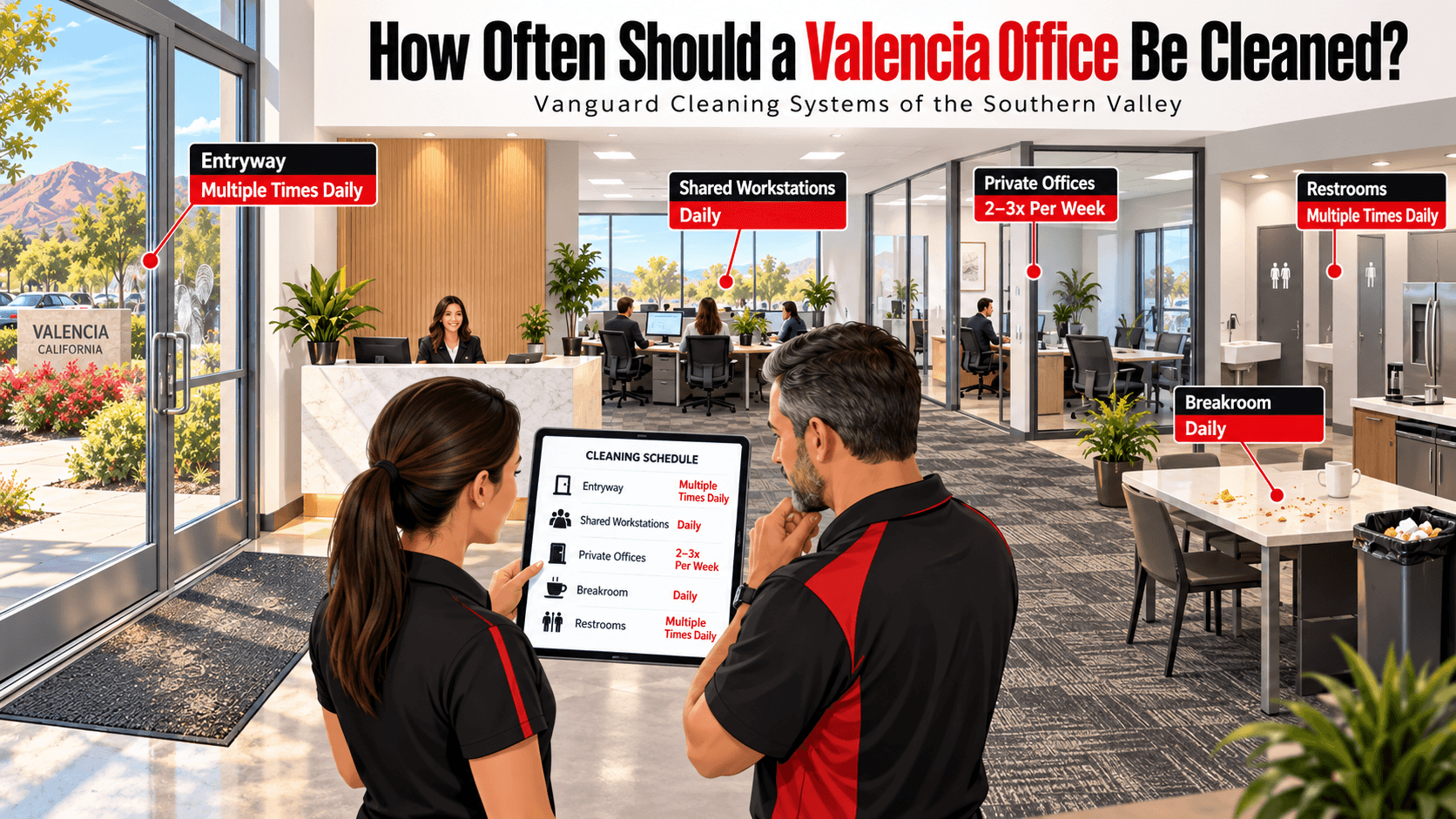
A Valencia office may need cleaning anywhere from a few times per week to five or more service periods per week, depending on occupancy, visitor traffic, restroom demand, food use, flooring, waste volume, entry conditions, and shared-space activity.
The entire office does not always need every task completed at the same frequency.
Busy restrooms, entrances, breakrooms, conference rooms, and waste stations often change faster than private offices or low-traffic spaces. A useful schedule assigns frequencies by area and task, then adjusts them when recurring problems show that the original plan is no longer keeping pace.
What Is Office Cleaning Frequency?
Office cleaning frequency is the schedule that determines how often specific cleaning tasks are performed in each part of a workplace.
It is more detailed than saying an office receives service three nights per week or five nights per week.
A complete frequency plan might specify that:
- Waste is removed during each scheduled visit.
- Restrooms receive routine attention every business day.
- Entry glass is checked more often than interior glass.
- Carpet receives routine vacuuming based on traffic.
- Hard flooring receives spot attention as conditions develop.
- Breakroom counters and floors receive frequent attention.
- Private offices receive certain tasks less often than shared rooms.
- Baseboards, edges, vents, and other detail areas follow a separate periodic schedule.
This approach matters because soil and use are rarely distributed evenly.
People concentrate activity around entrances, corridors, shared rooms, restrooms, meeting areas, printers, coffee stations, and waste containers. A large private office that is occupied by one person may change slowly. A small conference room used by several groups each day can look different within hours.
The written scope should account for those differences.
How Office Cleaning Frequency Works
A practical cleaning schedule starts with how the building is used, then assigns service based on how quickly each area changes.
That process can begin with a walkthrough.
Look at each room and ask a few simple questions:
- How many people use this space?
- How many times is it used during a normal day?
- Is food or drink commonly present?
- Is there a waste container?
- Does the area have carpet or hard flooring?
- Do visitors use the room?
- Are supplies consumed here?
- Does outdoor soil reach this area?
- Are there recurring complaints?
- How does the space look shortly before the next service visit?
Those observations give more useful information than square footage alone.
The written scope can then separate frequent work from weekly and periodic tasks.
For example, a busy breakroom may need frequent surface, floor, sink, and waste attention. Cabinet fronts, furniture legs, wall marks, appliance edges, and other detail work can follow a different schedule.
That distinction helps keep routine work focused while still giving slower-developing conditions a place in the scope.
Businesses reviewing routine janitorial services should look closely at both parts of the schedule. Routine tasks and periodic detail work need clear frequencies.
Employee Occupancy Changes the Workload
Daily occupancy is one of the strongest clues when reviewing office cleaning frequency.
More people generally create more activity across the building.
Employees walk through entrances and corridors, use restrooms, prepare food and drinks, throw away waste, occupy meeting rooms, touch shared surfaces, and move between workspaces. As occupancy increases, the time between noticeable changes can shrink.
Headcount alone does not tell the whole story.
Consider an office with forty employees spread across private rooms and another with forty employees working in an open office. The open office may have more concentrated movement around shared equipment, meeting spaces, printers, waste stations, and corridors.
Hybrid work can change the pattern again.
An office may be quiet on Monday and Friday but heavily occupied Tuesday through Thursday. In that situation, a fixed schedule that treats every weekday the same may place service at the wrong times.
Track actual attendance instead.
A useful review can include:
- Average daily occupancy
- Highest-occupancy weekdays
- Shift changes
- Extended operating hours
- Hybrid-work patterns
- Seasonal staffing
- Training days
- Large meetings
- Company events
When occupancy changes for more than a short period, the cleaning schedule deserves another look.
Visitor Traffic Can Create a Separate Frequency Need
Visitor traffic affects some areas far more than others.
Reception areas, entrances, conference rooms, customer-facing restrooms, and main corridors may experience repeated use even when employee occupancy stays stable.
A professional office that hosts appointments throughout the day can develop fingerprints on entrance glass, tracked material near the doorway, fuller waste containers, disturbed furniture, and more frequent restroom use.
The visitor count is useful. The route visitors take through the building is even more useful.
Follow that route during an inspection.
Check:
- Exterior-to-interior transitions
- Entrance mats
- Glass doors
- Reception flooring
- Lobby seating
- Main corridors
- Meeting rooms
- Visitor restrooms
- Waste containers
If those areas decline well before the rest of the office, the schedule may need a targeted adjustment rather than a broad increase everywhere.
Restroom Demand Often Sets the Pace
Restrooms can become one of the fastest-changing areas in an office.
Their workload depends on the number of users, number of fixtures, operating hours, visitor access, supply capacity, and how frequently the rooms are checked.
A restroom that serves eight employees has a different workload from one serving fifty employees plus customers.
Pay attention to conditions during the workday instead of inspecting only after service.
Signs that the current frequency may be falling behind include:
- Waste filling before the day ends
- Paper supplies running low
- Soap requiring frequent replacement
- Water spots and residue returning quickly
- Floor conditions declining before the next service
- Repeated complaints during the same part of the day
- High use after meetings or shift changes
When these patterns repeat, increasing attention to the restroom may make more sense than changing the schedule for every office.
A more detailed commercial restroom care plan can separate routine cleaning, supply checks, floor work, waste removal, and periodic detail tasks.
For offices with heavy daytime restroom use, the schedule may also need a check during occupied hours in addition to regularly scheduled service.
Breakroom Use Can Change Quickly
Breakrooms concentrate several types of activity in a small space.
Food, coffee, water, employee traffic, appliances, tables, sinks, cabinets, and waste all meet in one room.
A lightly used breakroom may remain in acceptable condition through a normal workday. A busy one can change noticeably after breakfast, lunch, or an afternoon rush.
Frequency should follow that activity.
Look for patterns around:
- Coffee stations
- Sinks
- Counters
- Tables
- Refrigerator handles
- Microwave exteriors
- Floors near food preparation areas
- Waste and recycling containers
- Vending areas
- Water dispensers
Timing matters here.
Suppose the breakroom receives service every evening but becomes heavily soiled after lunch each day. The problem may continue even though the nightly task is being completed exactly as written.
A daytime check or a different service time may address the condition more directly.
Periodic work is also important. Crumbs, dust, marks, and residue can build beside appliances, beneath movable furniture, around cabinet toe-kicks, and near waste stations even when visible counters receive regular attention.
Those are examples of hidden cleaning gaps that should have their own place in the scope.
Flooring Should Have More Than One Frequency
“Clean the floors” is too broad for most office schedules.
Carpet, resilient flooring, tile, mats, and other floor surfaces respond differently to foot traffic and soil. Their location matters too.
Entrance flooring can receive more outdoor material than a private office only a short distance away. Main corridors may show repeated traffic patterns. Conference rooms may collect crumbs and chair marks. Restroom flooring deals with a different set of conditions from general office areas.
Routine floor work can include:
- Vacuuming
- Spot cleaning
- Mopping
- Debris removal
- Mat care
- Edge work
Periodic floor work follows another schedule based on the material, manufacturer guidance, condition, and level of use.
Carpet can also hold and release settled particles as people move across it. Research in occupied office spaces has found higher particle resuspension in occupied and carpeted rooms than in unoccupied or uncarpeted spaces. That reinforces the value of considering occupancy and flooring together rather than setting floor frequency from square footage alone.
A floor plan can make this easier.
Mark the busiest walking routes from:
- Entrances
- Reception
- Restrooms
- Breakrooms
- Elevators
- Conference rooms
- Shared equipment
- Building exits
Then compare those routes with visible soil and recurring floor complaints.
The busiest paths may need more frequent routine attention while other areas stay on a lighter schedule.
Waste Volume Provides an Easy Measurement
Waste is one of the simplest conditions to track.
Check containers before scheduled service.
Are they nearly empty, half full, approaching capacity, or already full?
Do the same thing for several days.
Patterns usually appear quickly.
Some offices produce little waste at individual desks but fill shared containers near kitchens, printers, conference rooms, or reception areas. Others produce more packaging, paper, food waste, or shipping material.
Location matters as much as total volume.
A waste schedule might include:
- Frequent service for food-related waste
- Routine service for shared office containers
- Less frequent attention for lightly used individual containers
- Separate handling for recycling
- Periodic cleaning around and beneath receptacles
Recurring overflow is a clear sign that frequency, container capacity, placement, or the written scope needs review.
And when the container itself is emptied but residue keeps appearing on the wall or floor around it, the issue may be task detail rather than visit frequency.
Entryway Soil Changes With Traffic and Outdoor Conditions
An office entrance connects outdoor conditions directly to indoor floors.
Shoes can carry dust, soil, moisture, and small debris inside. The amount changes with foot traffic, landscaping, parking surfaces, weather, nearby construction, and the layout of the entrance.
Valencia commonly experiences long dry periods, so visible dust and dry outdoor soil can become practical entryway concerns. Wind and changing weather can alter conditions quickly.
Entrance mats help intercept material, but they also become part of the cleaning plan.
Inspect:
- Exterior approaches
- Door thresholds
- Entry mats
- Flooring around mats
- Glass doors
- Corners
- Reception flooring
- The first interior corridor
If visible soil spreads well beyond the entrance between scheduled visits, adjusting entry care may be more useful than changing the entire office schedule.
The frequency can also change temporarily when outside conditions change.
A building does not have to use the exact same entry schedule every month of the year.
Shared Rooms Need Their Own Schedule
Conference rooms, training rooms, huddle spaces, copy areas, and shared workstations can be easy to underestimate.
Their square footage may be small, but many people can use them during a single day.
A conference room may be occupied by six groups before a private office has hosted one visitor.
Use booking activity as a clue.
A conference room used once or twice each week may require a different schedule from one booked throughout the day. Training rooms may be quiet most weeks and heavily used during onboarding or meetings. Shared desks can also create more concentrated activity than assigned offices.
Inspect these rooms after periods of heavy use.
Look at:
- Tables
- Chair areas
- Floors
- Waste
- Whiteboards and ledges
- Door glass
- Handles
- Food and drink residue
- Corners and floor edges
Scheduling these rooms by actual use keeps attention closer to where the work is being created.
Environmental Factors Affect Office Cleaning Frequency
Cleaning frequency does not exist independently of the building.
Several conditions can change how quickly visible soil, dust, debris, and residue return.
Outdoor Dust
Outdoor particles can enter on shoes, through door openings, and through normal air movement. Research on indoor dust shows that indoor particles come from a mix of indoor and outdoor sources and can settle and return to the air as a building is occupied.
For routine planning, the practical question is simple: where does dust become noticeable first?
Those areas may need a different frequency.
Wind
Wind can increase the amount of dry material reaching walkways, doorways, mats, and entrance flooring.
Check entrance conditions after windy periods and compare them with calmer days.
Rain
Rain changes the entryway problem.
Moisture and tracked material may require more frequent attention to mats and hard flooring.
The frequency change can be temporary. It still belongs in the plan.
Landscaping
Bare soil, planted areas, mulch, parking lots, and pedestrian paths can influence what reaches the building entrance.
The goal is to observe the result inside the building and plan around it.
Building Layout
Long corridors, multiple entrances, centrally located restrooms, shared kitchens, and concentrated work areas can all change where the greatest cleaning workload occurs.
A walkthrough during normal operating hours often reveals those patterns better than an empty-building inspection.
Workplace Conditions Should Drive the Schedule
Office cleaning frequency works best when it is treated as an adjustable operating decision.
A schedule written two years ago may no longer match the building today.
Employee counts change. Departments move. Hybrid schedules develop. Offices add shared workstations. Meeting activity increases. A new tenant may begin using part of the building. Furniture layouts change. More customers may visit the office.
The service scope can fall behind even when every listed task continues to be completed.
That is why recurring conditions are useful.
The existing guide to common office cleaning problems in Valencia identifies issues such as restroom concerns, breakroom residue, entryway conditions, waste, floor appearance, missed corners, and inconsistent detail.
Those same problems can help evaluate frequency.
Document:
- The exact location
- The condition observed
- The day
- The approximate time
- How often it occurs
- Whether the task appears in the current scope
Do this for a week or two.
The pattern may show that a specific area needs more frequent service. It may reveal that periodic detail work is missing. In other cases, the task may simply need clearer wording.
More Frequent Service Is Only One Possible Adjustment
A recurring problem does not automatically mean the entire office needs another full service visit.
Start with the smallest useful change.
For example:
Restroom waste fills by 2 p.m. every day.
Consider adding a daytime waste and supply check for that restroom.
Entrance flooring looks poor after windy afternoons.
Adjust entry care during those conditions.
Breakroom floors decline after lunch.
Review timing around the lunch period.
Dust keeps collecting along floor edges.
Add or increase scheduled edge work.
A conference room looks poor after heavily booked days.
Tie attention to the room’s use.
Carpet looks acceptable most of the week but traffic lanes decline quickly.
Increase routine attention on those paths and review periodic carpet care.
These changes make the schedule more precise.
Build a Frequency Map by Area
A simple frequency map can turn observations into a working schedule.
Create a list of the main spaces in the building.
For each one, record:
- Typical daily users
- Peak-use period
- Floor type
- Food or beverage activity
- Waste volume
- Visitor use
- Current cleaning frequency
- Recurring problems
- Periodic tasks
- Whether current frequency is keeping pace
The completed map may show that different parts of the office fall into different frequency groups.
High-Activity Areas
These may include:
- Restrooms
- Main entrances
- Busy breakrooms
- Reception areas
- Heavily used conference rooms
- Main corridors
- Shared work areas
Moderate-Activity Areas
These might include:
- General office areas
- Secondary hallways
- Copy rooms
- Less-used meeting rooms
- Shared storage spaces
Lower-Activity Areas
Examples can include:
- Lightly occupied private offices
- Limited-access rooms
- Low-use storage areas
- Spaces that remain unused on hybrid-work days
The categories are only planning tools.
Actual conditions should determine the final schedule.
How Often Should a Low-Traffic Valencia Office Be Cleaned?
Some low-occupancy offices may be able to maintain acceptable conditions with service a few times per week.
That can be a reasonable starting point when the office has:
- Limited visitor traffic
- Low daily occupancy
- Light restroom demand
- Minimal food use
- Low waste volume
- Mostly private workspaces
- Standard business hours
Individual areas may still need greater frequency.
For example, restroom and food-related waste requirements can move faster than dusting needs in private offices.
Inspect conditions before the next visit. If the building consistently remains within expectations, the schedule may be working.
When Does Five-Day Service Make Sense?
More frequent service becomes easier to justify as daily building use increases.
Five-day service may fit offices with:
- Consistent weekday occupancy
- Regular customer or visitor traffic
- Busy shared restrooms
- Heavily used breakrooms
- Significant daily waste
- Active reception areas
- High floor traffic
- Frequent conference-room use
Even then, every task does not need to be performed every night.
The scope can still assign different frequencies to detail work, low-use spaces, and periodic floor care.
Can Parts of an Office Be Cleaned at Different Frequencies?
Yes.
In many offices, that is the most practical approach.
A restroom may require frequent attention while a private office needs less. The lobby may need regular glass and floor attention while an interior storage room changes slowly. A breakroom may require routine surface and waste work while cabinet-detail tasks follow a periodic schedule.
Assigning frequency by area keeps the scope connected to actual use.
People Also Ask
How often should a typical office be professionally cleaned?
The answer depends on occupancy, traffic, restrooms, food use, waste, flooring, and operating hours. Lower-use offices may require service several times per week, while busy offices may need weekday service or additional attention to high-use areas.
Should office restrooms be cleaned every day?
Busy shared restrooms often need daily attention, and some require additional checks during the workday. The number of users, fixtures, operating hours, supply use, and recurring conditions should guide the schedule.
How often should office carpets be vacuumed?
Traffic should guide vacuuming frequency. Entrances, corridors, reception areas, and busy shared spaces often require more frequent attention than low-use private offices.
Does a hybrid office need less cleaning?
It may need less frequent service in some areas when occupancy drops, but attendance patterns should be reviewed first. Shared rooms, restrooms, breakrooms, and occupied zones may still need regular attention on high-attendance days.
How do you know if an office needs more frequent cleaning?
Track recurring conditions. Note the location, day, time, and frequency of issues such as full waste containers, restroom concerns, breakroom residue, floor soil, fingerprints, or visible dust. Repeated patterns can show where the current schedule is falling behind.
Should every office area have the same cleaning frequency?
No. Areas change at different rates. Restrooms, entrances, breakrooms, conference rooms, shared spaces, and main corridors often require different schedules from private offices and limited-use rooms.
Frequently Asked Questions
Is square footage enough to determine cleaning frequency?
No. Square footage is useful for estimating the size of the workload, but occupancy, traffic, floor type, room use, restrooms, waste, and operating hours help determine how quickly the building changes.
Should cleaning frequency change during busy periods?
It can. Higher occupancy, company events, training, seasonal activity, construction, weather, or visitor traffic may temporarily increase the workload in specific parts of the building.
How often should office breakrooms receive cleaning?
Frequency depends on use. A busy shared breakroom may need routine attention during each scheduled service and may also benefit from a daytime check when food and waste activity is high.
What should be checked between cleaning visits?
Look at restrooms, entrances, waste containers, breakrooms, shared rooms, floors, glass, and recurring complaint areas. Inspect them shortly before the next scheduled service to see whether the existing frequency is keeping pace.
Can recurring cleaning problems be caused by the scope instead of frequency?
Yes. A task may be missing, vaguely written, assigned to the wrong interval, or focused on the wrong area. Review both the task description and its frequency.
How often should an office cleaning schedule be reviewed?
Review it whenever occupancy, room use, operating hours, visitor traffic, or complaint patterns change. A periodic walkthrough can also catch gradual changes that might otherwise go unnoticed.
Let Recurring Problems Tell You When the Schedule Needs Attention
The most useful cleaning schedule is based on what happens inside the office between service visits.
Track the areas where conditions return first. Pay attention to occupancy, visitors, restroom use, breakroom activity, floors, waste, entrances, and shared rooms. Then compare those observations with the written scope.
A pattern of recurring problems provides practical evidence that the frequency, timing, task detail, or periodic work may need adjustment.
Vanguard Cleaning Systems of the Southern Valley can help businesses connect with independently owned Vanguard Cleaning Systems janitorial franchise businesses serving Valencia. Businesses that want to compare their current schedule with actual building conditions can review your cleaning schedule and discuss the facility’s needs.
Each Vanguard Cleaning Systems business is independently owned and operated.
References
Allermann, L., Pejtersen, J., Gunnarsen, L., & Poulsen, O. M. (2007). Building-related symptoms and inflammatory potency of dust from office buildings. Indoor Air, 17(6), 458–467. https://doi.org/10.1111/j.1600-0668.2007.00493.x
Chao, C. Y. H., Tung, T. C. W., & Burnett, J. (1999). A methodology to investigate the particulate penetration coefficient through building shell. Atmospheric Environment, 33(6), 881–893. https://doi.org/10.1016/S1352-2310(98)00299-4
Hartmann, E. M., Dannemiller, K. C., Farmer, D. K., O’Brien, R. E., Berberich, J., Ditto, J. C., Farinas, O. R., Gall, E. T., Ganguly, A., Grassian, V. H., Greene, R., Hegarty, B., Ilacqua, V. A., Isaacman-VanWertz, G., Li, J., Loukou, E., Marr, L. C., Nastasi, N., Prussin, A. J., Stephens, B., Tillema, S. J., Turpin, B. J., Vance, M. E., Verma, V., & Waring, M. S. (2026). Ten questions concerning indoor dust. Building and Environment, 288, 113988. https://doi.org/10.1016/j.buildenv.2025.113988
Pejtersen, J., Allermann, L., Kristensen, T. S., & Poulsen, O. M. (2006). Indoor climate, psychosocial work environment and symptoms in open-plan offices. Indoor Air, 16(5), 392–401.
Saarinen, P., Kalliokoski, P., & Tang, J. W. (2015). Characterization, fate, and re-suspension of aerosol particles (0.3–10 μm): The effects of occupancy and carpet use. Aerosol and Air Quality Research, 15, 2710–2721. https://doi.org/10.4209/aaqr.2015.01.0039
