
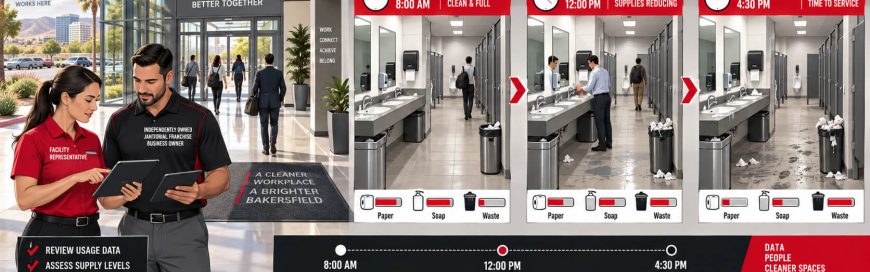
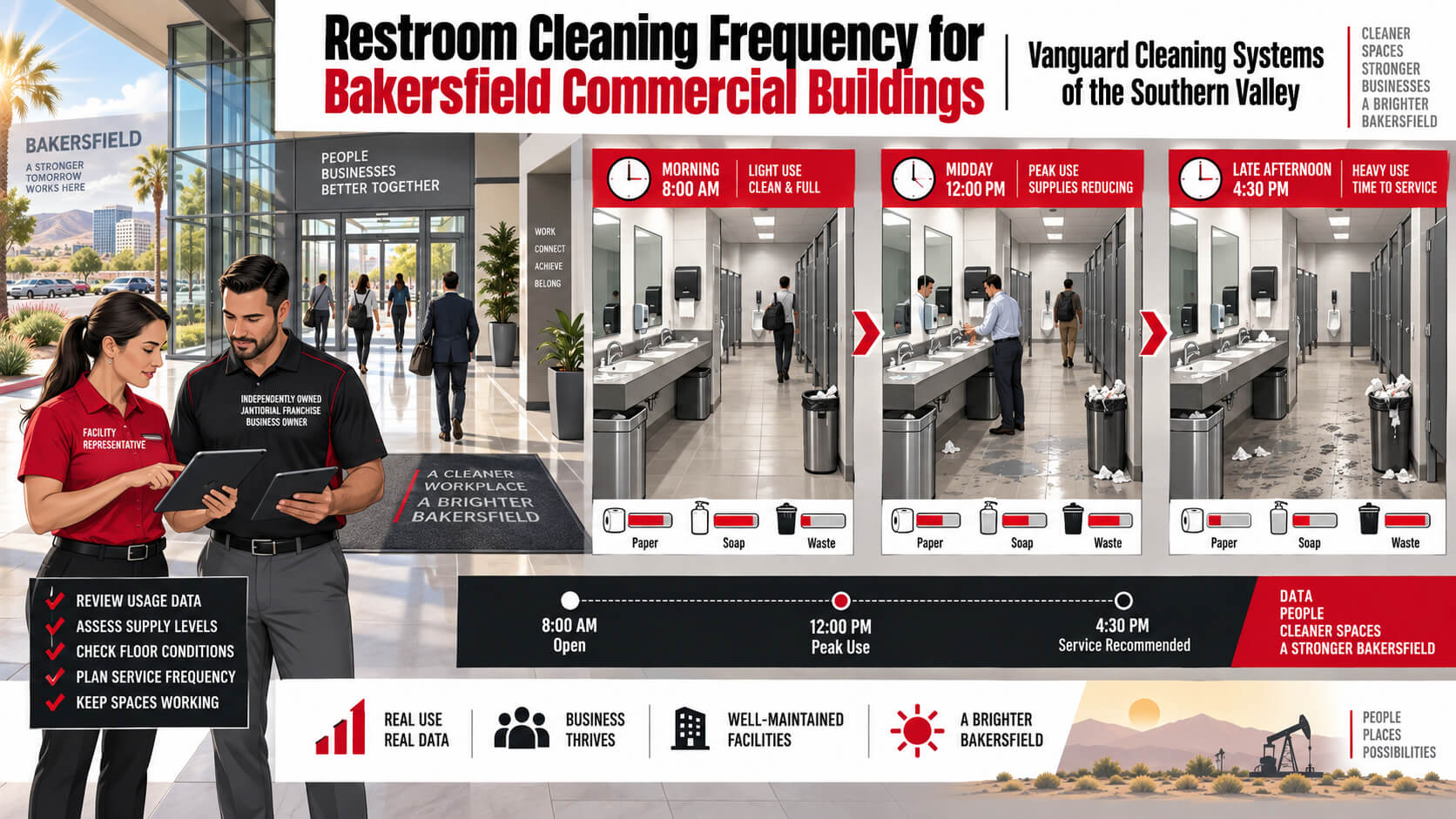
A useful restroom schedule follows real use, with service timed before supplies, floors, waste, or fixtures reach an unacceptable condition.
When One Restroom Visit No Longer Covers the Workday
A restroom can look ready when a building opens and need attention again before lunch. Employee routines, visitor volume, long operating hours, and a small number of fixtures can concentrate a great deal of use into a short period. Dry soil carried into a Bakersfield building may also reach restroom floors through the main paths people take all day.
A set schedule still matters, but the best schedule is based on the time when conditions begin to decline. A quiet office restroom may stay in good shape after one complete service each occupied day. A busy public-facing restroom may need a full daily service plus checks during peak periods.
Those checks should have a clear purpose. The person assigned to the check may refill supplies, remove waste, address visible soil, dry wet counters, inspect the floor, and report fixture problems. This keeps a quick check from becoming a vague promise that is hard to measure.
For a broader building plan, compare restroom needs with other commercial cleaning services in Bakersfield. Restrooms often require their own frequency because their use changes faster than private offices, storage rooms, and other low-traffic spaces.
Quick Answer: How Often Should Commercial Restrooms Be Cleaned?
Most commercial restrooms should receive a complete service on every day the building is occupied. Moderate-use and high-use restrooms may also need one or more daytime checks. The right number of checks depends on how many people use the room, when traffic peaks, how quickly supplies are consumed, and when visible conditions begin to slip.
- Low use: One complete service each occupied day may be enough, followed by a documented review of conditions.
- Moderate use: One complete daily service plus a midday check is a practical starting point.
- High use: A complete daily service plus checks before, during, or after peak periods may be needed.
- Extended hours or several shifts: Service should follow the operating schedule, with checks assigned across the day.
- Unexpected conditions: Spills, leaks, clogged fixtures, full waste containers, and empty dispensers need a response when found.
Use these ranges as planning guides. Track the hour when the restroom first falls below the building's standard for two weeks. Then place a service check shortly before that time.
What Is Commercial Restroom Cleaning Frequency?
Commercial restroom cleaning frequency is the number and timing of full service visits, condition checks, and periodic detail tasks assigned to a restroom. It should be written into the scope so each visit has a defined result.
A complete service often includes toilets, urinals, sinks, counters, mirrors, partitions, waste containers, dispensers, and floors. It also includes replenishing agreed supplies and noting damage, leaks, clogs, or other problems that need building maintenance.
A daytime check is shorter. It focuses on conditions that can change quickly while the building is open, such as:
- Soap, toilet tissue, and paper towel levels
- Waste-container capacity
- Water around sinks or on floors
- Visible soil on fixtures and partitions
- Paper debris
- Odor complaints
- Clogged or unusable fixtures
- Leaks and maintenance concerns
Periodic detail work follows a separate rotation. It may include edges, baseboards, vents, walls, partition details, grout lines, dispenser exteriors, and hard-to-reach areas. Placing these tasks on a weekly or monthly rotation keeps the daily scope focused without allowing slower buildup to go unaddressed.
The written plan for commercial restroom cleaning should separate complete service, daytime checks, periodic detail work, and building-maintenance reporting. That distinction makes performance easier to review.
How Restroom Cleaning Frequency Works
Frequency planning starts with a walkthrough, then improves through observation. The first schedule is a working estimate based on occupancy, layout, operating hours, fixture count, supply capacity, and known complaints. Once service begins, condition records show whether the estimate matches the building.
Start With a Daily Baseline
A full service on each occupied day is a sound starting point for most commercial restrooms. These rooms contain several surfaces and supplies that receive repeated use, often by nearly everyone in the building. Research on public restroom surfaces has also found that human use and the type of surface affect the microbial communities present.
The daily baseline creates a regular reset. It also gives the service team a chance to spot a slow leak, loose dispenser, damaged partition, recurring floor mark, or supply-storage problem before it becomes a larger complaint.
Add Checks at Useful Times
A midday check has little value if the restroom consistently declines at 10:00 a.m. The same applies to a check made after most employees have left for the day. Timing should follow the pattern of use.
Useful check times may include:
- Shortly after the morning arrival period
- Before a customer rush
- Before and after lunch
- Near a shift change
- After a scheduled event or training session
- Before evening operations begin
If a restroom declines at different times on different days, the weekly schedule can vary. Monday may need one daytime check, while a customer-heavy Thursday may need two.
Define What Each Check Includes
A service log should list the items checked and the time of the visit. A simple checklist can include supplies, waste, sinks and counters, toilet and urinal condition, floor condition, odor, fixture availability, and notes.
The record should also identify what was corrected. A checked box can show that someone entered the room. A short note shows whether the visit solved the condition that prompted it.
Review the Pattern
Review two weeks of notes after a new schedule begins. Look for repeat times, repeat fixtures, rapid supply use, and problems that return soon after a visit. Then adjust the schedule, dispenser capacity, task list, or maintenance plan.
This feedback loop is part of tracking recurring restroom concerns. It helps separate a missed task from a schedule that simply provides too little coverage for the amount of use.
Employee Count Sets the Starting Workload
Employee count is one of the first numbers to collect. More people usually mean more restroom entries, handwashing, paper use, and waste. Yet a headcount by itself can hide the busiest parts of the day.
A hybrid office may have 20 people on Monday and 70 on Tuesday. A warehouse may have a large team arriving and leaving at the same time. A small office can also have heavy restroom use when it receives a steady flow of customers, drivers, patients, or job applicants.
Record both total occupancy and daily variation. If the building has several shifts, count each shift and note the overlap. The period when one team is leaving and another is arriving can create a concentrated spike hidden by the daily total.
A Practical Way to Use Employee Count
Use the count to set an initial schedule, then confirm it with observed conditions. Ask:
- How many people are usually in the building each day?
- Which days have the highest in-office attendance?
- Do employees arrive, take breaks, and leave at similar times?
- Are restrooms shared by several departments or tenants?
- Has staffing changed since the scope was written?
An increase in headcount should trigger a review before complaints become routine. The same is true when employees return to the office after a remote or hybrid period.
Visitor Traffic Can Change the Schedule Quickly
Visitor use is less predictable than employee use. A lobby restroom may serve customers, delivery drivers, contractors, vendors, and family members. Some days remain quiet. Others bring steady traffic for several hours.
Public-facing restrooms also carry a higher appearance standard because they form part of the visitor's impression of the building. Empty soap, paper on the floor, or a full waste container can be noticed immediately, even when the room received complete service the prior evening.
Track visitor patterns by hour rather than relying on a monthly estimate. Reception counts, appointment schedules, event calendars, and lobby activity can help identify when checks should occur.
Buildings with uneven traffic may need flexible coverage. Add a scheduled check on training days, open-house dates, clinic days, or other periods when demand rises beyond the normal plan.
Hours of Operation Affect the Recovery Window
An eight-hour office and a building open from early morning into the evening have different needs, even with the same daily headcount. Longer hours spread use across more time and reduce the chance that one evening service will carry the restroom through the next closing time.
Several shifts create another issue. A restroom may never receive a long, quiet window during normal operations. In that setting, the scope should state when a full service can occur and how occupied-room checks will be handled.
Review these operating details:
- Opening and closing times
- Shift start and end times
- Weekend operations
- Public access hours
- Scheduled breaks
- Events outside normal hours
- Access restrictions for service personnel
A schedule should cover the full occupied day. If the restroom is reset at night and the building remains active for 14 hours, daytime checks may be required well before the next full service.
Fixture Count Determines How Use Is Spread
The number of toilets, urinals, sinks, and accessible fixtures affects how quickly each one accumulates use. Fifty people sharing one toilet create a different workload from fifty people using a larger restroom with several fixtures.
Fixture availability matters too. One clogged toilet in a two-toilet room removes half of the available capacity. The remaining fixture receives more use until repairs are completed. A schedule that looked adequate in normal conditions may fall short during the outage.
During the walkthrough, document:
- The number of working toilets and urinals
- The number and location of sinks
- Accessible fixtures and clearances
- Soap and paper dispenser capacity
- Waste-container size
- Floor drains where present
- Fixtures with repeat leaks, clogs, or marks
Fixture count also affects labor time. A check in a one-stall restroom is different from a full review of a multi-stall public room. The service scope should allow enough time to inspect and address each fixture.
Supply Usage Gives You Measurable Data
Supply use is one of the easiest ways to measure restroom demand. Soap, toilet tissue, paper towels, and liners leave a visible record of how often the room is used. Empty dispensers also show that the refill plan, dispenser capacity, or check timing needs attention.
Start by recording the level of each supply at opening, midday, and closing for ten occupied days. Note any refill and the amount added. A simple percentage, such as full, three-quarters, half, one-quarter, or empty, provides enough detail for most buildings.
Look for patterns such as:
- One dispenser empties much faster than the others
- Paper use rises on a specific weekday
- Supplies run low before the scheduled check
- A dispenser jams even though stock remains inside
- Backup stock is stored too far from the restroom
- Refill quantities vary between service visits
Research in shared work settings supports the value of soap-and-water handwashing. Dispenser availability belongs in every daily restroom-readiness check.
Set a Refill Point
Choose a refill point that leaves enough product to reach the next scheduled check. Waiting until a dispenser is almost empty creates little room for an unexpected increase in traffic.
The refill point will vary with dispenser size and demand. A high-volume restroom may need dispensers refilled whenever they fall below half. A lightly used restroom with large-capacity dispensers may use a different threshold.
Floor Conditions Can Require Added Attention
Restroom floors collect tracked soil, paper, splashes, moisture, and residue. Their condition can change much faster than flooring in a private office. Smooth hard floors also need prompt attention when water or another spill creates a slip concern.
Floor checks should assess the current surface condition. Review the areas near sinks, toilets, urinals, waste containers, doors, and transitions. Corners and edges may need separate detail work because routine traffic and quick passes reach them unevenly.
Note the floor material in the scope. Ceramic tile, grout, resilient flooring, sealed concrete, and other surfaces may need different tools and periodic care. Using the correct process helps avoid residue, haze, and damage.
Bakersfield Soil Can Travel Through the Building
Dry outdoor soil and windblown dust often enter a Bakersfield building at doors. Much of it stays near the entrance, but foot traffic can carry fine soil along common routes, including the path to the restroom. Nearby construction, unpaved areas, parking lots, and active landscaping can raise that load.
Entrance mats and routine floor care can limit how far material travels. Restroom floors still need their own condition checks because water around sinks can mix with tracked dust and leave visible marks or residue.
Rain changes the same pathway. Moisture and outdoor soil can reach interior hard floors, so temporary checks may be needed during wet weather even if the normal schedule works well through most of the year.
Peak-Use Periods Matter More Than Daily Averages
A daily average smooths out the moments when restroom demand is highest. Cleaning frequency should account for those peaks because supplies, waste capacity, and floor conditions can change quickly during a short rush.
Common peak periods include morning arrival, scheduled breaks, lunch, shift changes, large meetings, public events, and closing time. In a customer-facing building, appointment blocks may create another predictable pattern.
For two weeks, record the restroom condition at the same set of times each day. A useful schedule might include 9:00 a.m., 11:30 a.m., 2:00 p.m., and 4:30 p.m. Adjust the times to match the workplace.
At each review, note:
- Estimated supply levels
- Waste-container level
- Visible soil or paper
- Water on counters or floors
- Odor
- Fixtures out of service
- Complaints received
The first repeat decline point is the most useful finding. Place a check before that point, then watch whether the room remains acceptable until the next visit.
Sample Frequency Ranges for Commercial Restrooms
The following ranges are starting points. Actual frequency should follow observed use, contract scope, building policy, and any rules that apply to the facility.
Small, Low-Traffic Office
A restroom serving a small, stable staff during standard weekday hours may need one complete service each occupied day. A designated condition review can confirm that supplies and fixtures remain ready through closing.
Add a daytime check if supplies run low, waste fills, water remains around sinks, or complaints appear before the evening visit.
Moderate-Use Office
A midsized office with shared restrooms often benefits from one full daily service and a midday check. On high-attendance days, move the check closer to the busiest period or add a second brief visit.
The wider Bakersfield office cleaning frequency plan can place restroom checks alongside breakroom, entrance, waste, and high-traffic floor tasks.
Customer-Facing Building
Public access raises both use and visibility. A full daily service plus scheduled daytime checks is a useful starting point. Reception or onsite staff should also have a clear way to report an empty dispenser, spill, clog, or other condition between checks.
Building With Several Shifts
Restrooms serving several shifts may need a full service during a low-use window, with condition checks tied to shift changes and breaks. Supply storage should support the full operating day.
Large Event or Training Day
Temporary traffic deserves temporary coverage. Service may be needed before guests arrive, during the event, and after it ends. The event plan should account for supply demand, waste, floor checks, and fixture problems.
Environmental Factors That Change Restroom Needs
Restroom use provides most of the workload, but the building around it affects how quickly conditions change.
Entrance Distance and Traffic Routes
A restroom near a lobby, warehouse entrance, shop floor, or outdoor work area may receive more tracked soil than one reached through carpeted office space. Map the route people take and note where floor conditions first change.
Ventilation and Moisture
Ventilation problems can allow moisture and odors to linger. Cleaning can address surface conditions, while recurring airflow problems should be reported to building maintenance. A stronger cleaning schedule cannot repair a failed exhaust fan.
Plumbing Condition
Slow drains, leaks, clogs, worn seals, and fixtures that flush poorly create repeat problems. Log the exact fixture and time rather than treating each event as a general cleaning complaint. Maintenance history may reveal that the room needs a repair.
Weather and Outdoor Soil
Dry, windy periods can raise the amount of dust carried into the building. Rain can increase tracked moisture. A flexible plan can add floor checks when conditions change instead of applying the same task load every week of the year.
Events and Occupancy Changes
Hiring, office-return policies, tenant changes, seasonal demand, public meetings, and workplace events can make an old schedule obsolete. Review the scope whenever daily occupancy or operating hours change.
Why Restroom Frequency Matters Across the Workplace
Restroom conditions affect more than one room. Employees may begin reporting problems, moving supplies, or cleaning spills when service falls behind. Visitors may form an unfavorable view of the building. A leaking or clogged fixture can also create floor and maintenance concerns beyond the normal cleaning scope.
A clear restroom plan supports the rest of the building schedule. It defines when routine tasks occur, who reports urgent conditions, where backup supplies are stored, and how repeat issues are reviewed. This reduces guesswork for onsite staff and the service team.
Restroom frequency should still fit within the full set of routine janitorial services. Daytime checks, evening work, floor care, waste removal, and communication should operate as one coordinated plan.
How to Build a Restroom Schedule From Two Weeks of Data
1. List Every Restroom and Fixture
Create a simple inventory by room. Record toilets, urinals, sinks, dispensers, waste containers, floor type, and any fixture that is out of service.
2. Record Occupancy and Public Use
Note employee attendance, visitor traffic, operating hours, shifts, and events for each day. Daily totals help, but the time of use is more valuable.
3. Check Conditions at Set Times
Choose three to five times that cover the occupied day. Use the same short checklist so the results can be compared.
4. Find the First Decline Point
Identify when supplies, waste, water, visible soil, odor, or fixture availability first falls below the building's standard. Look for patterns by restroom and weekday.
5. Place Service Before the Pattern
Schedule a check before the usual decline point. Define the tasks included and the person responsible for reporting any repair need.
6. Review Results After Two More Weeks
Compare the new schedule with the same condition log. If the room remains ready through the next service period, the timing is working. If the same issue returns, adjust the frequency or address its cause.
7. Recheck After Building Changes
Repeat the review when occupancy, hours, fixtures, tenants, or visitor patterns change. A short review also helps before a recurring busy season.
Signs the Current Restroom Schedule Is Too Light
- Soap, paper towels, or toilet tissue run out before closing.
- Waste containers repeatedly fill before the next visit.
- Water remains on counters or reaches the floor.
- Paper and visible soil return during the same part of each day.
- Odor complaints follow a repeat pattern.
- Employees handle routine refills or cleanup between visits.
- One fixture receives heavy use because another is often unavailable.
- The restroom looks acceptable after service but declines hours too early.
A recurring problem may call for a short, well-timed daytime check. Other cases require a repair, larger dispenser, bigger waste container, better access to stock, or a clearer task list.
People Also Ask
How many times a day should a commercial restroom be cleaned?
Most commercial restrooms need one complete service each occupied day. Busy rooms may need one or more daytime checks based on traffic, supply use, waste, floor conditions, and peak periods.
Should office restrooms be cleaned every day?
Yes, daily service is a practical baseline for most occupied offices. A very lightly used room still needs regular checks for supplies, leaks, fixture condition, and visible soil.
How often should a busy restroom be checked?
Start with a check near the busiest period, then use condition records to adjust the timing. Some restrooms need checks every few hours, while others need one midday visit.
What determines commercial restroom cleaning frequency?
Employee count, visitor traffic, business hours, fixture count, dispenser capacity, supply use, floor conditions, peak periods, and maintenance problems all affect frequency.
How can restroom traffic be measured without sensors?
Use supply levels, waste volume, receptionist observations, appointment schedules, shift times, and condition checks at set hours. Two weeks of simple records can reveal a useful pattern.
Is a restroom checklist the same as a cleaning schedule?
No. A checklist states what to inspect or complete. A schedule assigns those tasks to a time and frequency. Both are needed for clear follow-through.
Should every restroom in a building have the same schedule?
No. A lobby restroom may receive far more use than one in a small staff area. Each room should be assessed by traffic, fixtures, supplies, floor condition, and hours of access.
Frequently Asked Questions
What should be included in a full restroom service?
The scope may include toilets, urinals, sinks, counters, mirrors, partitions, dispensers, waste containers, supply refills, and floors. It should also state which detail tasks follow a weekly or monthly rotation.
What should a daytime restroom check include?
Check supplies, waste levels, visible soil, sink and counter moisture, floor condition, odor, and fixture availability. Correct included items and report leaks, clogs, or damage.
Can supply use help set frequency?
Yes. Record dispenser levels at set times. If a supply repeatedly reaches its refill point before the next visit, move the check earlier or increase capacity.
When should a restroom schedule be reviewed?
Review it after changes in staffing, public traffic, shifts, operating hours, fixtures, tenants, or recurring complaints. Seasonal weather and major events may call for short-term changes.
Who should report plumbing problems?
The scope should name a contact and reporting method. Cleaning personnel can document the location and condition, while building maintenance handles the repair.
Does a complaint always mean the cleaning was missed?
No. A room can receive proper service and decline again during a heavy-use period. Time-stamped records help show whether the cause is a missed task, insufficient frequency, supply capacity, or a maintenance issue.
Can service frequency change by weekday?
Yes. Hybrid schedules, public appointments, delivery days, meetings, and events can produce different demand from one day to the next.
How should urgent restroom conditions be handled?
Spills, leaks, clogs, overflow, empty supplies, and unusable fixtures should have a defined reporting and response process outside the normal check schedule.
Use the Decline Point to Set the Schedule
Track when restroom conditions decline during the workday, then use that information to set frequency. Record the room, time, supply levels, waste, floor condition, fixture status, and any complaint. Two weeks of consistent notes can show whether the building needs a different check time, an added visit, larger dispensers, or a maintenance repair.
Vanguard Cleaning Systems of the Southern Valley can help review restroom conditions and develop a service scope around the way a Bakersfield building is used. Janitorial services are provided by independently owned and operated janitorial franchise businesses. To compare current conditions with the service schedule, review restroom service needs.
References
Flores, G. E., Bates, S. T., Knights, D., Lauber, C. L., Stombaugh, J., Knight, R., & Fierer, N. (2011). Microbial biogeography of public restroom surfaces. PLOS ONE, 6(11), e28132. https://doi.org/10.1371/journal.pone.0028132
Gibbons, S. M., Schwartz, T., Fouquier, J., Mitchell, M., Sangwan, N., Gilbert, J. A., & Kelley, S. T. (2015). Ecological succession and viability of human-associated microbiota on restroom surfaces. Applied and Environmental Microbiology, 81(2), 765–773. https://doi.org/10.1128/AEM.03117-14
Kurose, S., Moriwaki, H., Matsunaga, T., & Lee, S.-S. (2025). Predicting restroom dirtiness based on water droplet volume using the LightGBM algorithm. Sensors, 25(7), 2186. https://doi.org/10.3390/s25072186
Savolainen-Kopra, C., Haapakoski, J., Peltola, P. A., Ziegler, T., Korpela, T., Anttila, P., Amiryousefi, A., Huovinen, P., Huvinen, M., Noronen, H., Riikkala, P., Roivainen, M., Ruutu, P., Teirilä, J., Vartiainen, E., & Hovi, T. (2012). Hand washing with soap and water together with behavioural recommendations prevents infections in common work environment: An open cluster-randomized trial. Trials, 13, 10. https://doi.org/10.1186/1745-6215-13-10

Pingback: Restroom Supply Planning: Who Orders, Stores, and Restocks?