
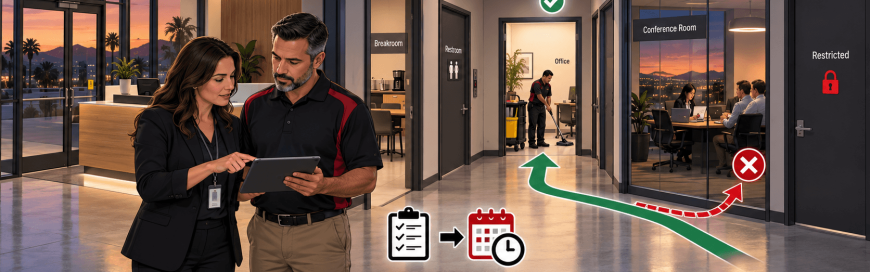
After-hours office cleaning needs an approved path from arrival to departure, with a clear response when a room or building is unavailable.
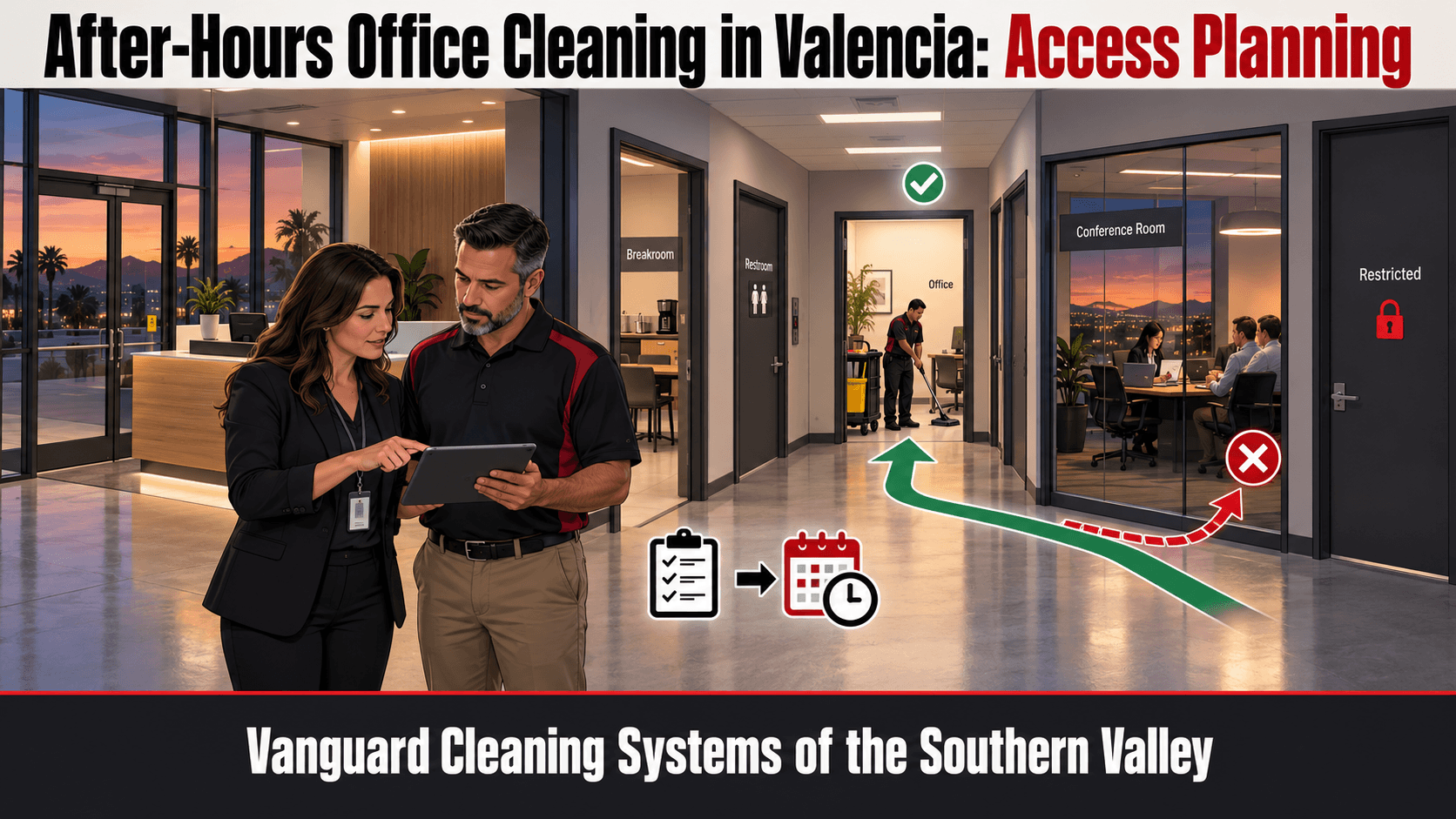
A quiet office can still have changing access needs
A conference room can stay occupied beyond its usual closing time. A replacement badge may not have the same permissions as the one used the week before. Someone working late may need the corridor while floor cleaning is scheduled. Those changes affect which tasks can begin and what needs to move to another window.
For a Valencia office, access planning should connect the service schedule to the building's actual use. Confirm who may enter, which rooms are included, and when each area is available. Give delayed work a reporting path and name the person who can approve a change.
Planning recommendations: The workflow and checklist below are recommendations for adapting a site-specific plan. They do not describe verified procedures at a particular building or guarantee a service provider's practices. Confirm the actual instructions with the authorized building contact and the independently owned janitorial franchise business providing service.
Quick answer: What should after-hours cleaning access procedures include?
Cleaning service access procedures should identify authorized entry, approved rooms, restricted areas, service windows, and the contacts for exceptions. They should explain what happens when entry fails, employees remain in a room, or work cannot finish within the approved period.
Keep credentials and building-specific security instructions in a controlled internal record. A public checklist can confirm that these arrangements exist without publishing the details used to enter the property.
What is after-hours office cleaning access planning?
After-hours office cleaning is scheduled janitorial work performed outside the office's main operating period. Some areas may still be occupied, and shared building access can follow different hours from the tenant's own office.
Access planning assigns the permissions, timing, and handoffs needed to complete that work. It connects the cleaning scope to room availability and the building's entry rules.
A frequency plan answers how often tasks occur. The access plan identifies the conditions that must be met during a visit. Link it to the office's cleaning frequency in Valencia so the scheduled work has a usable service window.
Assign entry, service, and approval responsibilities
Name the contact for each decision before service begins. An employee who can report a problem may have different authority from someone who can grant access or approve added work.
| Responsibility | Assignment to confirm | Required handoff |
|---|---|---|
| Authorize access | Building or tenant contact with authority for the affected space | Confirmed permissions, approved period, and restricted areas |
| Coordinate scheduled service | Contact at the independently owned janitorial franchise business | Current scope, schedule, and exception reports |
| Receive after-hours access reports | Primary site contact and named backup | Response to failed entry, unavailable rooms, or changed conditions |
| Approve schedule or scope changes | Person authorized for the service agreement | Written decision covering work, timing, and any added charge |
| Handle access-system faults | Assigned building, security, or maintenance contact | Fault response and confirmation of the approved next step |
| Review unresolved work | Assigned site contact and service coordinator | Replacement window, completion record, and follow-up |
Record coverage hours for the primary and backup contacts. If both are unavailable, the plan should already define how work is paused, deferred, or rescheduled.
Separate building access from suite access
In a shared building, entering the lobby may leave a tenant suite or supply room unavailable. Confirm each boundary needed for the agreed route.
Include shared restrooms and the waste collection destination where relevant. A task can depend on several access arrangements even when it appears as one line in the scope.
Confirm changes in the people attending
Agree on how the site is notified when personnel assigned to the account change. The building's authorization process should cover replacement personnel before their first visit.
Keep the current attendance and permission record available to the authorized contacts. Review access when someone leaves the account or no longer needs entry.
Plan authorized entry before the first visit
Walk through the approved arrival process with the responsible site contact. Confirm that the permissions and service window match the work that has been agreed.
Check the complete route
Confirm access to the rooms included in service and to the approved storage, water source, and waste destination needed for the work. Record any area that requires an escort or a separate release.
A walkthrough during office hours may leave some after-hours conditions untested. Arrange an authorized check of the actual service-period access before relying on it.
Record custody of keys or access devices
Use the site's approved issuance and return process. The internal record should identify the authorized holder and the contact to notify if an access device is missing or stops working.
Keep any credential identifiers or security instructions within the approved internal system. Distribute updates to the people authorized to use them.
Confirm a backup arrangement
Decide how the site handles unavailable access, including whether an authorized contact can provide assistance during the service period. Record the communication method and the limits of that assistance.
If entry cannot be restored under the approved process, the next action may be a deferred visit. Agree on that outcome before an access failure occurs.
Define restricted rooms and items
Room access and permission to handle its contents are separate parts of the scope. Identify the surfaces and items included in service, even where entry is approved.
Use clear room categories
- Approved for routine entry: Included rooms available during the agreed window.
- Entry by separate approval: Rooms needing an escort or a specific release.
- Excluded from service: Areas outside the confirmed scope.
- Temporarily unavailable: Included rooms affected by occupancy, repairs, or another recorded restriction.
Use the building's room identifiers in the controlled service record. A public planning example can use generic labels without revealing the actual room list.
Specify limits around documents and equipment
Record how accessible desk surfaces are handled and which items remain in place. Confidential waste, personal property, electronics, and specialized equipment need clear instructions if any handling is included.
When a task depends on occupants clearing a surface, give that instruction a place in the office's internal communication. Report unavailable surfaces through the agreed exception process.
Keep temporary restrictions current
Renovation work, testing, confidential meetings, and equipment changes can affect an otherwise approved room. Have the site contact communicate the restriction before the next visit.
Record when the restriction takes effect and who can release the room again. Carry the change into the route so the affected task remains visible.
Build service windows around late-working employees
Use actual room availability when planning the route. Closing time at reception may differ from the time a conference room or private office becomes available.
Agree on work that can continue during occupancy
Some approved tasks may fit around people working late. Confirm the limits in advance, including noise, equipment movement, and access to work areas.
Vacuuming near a call, moving a waste cart through a meeting, or cleaning a floor on the only available route may need a later window. Give the service provider another approved area to work in when that happens.
Use a consistent room-availability message
Agree on how an occupant or site contact communicates that a room is ready. The message should apply within the person's authority and the approved service period.
Keep room status distinct from permission to expand the task list. A room becoming available does not settle a request for additional work or an extended visit.
Allow time for the full task
Include setup, moving between rooms, and the final condition check when setting a window. Floor work also needs suitable controls and drying time before normal access resumes.
Research on cleaning-worker slips and trips supports attention to the conditions in which cleaning takes place. A usable route should account for both occupants and the people performing the work.
What happens when building access fails?
Agree on the response before the first visit. The site should define the authorized contact path, any waiting allowance, and the point when the visit is deferred.
- Pause entry. Use the approved process without improvising another way into the property.
- Report the failure. Notify the named site contact and the service coordinator through the agreed channel.
- Record the effect on service. State whether the whole visit or only part of the route is unavailable.
- Follow the approved next step. Continue only where entry and service remain authorized, or defer the affected work.
- Arrange follow-up. Record the person handling access restoration and the replacement service decision.
Keep codes, credentials, and images of access devices out of a routine service report. The report can identify the problem while directing authorized contacts to the controlled record.
Agree on return visits and added charges
State how a failed-access visit affects scheduling and billing. Define any charge for an extra trip or extended attendance in the agreement.
Confirm the replacement window with the authorized contact. Record who approved it and which tasks remain due.
What happens when a room remains occupied?
A room-level delay needs its own entry in the visit record. Work in other available areas can continue when the plan allows.
Offer the agreed alternatives
The plan may allow a return later in the same visit, a limited approved task, or deferral to another window. Choose among those options through the agreed site process.
Record a later return only when it fits the authorized period. If occupancy continues past that window, ask the approval contact to decide the next step.
Use an accurate completion status
Mark the room as completed, partly completed, deferred, or awaiting a site decision. Name the tasks that remain due so the next visit starts with a clear record.
Keep the reason brief and factual. The record needs room availability and the service effect, without personal details about the work happening inside.
Review repeated delays
If the same room stays occupied on several visits, compare its use with the assigned cleaning window. A different route order or a revised service time may fit better.
Confirm any recurring change in the scope and schedule. Carry its effective date into the service record.
Route reports to the person who can act
Name a recipient for routine completion records and a separate immediate reporting path for urgent conditions. The service coordinator also needs the information required to rearrange affected work.
| Issue | Recommended report recipient | Decision to record |
|---|---|---|
| Building entry unavailable | Authorized site access contact and service coordinator | Approved assistance, deferral, or replacement visit |
| Included room still occupied | Room-availability contact and service coordinator | Return within the window or revised timing |
| Request for extra tasks | Person authorized for the service agreement | Scope, timing, and price approval |
| Access device missing or malfunctioning | Designated site access or security contact | Site-directed response and effect on service |
| Building fault or unusual condition | Assigned site contact or urgent-response channel | Responsible responder and restrictions on work |
| Repeated incomplete work caused by access | Site decision-maker and service coordinator | Revised route, access arrangement, or service window |
Record the next action and its owner
An exception report should identify the observed condition, contact notified, and service effect. Add the agreed action and follow-up time when a decision is made.
At a shift change or handoff, confirm who has accepted any unresolved item. Keep the entry open until the remaining action is assigned and tracked.
Who approves changes to after-hours service?
The person authorized for the agreement approves changes to scope, schedule, and charges. A separate building authority may need to approve changed access permissions.
Document the proposed change before it starts:
- Affected room or task.
- Requested date and service period.
- Access or occupancy conditions.
- Whether the change is temporary or recurring.
- Additional price or agreed rate, when applicable.
- Approval and the updated service instructions.
A temporary room release should have an end point. For a recurring change, update the controlled access record and the service schedule together.
Access-planning checklist for an after-hours account
Adaptable checklist: Mark each item as confirmed, pending, or not applicable. Record actual credentials, access locations, room restrictions, and contact details only in the site's controlled internal plan.
Before the first visit
- The building and service provider have named authorized contacts.
- A backup reporting path covers the approved service period.
- Personnel attending are covered by the site's authorization process.
- Approved rooms and restricted areas are recorded internally.
- Entry permissions match the service window.
- Storage and waste-route access have been checked.
- Any escort or room-release requirement is confirmed.
- The first visit uses the current scope and access instructions.
For late occupancy and failed access
- Available tasks around occupied rooms are defined.
- A fallback route covers other approved areas.
- The process for an unavailable room is agreed.
- The failed-entry contact path and waiting allowance are confirmed.
- Return visits and any added charges have an approval process.
- Partial completion can be recorded by room and task.
- Urgent conditions have a separate reporting method.
For departure and account changes
- The assigned end-of-visit checks are documented.
- The plan accounts for people who remain in the building.
- Completion reports have a named recipient.
- Open work has a follow-up owner.
- Lost or failed access devices have a site-directed response.
- Changes in personnel trigger an access review.
- Old instructions are withdrawn when replacements take effect.
- The plan has a review date and named reviewer.
Finish the visit with a clear status record
Complete the checks assigned to the service provider in the written plan. Account for any areas that remain occupied and follow the site's instructions for that situation.
The departure record should show the work completed, any room left due, and the contact handling follow-up. Confirm that supplies and equipment have been placed in their approved locations and that no task remains in progress along an occupied route.
If a building condition prevents an assigned departure check, notify the designated contact and record the unresolved item. Closing-related instructions belong in the controlled plan, with clear limits on the service provider's responsibility.
Review the first service period
Compare planned access with the first several visit records. Look for delays at entry, rooms that remain occupied, and tasks that repeatedly run beyond their window.
Ask the account coordinator and authorized site contact to review those observations together. Confirm the change needed, its approval, and the date it takes effect. Update the current instructions and withdraw the old version so the next visit uses the same plan both contacts have accepted.
Keep public planning information separate from entry details
The checklist can show whether a process has been confirmed. The internal plan holds the details needed by authorized people to carry it out.
Keep building-specific entry instructions, credentials, actual security schedules, and private contact details out of public examples. Share operational information through the site's approved channel with the people who need it.
Apply the same care to completion photos and screenshots. A useful service image should avoid exposing documents, screens, or security information unrelated to the reported condition.
Workplace conditions that can change access in Valencia offices
Review access when the way the office is used changes. A recurring delay can come from a schedule that no longer matches occupancy.
Late meetings and changing attendance
Hybrid work, training sessions, and evening appointments can change which rooms remain available. Give the service coordinator advance notice where possible.
If these patterns continue, review the affected windows with the authorized contact. Record an approved recurring arrangement rather than relying on repeated verbal requests.
Shared buildings and temporary work
Shared access hours, repairs, and renovation activity can affect the path to a tenant office. Confirm any change with the building and the tenant contact before the next visit.
Record temporary closures and the work that remains possible. A replacement route should use approved areas and the current scope.
Entrances and floor conditions
Tracked soil or moisture can change the work needed near an entrance. Check whether that task can fit within the available period and the site's access controls.
Report leaks or damaged surfaces to the assigned maintenance contact. Keep repairs and any restriction on use visible alongside the cleaning record.
People also ask about after-hours office cleaning
Can office cleaning begin while employees are still working?
It can when the agreed tasks, access, and work conditions allow. Define which areas can be serviced around occupants and how unavailable rooms will be handled.
What happens if the cleaning provider cannot enter?
Use the approved site contact path, record the service effect, and follow the agreed assistance or deferral process. Arrange any replacement visit through the authorized contact.
Should every office room be accessible to the cleaning provider?
Access should match the approved scope. Record restricted rooms, escort requirements, and excluded areas in the controlled service plan.
Who approves a later cleaning window?
The authorized agreement contact approves the schedule change. The building's access authority also needs to confirm any changed entry permissions.
Frequently asked questions
How should a room that remains occupied be recorded?
Record its status, the work left due, and the agreed follow-up. Keep personal or confidential details out of the report.
What if the primary contact does not respond?
Use the agreed backup path. The plan should define what happens when authorized help remains unavailable.
Does after-hours cleaning include building closing duties?
Confirm any closing-related duty explicitly in the scope. Its instructions must account for other occupants and the building's procedures.
When should the access plan be reviewed?
Review it when personnel, hours, room use, permissions, or the service agreement changes. Repeated access failures also call for review.
Who should review the proposed procedures?
Have someone who coordinates after-hours accounts review the workflow with the authorized site contact. Confirm the actual permissions and exception response before service starts.
Confirm access during the Valencia walkthrough
When discussing Valencia janitorial services, bring the proposed service windows and a room list suitable for authorized review. Identify late-use areas and the decisions needed before the first visit.
Review the access plan with the commercial cleaning scope so tasks and entry permissions align. Confirm who receives reports and who approves changed work.
Contact Vanguard Cleaning Systems of the Southern Valley to discuss after-hours service planning with an independently owned janitorial franchise business.
Cleaning services are performed by independently owned and operated janitorial franchise businesses.
References
Bitzas, S., Ma, S., Pesanelli, K., & Zaia, A. M. (2022). Risk factors and impacts of slips, trips, and falls in janitorial populations: A literature review. Applied Ergonomics, 102, Article 103745. https://doi.org/10.1016/j.apergo.2022.103745
Health and Safety Executive. (n.d.). Cleaning. https://www.hse.gov.uk/slips/cleaning.htm
National Protective Security Authority. (n.d.). Guidance for suppliers. https://www.npsa.gov.uk/security-best-practices/supply-chain-guidance/guidance-suppliers
ProtectUK. (2022, March 1). Access control. https://www.protectuk.police.uk/advice-and-guidance/risk/access-control
