
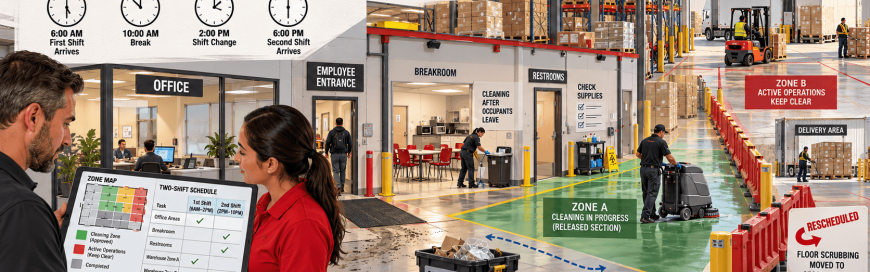
A warehouse cleaning schedule works best when each zone has a service window that fits the activity around it.
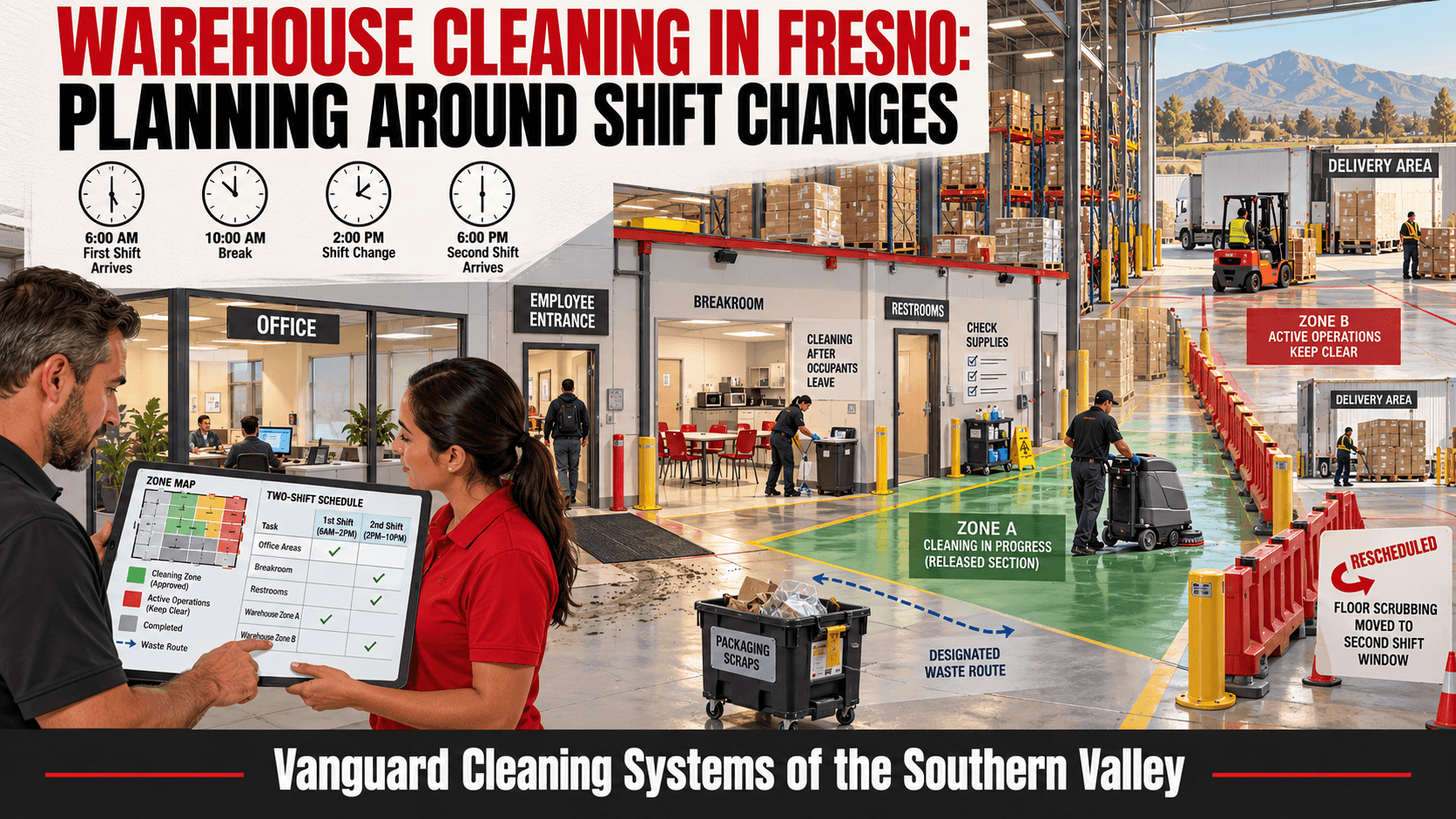
A shift change can fill the rooms that were quiet an hour ago
The breakroom fills as one shift finishes and another clocks in. A delivery arriving early keeps the receiving area busy beyond its planned cleaning window. Office traffic slows later in the day, while restroom use continues into the evening. Each change affects where routine cleaning can take place and how much time is available.
In Fresno warehouses, the route from exterior entrances to shared rooms can also carry dry soil or rainwater indoors. A useful plan gives those entrances attention when conditions change. It also shows which warehouse areas are approved for service and who confirms access before work begins.
Adaptable planning sample: The schedule and checklist below illustrate routine janitorial planning. Confirm the actual scope, methods, access rules, and staffing with the site and the independently owned janitorial franchise business providing service. Specialized industrial tasks require a separate review before they are included.
Quick answer: How should a warehouse cleaning schedule follow shift changes?
Map the building by zone, then match each area to its use during every shift. Check restroom supplies before breaks, clean breakrooms after groups leave, and schedule office work during approved access windows. Plan entrance checks around arrival and weather conditions. Clean approved warehouse areas only after the designated site contact confirms that the work area and route are available under the site's traffic controls.
Record delayed work with its reason, the person notified, and a replacement window. Urgent conditions need the site's immediate reporting process, even when routine cleaning must wait.
What is a warehouse cleaning schedule?
A warehouse cleaning schedule is a written plan that assigns janitorial work to specific zones and service windows. It identifies the tasks, frequency, access conditions, and person responsible for arranging entry when operations affect the work.
A warehouse janitorial checklist names the tasks and conditions to verify during each visit. The completion record shows what was done, what remains open, and when the next action is due.
Keep the schedule tied to the current operating hours. A second shift, seasonal staffing change, or new delivery pattern can change the demand in shared rooms even when the building's square footage stays the same.
Separate routine service from operational housekeeping
Assign responsibility for the debris generated during warehouse work. Packaging may accumulate between scheduled janitorial visits, and a blocked route needs attention when it occurs. The written scope should identify who handles those conditions during operations and how the cleaning provider reports them.
The broader demand for commercial cleaning in warehouses gives context for changing service needs. The daily plan should name the areas and tasks included at the individual site.
Map the cleaning zones before setting the times
Start with a floor plan that matches the current layout. Label room numbers, approved pedestrian routes, waste collection points, and restricted areas. Mark where the cleaning cart can be stored without interfering with operations.
Walk the route during a normal shift and again during a changeover. The time needed to move between buildings or wait for access belongs in the schedule.
| Zone | Routine work to define | Access condition | Boundary to confirm |
|---|---|---|---|
| Offices and meeting rooms | Waste, approved surfaces, floors, and shared touchpoints | Room available; documents and personal items left in place | Desk contents, electronics, locked rooms, and confidential waste |
| Breakrooms | Tables, counters, sinks, waste, and floors | Break group has left; safe access is available | Food disposal, appliance interiors, and personal containers |
| Restrooms | Fixtures, assigned surfaces, supplies, waste, and floors | Occupancy and temporary access procedures followed | Plumbing repairs, incident response, and alternate restroom access |
| Entrances and interior walkways | Mats, tracked soil, glass, litter, and floor conditions | Work can proceed with a safe route maintained | Exterior work, vehicle routes, security doors, and access equipment |
| Approved warehouse areas | Specified floors and agreed collection of identified routine debris | Site contact releases the defined area under site controls | Inventory, machinery, racking, loading operations, and specialized materials |
Offices need their own access arrangements
Confirm which rooms can be entered after office hours and who provides access. A locked office should have a recorded exception and a planned return visit.
List approved surfaces. Handling paperwork, cleaning computer equipment, opening drawers, and removing confidential material each need clear instructions if they are included in the agreement.
Breakroom use follows the people on each shift
Identify every break group, including staggered lunches and overtime. Leave a workable window after a group exits for the assigned tasks and any floor drying.
Set rules for food left on tables, personal dishes, and refrigerator contents. A posted food-disposal policy gives the cleaning provider a clear boundary when a room is still full of personal items.
Restroom checks should cover the full operating day
Check supplies ahead of expected demand and inspect conditions after busy periods. The plan should account for any rooms that stay open after the main office closes.
Allow for privacy and access when scheduling full cleaning. Identify the approved alternative when work requires a temporary closure.
Warehouse areas need a defined service boundary
Specify the aisle, floor section, or support area by its site name. Include the allowed method and equipment, along with the contact who can release it for cleaning.
Document exclusions on the same map. A nearby conveyor, charging station, or storage rack can require controls and expertise beyond the routine agreement. Review the proposed warehouse and logistics cleaning scope against the conditions found during the walkthrough.
How it works: Match cleaning windows to operations
Place the shift schedule beside the zone map. Add breaks, office hours, delivery periods, and any planned pauses in activity. Use that combined view to propose a route.
- Record the operating hours. Include overlap between shifts, weekend activity, and areas that remain staffed overnight.
- Mark demand in shared rooms. Identify when restrooms, entrances, and breakrooms receive the most use.
- Confirm available windows. Ask the designated site contact when each warehouse area can be released.
- Allow for the whole task. Include travel, setup, waste movement, floor drying, and the final condition check.
- Assign fallback work. Give the cleaning provider another approved zone to service when access changes.
- Test the route. Walk it during operations and revise windows that cannot be completed as planned.
Before a break
Check restroom supplies and the condition of the route into shared rooms. Address an identified shortage while the room is available, with enough time to leave it ready for use.
A break may pause activity in one warehouse area while employees gather elsewhere. Confirm access to the floor section through the site's release process before moving cleaning equipment into it.
Between break groups
Use the gap for the work that fits safely within it. Tables and waste may need prompt attention, while a larger floor task requires a longer window.
Record any task that must move to a later time. The next group should have a usable room and a clear path when it returns.
During a shift change
Expect more movement through entrances, clock-in areas, and shared corridors. Arrange cleaning so equipment and waste carts can stay clear of that movement.
Confirm whether the outgoing shift leaves packaging or waste at an agreed collection point. If that handoff changes, update the route before the next changeover.
When deliveries run early or late
Have the receiving contact advise when the planned access window changes. Move to the agreed fallback zone, then record the warehouse task as delayed with a new proposed time.
Access should be confirmed again before the return visit. A delivery timetable helps with planning, while the conditions at the site determine whether work can begin.
Sample warehouse cleaning schedule by zone and shift
Illustrative schedule: This example assumes a first shift from 6:00 a.m. to 2:30 p.m. and a second shift from 2:00 p.m. to 10:30 p.m. The overlap, breaks, and delivery windows are examples. Replace them with the site's hours and confirm that the service agreement provides coverage during the listed windows.
| Zone | First-shift window | Second-shift window | Access or handoff |
|---|---|---|---|
| Entrances | Opening check before 6:00 a.m.; follow-up after arrivals | Check after the 2:00–2:30 p.m. overlap; revisit as conditions require | Keep security controls and approved travel routes available |
| Restrooms | Check before morning break; revisit after lunch groups | Check before evening break; full cleaning during an agreed access window | Confirm supplies, occupancy procedures, and alternate access |
| Breakrooms | Reset after morning break and each lunch group where time allows | Reset after evening break; complete remaining work after final use | Confirm room is clear and allow needed drying time |
| Offices | Service available meeting rooms; respond to agreed daytime needs | Complete routine work after office hours in released rooms | Use approved access; record locked rooms and return time |
| Approved warehouse floor section | Proposed midmorning window after site release | Proposed evening window after site release | Site contact confirms defined area and traffic controls |
| Agreed waste collection points | Collect before containers exceed the agreed level | Collect after final break and before the service period ends | Use approved route and waste destination; report blocked access |
| Shift handoff | Record open issues before changeover | Record completion, restrictions, and tasks for the next service period | Named contact accepts unresolved work |
For a third shift, add its shared-room checks and service windows explicitly. A daytime schedule cannot establish what happens overnight without an assigned coverage plan.
Keep periodic work on a separate calendar
Tasks such as carpet extraction or a larger floor-care project may need an extended release. List those dates separately and confirm equipment, access, and reopening conditions before the work.
Where periodic work changes a waste route or blocks normal access, communicate the temporary arrangement to each affected shift. Carry the change into the daily schedule for that date.
Warehouse janitorial checklist for routine service
Use a checklist for each zone so the completion record shows where work took place. Mark inaccessible areas with a reason and follow-up plan.
Offices and shared rooms
- Service agreed waste containers and replace liners as specified.
- Clean approved accessible surfaces without moving documents or personal property.
- Vacuum or clean floors using the agreed method.
- Inspect walking routes for loose material or wet areas.
- Record rooms that were locked or still occupied.
Breakrooms
- Clean available tables, counters, and sinks within the scope.
- Remove ordinary waste to the assigned destination.
- Address crumbs and visible soil on approved surfaces.
- Check supplies included in the agreement.
- Clean floors when access and drying time allow.
- Record personal items or active use that prevent a task.
Restrooms
- Check toilet paper, soap, and the installed hand-drying supplies or equipment.
- Complete the assigned fixture and surface cleaning.
- Empty agreed waste containers.
- Inspect floors and report leaks or drainage problems.
- Identify unavailable fixtures and notify the site contact.
- Record the final condition and any remaining restriction.
Entrances and approved warehouse areas
- Confirm that access is available for the planned task.
- Inspect mats and approved floor surfaces for tracked soil.
- Collect identified routine packaging debris within the agreed boundary.
- Keep cleaning equipment inside the authorized work area.
- Follow the approved waste route.
- Report unexpected materials, damage, or changes in activity.
Plan packaging debris collection and waste routes
Agree on what counts as routine waste before collection begins. Empty cartons, loose wrapping, product returns, and damaged stock can have different destinations. Identify the person who can decide when the material is unclear.
Name the material and its collection point
List accepted materials in the scope, such as ordinary office waste or identified packaging scraps. Mark where those materials will be placed and how often the point will be checked.
Loose strapping, sharp objects, broken pallets, and heavy items need an agreed handling method and assigned responsibility. Report material outside that arrangement so the site can arrange the appropriate response.
Walk the route to the waste destination
Map the path from each collection point to the approved container. Confirm door access and any vehicle crossing with the site contact.
Keep exits and designated routes clear when positioning carts. If deliveries block the approved route, record the condition and arrange an authorized alternative before collection continues.
Confirm who operates waste equipment
State where collected material is to be left. Baler or compactor operation requires separate authorization, equipment procedures, and appropriate training when included. Keep that responsibility explicit in the service agreement.
Report damaged containers or waste that exceeds the agreed handling limits. Repeated overflow can call for a change in collection frequency, container capacity, or the site's removal arrangements.
Access restrictions and unexpected conditions
Give the cleaning provider a current contact for each service period. The contact needs to know which area is affected and what action has already been taken.
Keep the release process simple enough to use during a busy shift. Record the zone, authorized window, and site contact. Changes in activity require another check before work resumes.
Vehicle movement changes the cleaning window
Follow the site's pedestrian and vehicle traffic controls when reaching an approved area. Report a blocked or changed route before moving a cart through it.
Warning signs alone cannot establish a warehouse traffic plan. The site needs to confirm the controls required for work around vehicle routes and loading activity.
Unknown spills need the site's response procedure
Report the location and visible condition of an unidentified liquid or powder. Follow the site's instructions for keeping clear and alerting others, without disturbing the material.
Chemical releases, battery-related material, suspected hazardous dust, and product spills require assessment under the site's procedures. Confirm the responsible responder and service boundaries before including any related cleanup in routine work.
Equipment faults and product damage need a separate handoff
Record the location of leaking equipment, damaged racking, or unstable material and notify the designated contact promptly. Work that reaches into machinery or requires energy control needs its own authorized procedure.
The site should also decide how damaged packaging or exposed product is handled. Preserve the location details so the responsible person can find the condition without a second search.
Use an exception record with a next step
| Field | What to enter |
|---|---|
| Time and zone | Actual observation time and the site's room or aisle identifier |
| Condition | Plain description of what was observed or what prevented access |
| Immediate action | Work paused, contact notified, or other action under site procedure |
| Person notified | Name or assigned role, contact method, and report time |
| Next action | Assigned person, work-order reference where relevant, and follow-up time |
| Resolution | Task completed or authorized return to use, with time and verifier |
Label these entries clearly as completed, delayed, or awaiting site action. A maintenance request can remain open after the surrounding janitorial work is finished.
Fresno conditions that affect the cleaning plan
Fresno's dry summers and seasonal rain affect what reaches entrances. Check the condition at each building and adjust the route where outdoor material is being carried inside.
Dry soil near exterior access
Inspect entrances serving yards and parking areas for tracked soil. Review mat placement and the agreed floor-cleaning method when the same area needs repeated attention.
Dust observed near warehouse operations needs identification before a method is chosen. Keep specialized dust assessment and removal within the site's approved procedures and confirmed service scope.
Rain and changing floor conditions
Add checks where people enter from wet exterior routes. Inspect mats for saturation or movement, and report leaks or damaged thresholds when they contribute to recurring moisture.
Floor cleaning needs a usable drying window. Follow the product instructions and arrange access controls appropriate to the area until the floor is ready for use.
Seasonal changes in workload
Temporary staffing, extra shifts, and changes in shipments can increase use of shared rooms. Review the schedule when those changes are planned, then check the first week's record for shortages or missed windows.
Arrange additional coverage through the service agreement when the revised workload requires it. Include the extra hours and zones so expectations remain clear across shifts.
Review the plan during an operating shift
Ask an independently owned janitorial franchise business with warehouse account experience to review the proposed scope on site. Walk the route with the designated operations contact while the building is in normal use.
Compare the planned windows with observed access. Include time to collect supplies and move waste, then check that the route still fits when a task is delayed.
Research on slips, trips, and falls among cleaning workers supports attention to the conditions and organization of cleaning work. It does not establish a universal warehouse timetable. The sample schedule needs review against the individual building before use.
For the first service week, retain records of delayed areas, repeat debris, supply use, and handoffs. Use those observations to revise the affected zone or window with the service provider.
People also ask about warehouse cleaning schedules
How often should a warehouse be cleaned?
Set frequency by zone, use, and the agreed scope. Shared rooms may need attention around several breaks, while approved warehouse floor sections need windows coordinated with operations. Address reported hazards through the site's immediate response process.
What should a warehouse janitorial checklist include?
Include the assigned tasks for offices, breakrooms, restrooms, entrances, and approved warehouse areas. Add access confirmation, waste destinations, completion time, and a way to report work that remains open.
Can warehouse cleaning take place during operations?
Some tasks can be planned during operations when the site provides suitable access and controls. Confirm the area and method before work begins. Shared-room use, vehicles, and deliveries can require a different window.
Is a shift change a good time to clean?
It depends on the zone. Entrances and shared rooms often receive more use during changeover. A warehouse section may become available at a different time, subject to the site's release process.
Frequently asked questions
Who approves access to warehouse floor areas?
Name the authorized site contact in the written plan. That contact confirms availability under site procedures and advises when activity changes.
Does routine service include moving pallets?
Pallet and inventory movement need an explicit assignment. Confirm the responsible party and access arrangements before work that depends on moving stock is scheduled.
What happens when a delivery blocks the route?
Notify the site contact, record the delay, and move to an agreed available zone. Arrange a replacement window and confirm access again before returning.
Should food-storage or refrigerated areas use this sample?
Those areas need review against their product, temperature, and sanitation requirements. Confirm any additional procedures and qualifications before adding them to the service agreement.
How should a missed task be reported?
Record the zone, reason, notification, and planned next action. The handoff should identify who owns the follow-up and when it is due.
How often should the schedule be reviewed?
Review it after the initial service period and when shifts, deliveries, layout, or use change. Repeated exceptions also warrant a review of the affected task.
Bring the shift schedule to the Fresno walkthrough
Have the current floor plan, break times, and delivery pattern available when discussing Fresno janitorial services. Mark the approved cleaning areas and identify the contact for each service period.
Review the proposed commercial cleaning scope with the independently owned janitorial franchise business providing service. Confirm the waste route and process for rescheduling unavailable areas.
Contact Vanguard Cleaning Systems of the Southern Valley to discuss service planning for a Fresno warehouse.
Cleaning services are performed by independently owned and operated janitorial franchise businesses.
References
Bitzas, S., Ma, S., Pesanelli, K., & Zaia, A. M. (2022). Risk factors and impacts of slips, trips, and falls in janitorial populations: A literature review. Applied Ergonomics, 102, Article 103745. https://doi.org/10.1016/j.apergo.2022.103745
California Department of Industrial Relations. (n.d.). California Code of Regulations, Title 8, section 3272: Aisles, walkways, and crawlways. https://www.dir.ca.gov/Title8/3272.html
Health and Safety Executive. (n.d.). Cleaning. https://www.hse.gov.uk/slips/cleaning.htm
National Institute for Occupational Safety and Health. (2026, March 3). Cleaning and custodial services and your safety. Centers for Disease Control and Prevention. https://www.cdc.gov/niosh/cleaning-custodial-services/about/index.html
National Weather Service. (n.d.). Fresno climate. https://www.weather.gov/hnx/fatmain
Occupational Safety and Health Administration. (n.d.). Powered industrial trucks: Physical conditions. https://www.osha.gov/etools/powered-industrial-trucks/workplace/physical-conditions
Occupational Safety and Health Administration. (n.d.). Warehousing: Hazards and solutions. https://www.osha.gov/warehousing/hazards-solutions
