
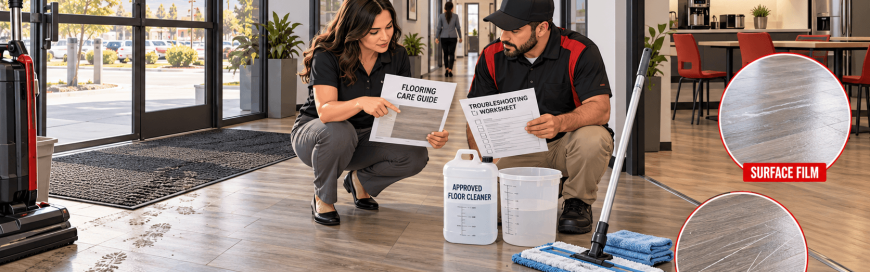
Recurring haze on luxury vinyl calls for a check of the installed floor, cleaning process, and dry result before the method changes.
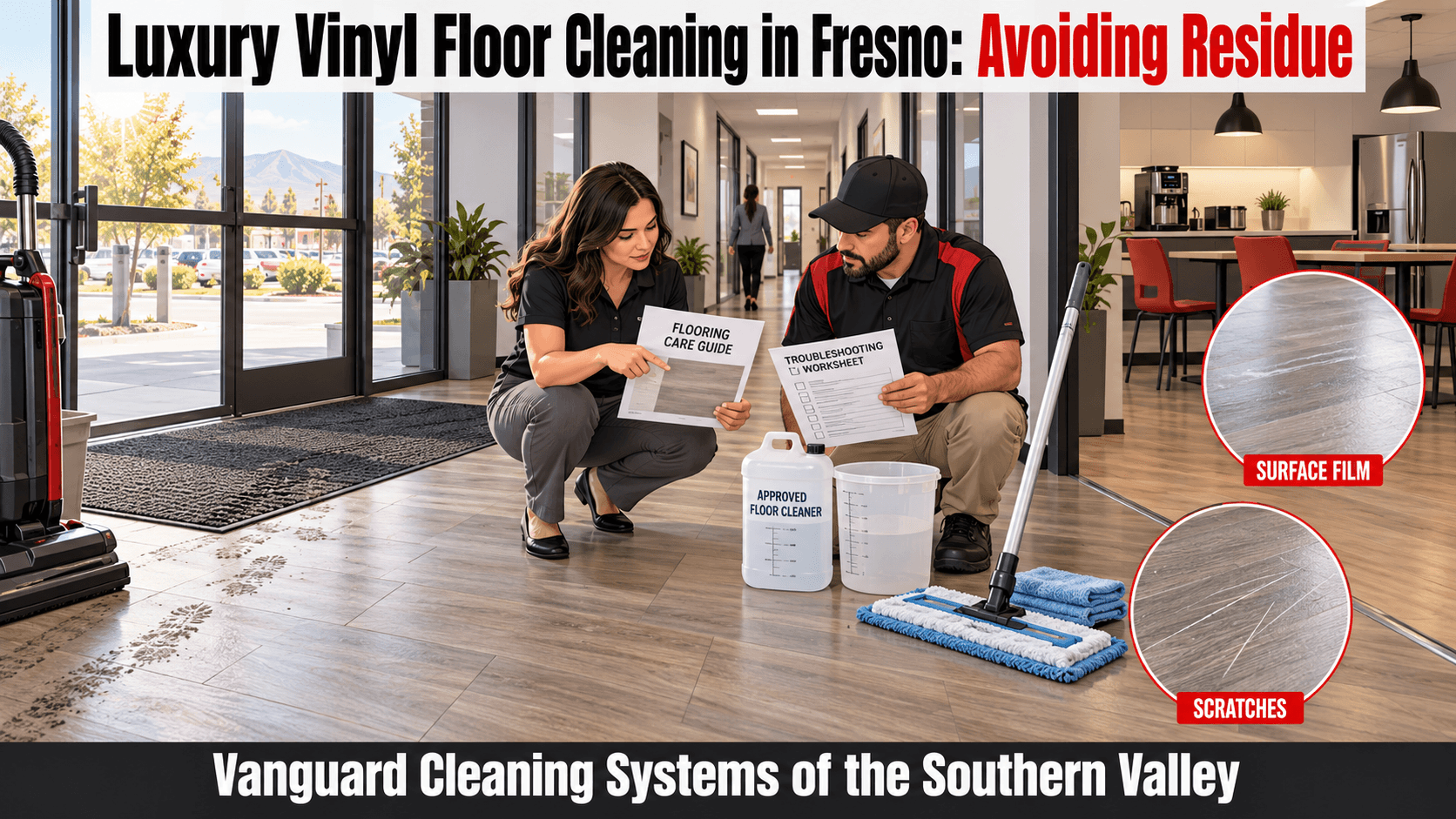
A floor can look clear while damp and cloudy after it dries
The surface looks even during cleaning, then a streak appears near the entrance. Another area develops a dull patch along the path between desks. The next visit may leave the same marks, even after more cleaning time. Those observations need a record that separates what is visible from what is causing it.
Commercial luxury vinyl floor cleaning in Fresno should begin with the installed product's care instructions. Record the cleaner, dilution, tools, and amount of moisture used. Compare the floor after it has dried, then use those findings to decide whether the routine needs adjustment or the manufacturer should review the condition.
Quick answer: How can LVT cleaning residue be avoided?
Identify the floor and its surface treatment, then follow the matching manufacturer instructions. Remove loose soil using the approved method, measure any required cleaner dilution, and keep tools ready to collect soil. Use the specified moisture level and complete any required solution removal or rinse step. Inspect the dry result before returning the area to normal use.
If haze returns, document where it appears, when it returns, and the exact process used. Ask the flooring manufacturer or its technical representative to review persistent conditions before changing chemicals, abrasion, or finish treatments.
What is LVT cleaning residue?
LVT cleaning residue is material remaining on luxury vinyl tile after a cleaning process. It can involve leftover cleaning product, soil carried in the solution, or material transferred by the tools used.
Haze describes a cloudy appearance. A hazy area may need investigation for residue, deposited soil, an added finish, or a change in the floor surface. The appearance alone cannot confirm which explanation applies.
Luxury vinyl also comes in plank formats. A wood-look surface or a familiar plank size does not identify the exact product, coating, or installation system.
The broader Fresno commercial floor-cleaning guide compares materials across a building. For a recurring LVT problem, narrow the record to the specific floor and affected area.
Identify the installed product and find its care instructions
Start with the installation paperwork, purchase records, or flooring schedule. Ask the building contact or installer for the product collection, item number, installation date, and any recorded surface treatment.
Use records that can confirm the product
- Original invoices or installation documents.
- Specification sheets for the rooms involved.
- Labels on retained cartons or spare material.
- Installer handover records and warranty documents.
- Manufacturer confirmation when records are incomplete.
Keep a copy of the confirmed product information with the cleaning scope. Where several products meet, mark the boundaries on the building's floor inventory.
Check the guide's product range and revision
Locate care information through the manufacturer's official website or technical support. Confirm that the document applies to the installed collection and installation type.
Record the guide title, revision date, and date obtained. A saved document from an earlier installation may have been replaced, while instructions for another product family may include different methods.
Find out whether a finish was added later
Ask whether any polish, coating, sealer, or other surface treatment has been applied since installation. Collect the product name and service history where available.
An added treatment can change the surface being cleaned. Have the flooring and treatment suppliers resolve care questions before trying to remove or cover an unidentified layer.
Manufacturer examples show why the product matters
The examples below summarize selected instructions from named manufacturer documents. They illustrate differences to check, with the full applicable guide controlling the work.
| Manufacturer document | Selected guidance | Question for the installed floor |
|---|---|---|
| Interface LVT Maintenance Guidelines, revised March 2025 | Specifies microfiber mops and a neutral cleaning solution within its stated pH range of 6–9. It excludes string mops, directs a damp clean-water rinse, and warns against soaking or puddles. Waxing and polishing are not recommended. | Does this guide cover the product, and has any additional finish been applied? |
| Shaw Contract Resilient Maintenance Checklist | Calls for dry-soil removal before wet cleaning, label-based dilution, and clean-water rinsing to remove haze. Its equipment instructions exclude brown or black pads and brushes. | Are the cleaner, tools, and rinse step consistent with the applicable Shaw instructions? |
| Mannington Commercial Product Care Guidelines, updated December 2025 | Directs attention to pad soil load, the amount of water or solution, and inspection after drying. It includes product-specific equipment options and treats added floor finish as optional within its covered system. | Which listed method applies to the installed product and its current surface treatment? |
Resolve any conflict between a floor guide and cleaning-product directions with the relevant technical contacts. Record their answer before using the proposed combination.
How residue can remain after cleaning
Cleaning needs to collect and remove material from the floor. When the process leaves material behind, its appearance can become clearer as the liquid dries.
Loose soil enters the wet-cleaning step
Check whether loose soil was removed before the wet process and which approved tool was used. Record the condition of that tool and the area covered.
Observe edges, transitions, and entrance routes as well as the center of the room. Soil can be distributed unevenly, so one pad may reach its useful soil capacity sooner in a busy entrance than in a lightly used office.
Too much product or an unsuitable product is used
Verify the exact product and its directions. A ready-to-use cleaner and a concentrate need different preparation, and different concentrates can have different dilution instructions.
Record what was measured. Adding extra product in response to a dull appearance can change the process without resolving the cause.
Tools stop collecting material effectively
Inspect the condition of pads, mop heads, and any equipment used. Include how they are cleaned, stored, and replaced in the maintenance record.
Mannington Commercial's discussion of LVT care identifies overloaded or poorly maintained microfiber as a concern when floors are difficult to clean. Follow the tool supplier's care instructions and check the specific floor guide when selecting a replacement.
The removal or rinse step is incomplete
Compare the actual process with the required final steps. Record whether soiled solution was recovered and whether any specified rinse was completed with clean tools and water.
For machine cleaning, check the recovery system using the equipment instructions. Visible trails can help locate a problem, while the equipment check establishes what needs attention.
Measure dilution and record the cleaning setup
Keep the current product label available to whoever prepares the solution. Use the stated units and the preparation method approved for that product.
Use the specified measure
- Confirm whether the product is ready to use or concentrated.
- Read the dilution for the task being performed.
- Use the specified measuring or dispensing equipment.
- Record the product quantity and water volume.
- Check any automatic dispensing system under its supplier's instructions.
- Keep unapproved substitutions out of the process.
There is no single dilution rate for every commercial LVT floor and cleaner combination. The floor guide identifies suitable care, while the selected product's directions govern its preparation and use.
Keep trial conditions traceable
For an approved comparison, record the area and the method before work begins. Keep the relevant conditions consistent so the resulting observations can be understood.
If a technical contact recommends a change, note the instruction and what changed. Avoid changing several process variables at once unless the approved procedure requires it.
Choose cleaning tools for the surface and task
Check the installed floor guide for approved mops, brushes, pads, and machines. Confirm the specific tool and operating conditions instead of relying on a pad color alone.
Record the tool beyond its general name
“Microfiber mop” leaves out its condition, preparation, and replacement interval. Record the tool type and the details needed to repeat the approved work.
For a machine, identify the model, attachment, and any operating settings required by the applicable instructions. Have changes reviewed when the floor or surface treatment is uncertain.
Protect neighboring materials
Mark where LVT meets carpet or another floor material. Use equipment and methods approved for each side of that transition.
Plan the work so a cleaning process does not carry onto an adjoining surface that needs different care. Include edge work in the scope where the main machine cannot complete it.
Control moisture and inspect after drying
Follow the product-specific amount of moisture, solution handling, and drying instructions. A floor marketed for water resistance still needs the care method approved for its installation.
Watch for liquid left behind
Record puddles, wet seams, or liquid trails and check the process before continuing. Report a leak or a change in the floor itself through the building's maintenance channel.
Use the site's controls around wet work and keep the area available for normal use only when the applicable reopening conditions have been met.
Compare dry results under consistent light
Inspect from the same viewpoint after the floor dries. Daylight and overhead fixtures can make the same patch look different at separate times of day.
Use a nearby reference area of the same installed product when available. A retained sample can help establish the intended appearance, although it may have a different use history from the installed floor.
Separate visible soil, suspected residue, and visible wear
Describe what is observed before assigning a cause. A photograph can document a streak or scratch, but the surface history and response to approved cleaning help interpret it.
| Observation | What to record | Follow-up |
|---|---|---|
| Loose particles or tracked material | Location, route from outside or another area, and condition before soil removal | Compare with the approved dry-soil process and entrance-care plan |
| Streaks or cloudy film after drying | Cleaning setup, pattern, dry inspection time, and whether the area was reused | Review dilution, tools, recovery, and any required rinse |
| Fixed scratches, scuffs, or altered sheen | Close-up detail, traffic or furniture pattern, and change after approved cleaning | Ask technical support whether a mark, finish issue, or surface damage needs assessment |
| Change at joints or plank edges | Location, visible condition, moisture history, and installation details | Refer to the flooring or installation contact before corrective treatment |
A matte factory appearance can be normal for the product. Confirm the expected finish before treating a lack of shine as a cleaning failure.
What to document when haze returns
Make the recurrence record specific enough for another person to compare visits. Include when the area looked clear and the conditions before the haze was noticed again.
- Room and marked floor area.
- Confirmed product and known surface treatment.
- Care-guide title and revision.
- Cleaner name and measured dilution.
- Tools, pad condition, and equipment settings where relevant.
- Dry-soil removal and wet-cleaning steps completed.
- Solution removal or rinse method.
- Dry inspection time and observed result.
- Time the condition returned and intervening use.
- Approved photos and technical follow-up.
Use timing to guide the next question
Haze visible immediately after drying raises questions about the completed process or the surface already present. A change after the next busy period also calls for a look at traffic and the material being carried into the area.
Record both observations without treating timing as proof. Repeated visits under a documented method provide a better basis for technical review.
LVT residue troubleshooting worksheet
Adaptable worksheet: Complete the entries before approving a corrective method. Use the installed floor manufacturer's instructions to resolve the questions in the last column.
| Check | Entry | Manufacturer-guided question |
|---|---|---|
| Floor identification | Brand, collection, item number: __________ | Is the exact product confirmed? |
| Installation and surface | Date, system, added treatment: __________ | Are initial-care limits or finish-specific instructions relevant? |
| Applicable instructions | Guide title, revision, page: __________ | Does this document cover this installation? |
| Observed condition | Location and visible pattern: __________ | Does the guide address this condition, or is technical review needed? |
| Loose soil | Tool and removal step: __________ | Was the approved preparation completed? |
| Cleaning product | Name and measured dilution: __________ | Are product selection and preparation approved? |
| Tools and equipment | Model, pad or brush, condition: __________ | Are these suitable for the surface and task? |
| Moisture | Application and liquid remaining: __________ | Was the specified moisture control followed? |
| Removal and rinse | Completed steps and tools: __________ | Were required final steps completed? |
| Dry result | Time, lighting, and observation: __________ | How does the appearance compare with the expected surface? |
| Recurrence | Return time and intervening activity: __________ | Which process or traffic condition needs review? |
| Next action | Technical contact, instruction, approval: __________ | What is authorized before the next treatment? |
Prepare a focused request for technical review
Send the completed worksheet through the building's approved process to the flooring supplier or manufacturer contact. Include the confirmed product, its installation history, and the care document used for the recorded work.
Ask the contact to address the unresolved question directly. That may be whether the current cleaner is compatible, whether an added treatment changes the method, or whether the visible condition needs an on-site assessment.
Include the dry result and any repeat observations. A report that states which approved steps were completed gives the reviewer more to work with than a request to make the floor shinier.
Keep the approved change with the service record
Record the technical response, the person approving any added work, and the effective date. Identify the product, tool, or process step that will change, along with the area where it applies.
Have the next service period use that current instruction. If a substitute product or tool becomes necessary, resolve its suitability before applying it to the affected area.
Revisit the same observation point after the revised process and again after normal use. Record the result even when the appearance does not change, so the next decision builds on the previous work.
Preserve records when responsibility changes
A new cleaning provider needs the confirmed floor identity and known treatment history. Include open technical questions and the latest approved method in the handover.
Keep older records available for comparison, with superseded instructions clearly marked. A change of service provider should not erase the information needed to understand why a recurring patch has already received attention.
Review the care record after floor replacement or repairs. A replaced section can introduce another product with different cleaning requirements.
Use approved close-up photos to support the record
Obtain permission for site photography and publication before using floor images. Record the product, location reference, date, and observed condition with each approved photograph.
Photograph the same area before and after approved cleaning
Take an overview that locates the condition, followed by a close-up showing the surface. Repeat the viewpoint and lighting after the floor has dried.
Retain the original files. Avoid filters or edits that change color, gloss, contrast, or the visibility of the condition being documented.
Caption the observation accurately
- Soil image: Identify visible loose material before the approved removal step.
- Suspected residue image: Describe the dry streak or film and the documented cleaning conditions.
- Wear image: Identify visible scratches or surface change, using a confirmed assessment where one is available.
Keep “suspected” in the caption when the cause remains unresolved. Comparable images can show a change, while a technical assessment establishes what treatment is appropriate.
Fresno workplace conditions to include in the review
Follow the routes that bring material onto the LVT. Entrances, breakrooms, and delivery paths may present different cleaning needs within the same building.
Outdoor soil and entrance mats
Inspect tracked dry soil and changing wet-weather conditions at active doors. Include mat care in the schedule and check that the mat system is compatible with the flooring.
Compare the entrance with an interior reference area. A recurring pattern along one route can help focus observation and cleaning records.
Food areas and nearby work
Note food or beverage use, renovation activity, and materials moved through the space. Construction dust and ordinary tracked soil need accurate identification when choosing a method.
Record suspected water-related deposits for technical review rather than assuming the cause from location alone. The worksheet should preserve the water source and cleaning setup when they are relevant.
People also ask about luxury vinyl floor cleaning
Why does LVT look cloudy after cleaning?
Possible explanations include material left by the cleaning process, soil, an added finish, or a changed surface. Check the product records and inspect the dry result under a documented approved method.
Should luxury vinyl floors be rinsed?
Follow the applicable floor guide and cleaning-product directions. Some manufacturer procedures require a clean-water rinse; resolve uncertainty with technical support before changing the process.
Can more cleaner remove persistent haze?
Use the prescribed dilution. Review the cause of the condition and obtain guidance before increasing concentration or changing products.
Can luxury vinyl be polished?
Check the specific product's instructions and treatment history. Manufacturer rules differ, and some LVT guides warn that wax or polish can damage the surface.
Frequently asked questions
What if the installed floor cannot be identified?
Ask the building contact, installer, or supplier for confirmation. Resolve compatibility before authorizing a corrective chemical or machine treatment.
Can a photograph prove that haze is residue?
A photograph records appearance. Product history, the cleaning record, and technical assessment help determine the cause.
What should happen when approved cleaning does not change a patch?
Record the method and dry result, then request technical guidance. Fixed marks or surface changes may need a different assessment.
Is one machine pad suitable for every LVT floor?
Confirm the specific pad, equipment, and task against the applicable guide. Color alone does not establish suitability.
Who approves corrective floor work?
The authorized building contact approves the work and scope. Obtain applicable manufacturer guidance before the proposed treatment begins.
Bring the product records to the Fresno walkthrough
When discussing Fresno janitorial services, have the floor identification, applicable care guide, and recurrence record available. Mark the affected areas and the neighboring floor materials.
Connect the documented method with the commercial cleaning scope. Confirm routine tasks and any separately approved corrective work with the independently owned janitorial franchise business providing service.
Contact Vanguard Cleaning Systems of the Southern Valley to discuss cleaning needs for a Fresno workplace.
Cleaning services are performed by independently owned and operated janitorial franchise businesses.
References
Interface. (2025, March). Luxury vinyl tile maintenance guidelines. https://www.interface.com/content/dam/interfaceinc/interface/technical/ams/maintenance/LVT_Maintenance%20Guide_Global.pdf
Mannington Commercial. (2025, December). Product care guidelines: Homogeneous and heterogeneous sheet, LVT, non-vinyl resilient. https://fkqgyt.files.cmp.optimizely.com/download/2f5ab614768411f09c92aee065b00814
Shaw Contract. (n.d.). Resilient maintenance checklist. https://pdmsview.shawinc.com/Shaw-Contract-Group-PDMS/SCG-Product-Care/Resilient/Resilient-Maintenance-Checklist
Toth, J., Jr. (2021, January 28). How to clean luxury vinyl tile and sheet vinyl. Mannington Commercial. https://blog.manningtoncommercial.com/cleaning-commercial-lvt-and-sheet-vinyl
