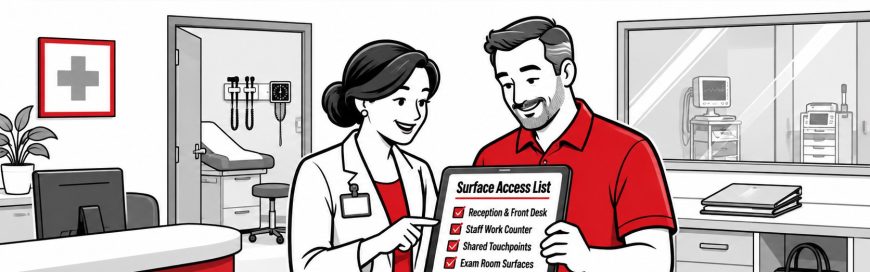
A medical office cleaning task can stay unfinished when belongings, records, or clinical items cover the surface assigned for service.
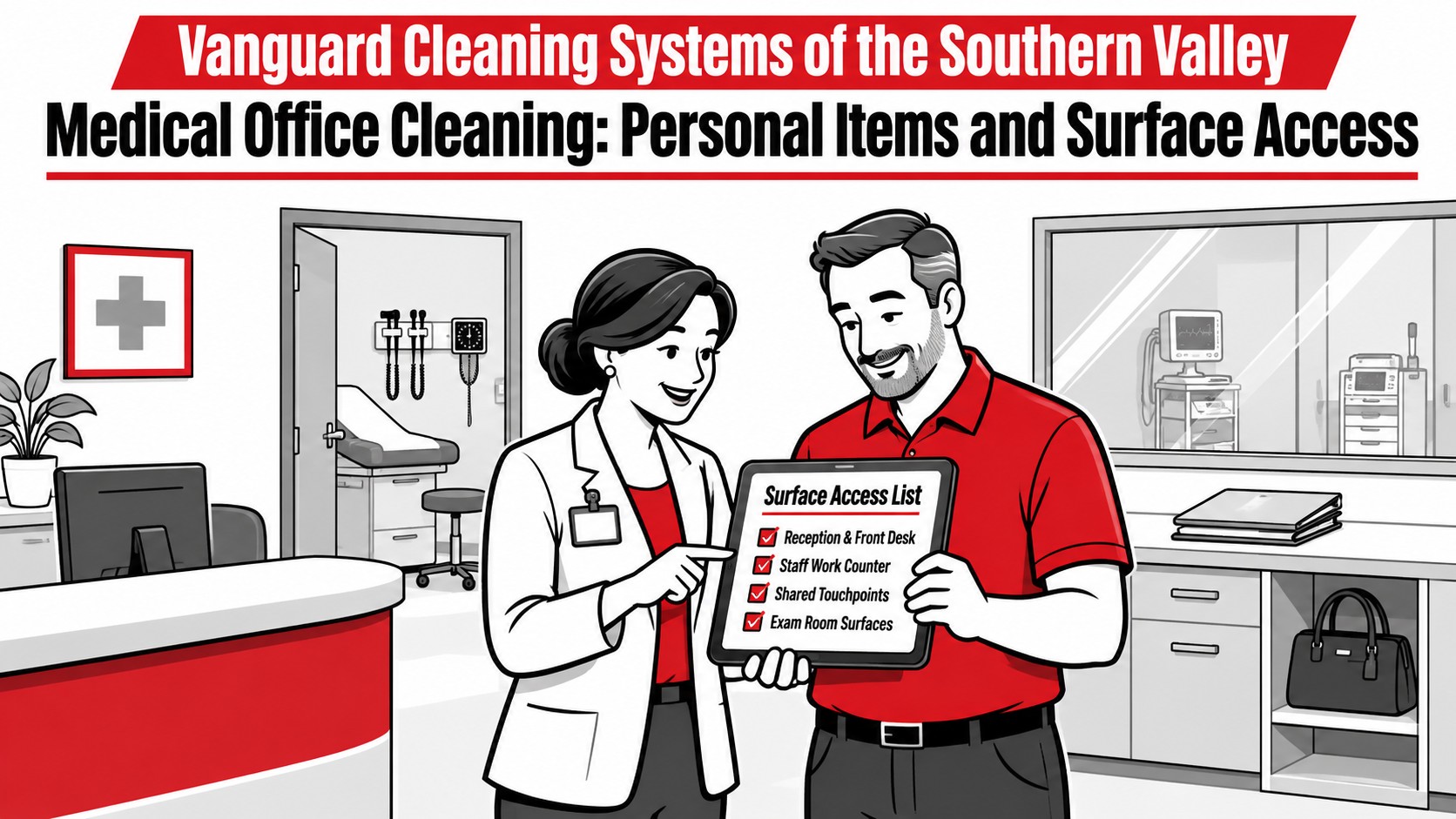
The counter is assigned, but the space is still occupied
A reception counter may hold appointment papers after the last patient leaves. A staff table can remain covered with lunch containers, while a phone charger crosses the edge of an adjacent work surface. In an exam room, a clear floor does not establish that clinical materials have been secured. These conditions affect which tasks can begin and who needs to prepare the area first.
Surface access belongs in the medical office cleaning agreement. Each listed surface needs a clear preparation rule and an authorized person who can resolve questions about the items on it. The practice also needs a way to record partial completion without losing track of the blocked work. That handoff lets routine service proceed within approved boundaries while the appropriate person handles belongings, information, and clinical materials.
Quick answer: Who clears surfaces before medical office cleaning?
The practice should assign authorized personnel to secure records, personal belongings, clinical supplies, and equipment before releasing surfaces for contracted work. The cleaning scope should identify the accessible surfaces included, any permitted movement of objects, and the report process when work is blocked. Clinical areas require the practice's approved release and task procedures.
Record the specific surface left inaccessible and the next action needed. A room-level completion mark should identify any remaining exception. The practice's authorized person decides clinical readiness under its own procedures.
What is surface access in medical office cleaning?
Surface access means that an assigned surface is available for the approved cleaning task. Its availability depends on more than whether someone can physically reach it. Records, patient belongings, clinical equipment, special precautions, and the room's operating status can all limit what may be handled.
A surface-access rule identifies who prepares the area, what may remain in place, and what the provider may do if the area is blocked. It should be specific enough to use during an ordinary visit. “Clean all counters” leaves too much uncertainty when counters contain materials with different owners and handling requirements.
Keep these rules with the practice's approved task list. The existing medical office cleaning task-assignment checklist provides a related framework for assigning duties and room handoffs. Add surface-level access decisions to the actual agreement used at the site.
How it works: Prepare, release, clean, and review
Identify the exact surfaces included
Walk each room with the practice's authorized representatives. List the environmental surfaces assigned for contracted service and the areas excluded or handled under separate procedures. Keep the language aligned with the room labels used by the practice.
Describe the surface rather than only the room. A reception counter can have a public-facing ledge, a work area holding records, and attached devices. Each portion may need a different preparation rule or assignment.
In clinical rooms, have the qualified clinical reviewer approve the boundary between environmental tasks and clinical duties. The practice determines the authorized methods and verifies the people carrying them out. A general office-cleaning rule should not become an exam-room instruction by default.
Assign preparation to an authorized person
Name the person or practice function responsible for clearing each surface before the visit. Include a backup when late appointments or absences change the usual handoff. The assigned person needs authority over the materials involved.
Personal belongings can be moved by their owners or another person designated under the practice's policy. Records and clinical materials need the practice's approved handling process. Keep those assignments visible so the cleaning provider does not have to decide who owns an unfamiliar item.
Set a preparation time that fits actual operations. A fixed end-of-day reminder may help common work areas, while clinical rooms may need release after their final use. The current room status should reach the provider before the task begins.
Define the release condition
Specify what must be ready for the surface task. Documents may need to be secured, belongings placed in assigned storage, and clinical items handled by the designated practice personnel. The exact condition depends on the surface and the practice's procedures.
Use a clear release signal for areas requiring one. Identify who may change the status and how the provider checks it. Keep patient details out of the general cleaning record.
A release can cover selected tasks while another part of the room remains on hold. The instructions need to state those limits. If the surface cannot be serviced safely within them, record the blocked work and seek direction through the agreed contact.
Record completed work at the right level
Use a surface or task identifier when part of a room remains inaccessible. “Reception public counter complete; rear work counter blocked by documents” provides useful detail without identifying the papers. Record the report recipient and follow-up action.
The provider can continue with other authorized tasks when the practice's procedures allow. A partial record should show which work was performed and which work remains pending. Avoid a completion label that hides the access exception.
The practice reviews open items before the next use of the affected space. Its authorized person determines what additional preparation, service, or clinical checks are needed. Keep that decision distinct from the record of the cleaning task itself.
A surface-access planning table
Use this table as a discussion aid. The practice's qualified reviewer should approve clinical boundaries and any handling instructions before use.
| Area | Preparation assignment | Access rule to confirm | Exception record |
|---|---|---|---|
| Public reception counter | Practice-designated person secures papers and belongings | Identify the public-facing surface included in service | Counter section and blocked task |
| Reception workstations | Authorized practice personnel handle records and devices | List accessible surfaces and approved device limits | Workstation identifier without patient information |
| Staff desks | Owner or practice-designated person clears the assigned surface | State whether any objects may be moved | Desk or room identifier and remaining work |
| Staff breakroom | Assigned occupants clear dishes and stored food as agreed | Identify counters, tables, and appliance tasks included | Surface and item category blocking access |
| Waiting area | Practice handles lost property and room release | Confirm seating and tables included in the scope | Location and approved lost-property handoff |
| Approved exam room | Clinical designee prepares and releases the room | Use the practice-approved surface list and procedures | Task status and clinical contact notified |
| Clinical equipment or supplies | Practice-designated authorized personnel | Follow separate approved handling instructions | Refer the concern through the clinical process |
Keep the table current when room use changes. A counter converted into a medication preparation area requires a new clinical decision about its care. The previous label in the cleaning scope should not remain the only instruction.
Personal items need a predictable storage rule
Give everyday belongings an assigned place
Choose practical storage for bags, coats, drink containers, and personal accessories. The location should fit the practice's operating and safety procedures. Make it easy for the item's owner to prepare the surface before leaving.
Explain which work areas must be cleared and when. A specific instruction about an assigned counter is easier to follow than a broad request to tidy the entire office. Include the same preparation rule when a new person begins using the space.
Review storage problems when they recur. A surface may remain crowded because the room lacks an appropriate place for belongings. The practice can address that layout issue while the service record continues to show which tasks were blocked.
Define whether small objects may be moved
Some agreements allow limited movement of listed nonclinical objects. Others require surfaces to be clear before service. Write the actual rule and identify any conditions that limit handling.
Avoid a general instruction to move everything and put it back. Similar-looking objects can have different handling requirements, and someone providing routine service may not know their intended placement. The practice needs to approve any permitted movement in terms that fit the real room.
Clinical devices, specimen containers, medications, instruments, sharps, and related materials require their own authorized procedures. An object being small or sitting on an ordinary desk does not establish that it can be moved as part of routine service.
Handle lost property through the practice
Assign a contact for belongings found in waiting areas or other shared rooms. Use the practice's lost-property process and approved storage location. Keep the service report limited to the information needed for the handoff.
A phone, wallet, or bag may contain private information. The report can identify the general item category and where it was found without examining its contents. Authorized practice personnel can manage identification and return.
Record who accepted the item when the procedure calls for a custody record. If nobody is available, follow the approved after-hours arrangement. Avoid inventing a storage location during the visit.
Records and screens belong in the preparation process
Ask the practice to define how paper records, labels, schedules, and other protected materials are secured before service. Keep that procedure within the practice's privacy controls. The cleaning scope can reference the preparation requirement without reproducing sensitive details.
Screens and devices need an explicit assignment. Identify which exterior surfaces, if any, are included and which manufacturer and practice instructions apply. Moving a mouse, using a keyboard, opening a drawer, or handling a cable can affect access and information as well as the cleaning task.
Report a blocked workstation by location. “Reception workstation 2 surface unavailable” may be enough to trigger the correct follow-up. The designated practice contact can assess the information left in place through the appropriate internal process.
Use photos only when the practice has approved the method and the image can be captured within its privacy rules. Written descriptions often provide the required detail. Keep any authorized images in the approved reporting channel with the access limits the practice requires.
Clinical clearance remains a practice decision
A vacant exam room can still contain materials requiring clinical handling. The practice's designee needs to complete the approved preparation steps before releasing it for assigned environmental tasks. The provider should receive the relevant access and precaution instructions through the approved process.
The scope should distinguish routine environmental work from between-patient duties, equipment processing, and waste tasks needing specialized arrangements. Each requires the practice's appropriate assignment and procedures. A single “room cleaned” entry cannot establish that every clinical responsibility is complete.
For the broader service boundary, use the existing discussion of medical office cleaning scope in Bakersfield. The actual clinical rules must come from the practice's qualified reviewer and current procedures.
If an unexpected sharp, spill, or other hazard appears, follow the facility's immediate response process. The designated responder determines the controls and authorized handling. Keep the affected work on hold as directed and record the notification without including patient details.
Environmental factors that change surface availability
Late appointments and occupied rooms
A schedule change can leave one room occupied after the normal service route begins. Confirm how the provider learns about the change and whether another room can be serviced first. Any return to the occupied room must fit the approved window and release process.
Use a named contact for updates. A room's usual closing time cannot confirm its present availability. The current status needs to reflect the late appointment or other activity.
If release occurs after the visit ends, the practice should decide the next action under the agreement. Record the task and who owns the follow-up. Avoid carrying it forward as an unrecorded assumption.
Shared workstations
Several people may use the same desk during the day. Assign surface preparation to a defined closing step or practice-designated person. A rule addressed only to the usual occupant can fail when that person leaves early.
Keep the preparation instruction close to the workflow. It may appear on the practice's closing checklist or in the handoff system already used for the room. Identify the exact work area that needs to be available.
Review shared devices separately from the desk surface. Their care and approved handling can differ. The service scope should make those distinctions visible without requiring the provider to infer them from appearance.
Storage pressure and new equipment
A new printer, supply cabinet, or device can reduce the accessible area on a counter. Reassess the surface list after the layout changes. Confirm whether the original cleaning method and access rule still apply.
Ask the practice to identify where displaced items should go. A temporary stack can become a recurring obstacle when nobody owns the storage decision. Keep the task exception open until the area is prepared or the scope is revised.
Record changes through the normal approval process. Someone covering the next visit needs the current instruction. An old room photo or earlier walkthrough cannot establish the care requirements for newly installed equipment.
Surface materials and product compatibility
Identify the installed surface and the approved care instructions. Coatings, seams, upholstery, electronics, and damaged finishes can affect the method. Follow the practice's approved procedures and the relevant manufacturer instructions.
Report damage or uncertain compatibility before attempting a different treatment. The practice can obtain guidance and decide whether repair or another service is needed. Record the location and task affected.
Accessible surfaces also need enough space for the approved work. A narrow strip between belongings may leave part of the assignment unfinished. Record partial completion at the surface level so the next review reflects the actual result.
Workplace relevance: Make preparation part of closing
Put surface preparation into the practice's existing closing routine. Assign the room or surface, the responsible person, and the point at which release is recorded. Keep the instruction short enough to use during a busy evening.
A practical preparation checklist can ask:
- Are records secured under the practice's procedure?
- Have owners removed personal belongings from assigned surfaces?
- Are dishes and food containers handled under the breakroom plan?
- Have clinical personnel completed the required room preparation?
- Are excluded devices and materials clearly identified?
- Does the provider have the current release status?
- Is there an available contact for a blocked task?
Use the checklist to support the actual work rather than adding duplicate records. If the practice already uses a room board, connect the release there. Identify the authoritative status so two systems do not show different instructions.
A blocked-surface log that protects privacy
Keep the report focused on the cleaning task. Include the date, room identifier, surface, observed barrier category, work performed, and contact notified. Add the next action and person responsible for resolving access.
Use neutral descriptions. “Staff table partly covered by personal items” identifies the condition without making assumptions about the owner. “Exam room 3 awaiting practice release” preserves the clinical boundary without describing a patient's visit.
Choose clear working statuses, approved by the practice:
- Available for the assigned task.
- Assigned task complete.
- Partly complete, with a named surface pending.
- Awaiting preparation or practice release.
- Follow-up assigned.
- Closed after the agreed check.
The practice should define who can change each status. The cleaning provider records its authorized work, while the practice controls clinical readiness and any related holds. Keep those decisions visible in their appropriate systems.
Review repeat access problems with the scope
Group recurring exceptions by surface and cause. Records left on a counter, belongings without storage, and a clinical room awaiting release require different follow-up. The pattern becomes clearer when reports use consistent location names.
Check whether the preparation time fits the operating schedule. A reminder sent before the final appointment may miss the person who closes the room. Adjust the handoff where the practice's workflow allows and record the new assignment.
Include these access decisions in a discussion of Bakersfield janitorial service arrangements. The site walkthrough should confirm which surfaces an independently owned janitorial franchise business may service after the practice completes its preparation steps.
Check the handoff when someone provides coverage
A substitute contact needs the same surface list and release instructions used during the regular visit. Identify where the current version is kept and how the provider confirms that it applies to the room. Keep preparation assignments tied to the practice's actual closing process.
Review any temporary exception before the next visit. A counter held for an equipment installation may become available again, while an adjacent area remains restricted. The current instruction should identify each affected surface and the person who can release it.
When coverage ends, carry unresolved items back into the normal handoff. Record the next action and the person responsible. The practice should be able to see the current status without relying on a private conversation between the people who handled the temporary arrangement.
People also ask
Should a cleaning provider move personal belongings in a medical office?
Only as specifically authorized in the approved scope and practice procedures. Assign belongings preparation to owners or designated practice personnel and identify any permitted handling clearly.
Can a surface be marked complete if part of it was covered?
Record the completed section and the inaccessible section separately. The exception needs a next action and an owner so the unfinished portion stays visible.
Who clears an exam room before evening service?
The practice's authorized clinical designee follows its preparation and release procedure. The provider begins only the tasks approved for that released room.
What should happen when records remain on a desk?
Leave record handling to the authorized practice personnel. Report the blocked surface by location through the approved channel, without reproducing the information on the documents.
Does routine cleaning establish clinical readiness?
The cleaning record shows the assigned work and exceptions. The practice's authorized person determines readiness under its clinical procedures.
Frequently asked questions
Should the same access rule apply to every room?
Use room-specific rules where duties differ. A staff office, waiting room, and clinical room can require different preparation and release steps.
Can photos document a blocked counter?
Use photos only through a practice-approved process that protects private information. A written surface identifier may provide enough detail.
Who handles misplaced clinical items?
Notify the practice's designated clinical contact and follow its procedure. Keep handling within authorized duties.
What if no release contact is available?
Use the named backup. Record affected work as pending when authorization cannot be confirmed.
Should the provider unplug equipment to reach a surface?
Follow the explicit equipment and access instructions. Any electrical or device handling must have a separate authorized assignment.
When should the surface list be reviewed?
Review it after changes in room use, equipment, materials, service timing, or clinical procedures. Repeated blocked tasks also justify review.
Bring surface access into the service agreement
Contact Vanguard Cleaning Systems of the Southern Valley to discuss the approved rooms, accessible surfaces, and preparation handoffs at the practice. Clinical duties and release decisions remain with the practice's authorized procedures, while an independently owned janitorial franchise business provides the contracted tasks within its agreed scope.
Each Vanguard Cleaning Systems® business is independently owned and operated.
© 2026 Prestige Worldwide, Inc. DBA Vanguard Cleaning Systems of the Southern Valley.
References
Centers for Disease Control and Prevention. (2024, April 15). Considerations for reducing risk: Surfaces in healthcare facilities. https://www.cdc.gov/healthcare-associated-infections/hcp/infection-control/index.html
U.S. Department of Health and Human Services. (n.d.). Does the HIPAA Privacy Rule require hospitals and doctors' offices to be retrofitted, to provide private rooms, and soundproof walls to avoid any possibility that a conversation is overheard? https://www.hhs.gov/hipaa/for-professionals/faq/must-facilities-have-private-or-soundproof-rooms/index.html
