
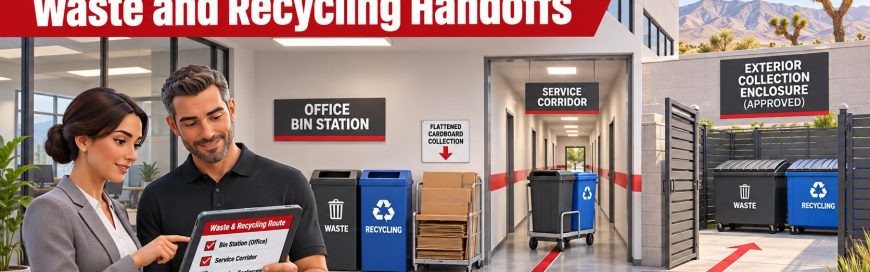
An emptied desk bin is only one step in a waste route that needs clear ownership all the way to collection.
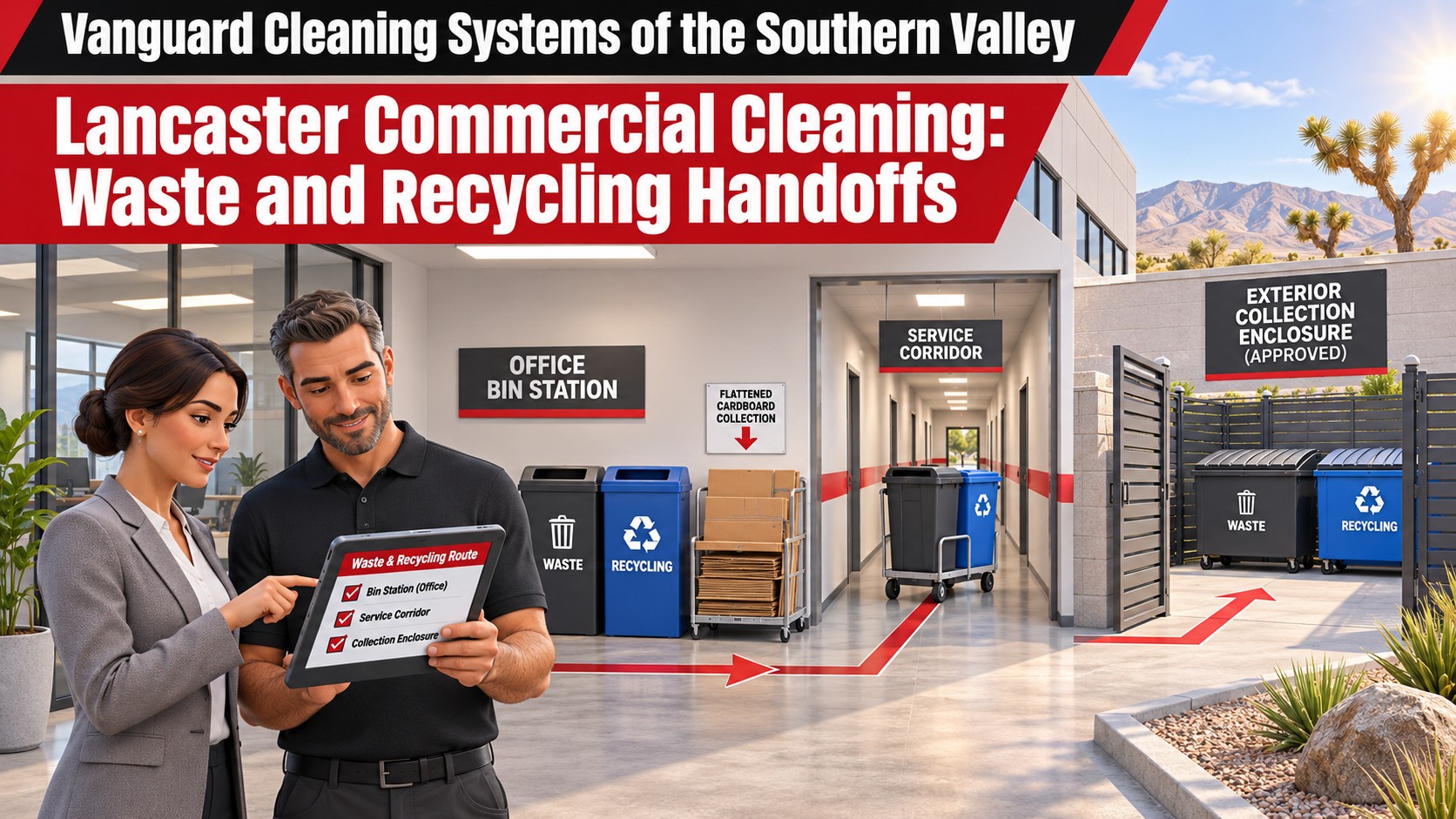
The gap between the office bin and the collection enclosure
A bag can leave an office and still miss the right destination. Flattened boxes may wait beside a receiving door because nobody has confirmed who moves them outside. A shared recycling cart might be full when the evening visit begins. When these handoffs are vague, the next person inherits materials without knowing whether they have been sorted, accepted, or left for a separate service.
Lancaster commercial cleaning plans work better when the waste route is written down. Each collection point needs an assigned service, an approved destination, and a way to report an interruption. Shared buildings also need a decision about what happens outside the tenant's suite. A short route sheet can connect those steps without turning each nightly visit into a new negotiation.
Quick answer: How should waste and recycling handoffs work?
List the indoor bins included in service, identify the accepted materials for each stream, and name the person or business responsible for every transfer. Confirm the approved route to the collection containers, enclosure access, collection days, and the response when a container is full or unavailable. Record exceptions with a location, time, recipient, and next action.
Use the building's current waste-service instructions to decide where materials belong. An indoor recycling label alone cannot establish what the collection provider accepts. Keep confidential paper and materials needing separate handling out of the ordinary waste route.
What is a waste and recycling handoff?
A waste and recycling handoff is the point where responsibility for collected material passes to another person, business, or service. It may happen when office occupants place material in a marked bin, when an assigned provider transfers that material to an exterior container, or when the collection company removes the container's contents.
Each handoff needs enough detail for the receiving party to continue the route. That detail includes the material stream, approved container, access arrangements, and any condition that prevents the transfer. A bag left beside a door has an unclear status until someone accepts responsibility for its next move.
The cleaning agreement should describe the portion of the route covered by the independently owned janitorial franchise business. The building's waste collection arrangement can have a different provider and a separate contact. Keeping both records together makes gaps easier to resolve.
For the broader room-by-room plan, use the existing guide to what commercial cleaning should include in Lancaster workplaces. Add the waste route as a specific task within that scope.
How it works: Follow the material through the building
Start with a bin inventory
Walk the building during a normal workday. Record the bins that people actually use, including the small containers under desks, shared kitchen stations, meeting-room bins, and receiving-area cardboard collection points. Compare that inventory with the current service agreement.
Give each shared station a stable location name. “North breakroom recycling” is easier to find than “the blue bin,” especially when several containers share the same color. Use the same names on the route sheet and the exception log.
Record whether each bin is serviced on every scheduled visit, on selected days, or only when an agreed condition occurs. A low-use office can have a different schedule from a busy breakroom. The written plan should make those differences visible before someone reports a missed task.
Confirm the material stream at each station
Obtain the current acceptance list from the building's collection provider. Check which materials belong in trash, recycling, organics, or another separately arranged service. If a container's label conflicts with that list, have the building contact resolve the label before revising the cleaning route.
Use simple examples on signs, based on the products found in the building. Product packaging varies, and a recycling symbol does not establish local acceptance. Questions about unfamiliar materials should go to the designated waste contact.
Avoid asking the person collecting bins to make unsupported decisions about mixed or unknown contents. Agree on a report-and-hold process for questionable material where appropriate. Keep ordinary collection moving in unaffected areas while the responsible contact resolves the exception.
Identify the receiving container
Map each indoor stream to its approved exterior destination. Include the container label or identifier, enclosure location, and access instructions. In a shared property, confirm whether the container serves one tenant or several businesses.
Check the route while the building is operating. A path that looks open during a walkthrough may be occupied by deliveries during the actual service window. Include an approved alternate route if access changes at predictable times.
Put access codes and key details in the building's controlled access system. The general scope can identify the approved access method without printing security details on a public route sheet. Someone covering an absence still needs a reliable way to obtain authorized access.
Close the transfer with a useful record
A routine completion entry can stay brief. Record that the assigned bins were serviced and the material reached the approved container. Add detail when the route was interrupted or part of the assignment remained open.
Useful exception wording identifies the blocked step. “East enclosure recycling container full at arrival; indoor station serviced, transfer awaiting building direction” tells the next person where the problem occurred. The entry also needs the report recipient and agreed follow-up.
Keep completed work separate from pending work. If the bins were emptied but exterior transfer could not occur, the route still has an open step. The service record should preserve that distinction until the material reaches an approved destination.
A responsibility table for the full waste route
Use this planning table during a scope review. Replace the suggested assignment with the actual agreement before it becomes a working instruction.
| Step | Assignment to confirm | Record or handoff |
|---|---|---|
| Place material in indoor bins | Building occupants follow the site's sorting instructions | Clear labels and approved stream examples |
| Service listed indoor bins | Assigned cleaning provider within the agreement | Locations completed and exceptions |
| Prepare delivery cardboard | Party named in the receiving process | Released packaging and approved staging point |
| Transfer collected material | Assigned business or building personnel | Destination and route completion |
| Maintain enclosure access | Building's designated contact | Authorized access and backup contact |
| Arrange external collection | Building or property party holding the waste account | Collection schedule and service contact |
| Resolve contamination questions | Designated waste contact with collection-provider input | Accepted instruction and follow-up |
| Handle confidential paper | Separately authorized document service | Secure container and approved custody process |
| Respond to a full container | Named building or property contact | Alternate approved arrangement and closure |
A tenant's cleaning agreement may stop at an indoor collection room. Another agreement may include the exterior transfer. Confirm the boundary in plain language so a shared property does not depend on assumptions about who covers the last few feet.
Separate ordinary waste from items needing another route
Give confidential paper a secure destination
Provide an identified secure-paper process for documents that require controlled disposal. The cleaning route should show whether the provider has any authorized task involving the secure container. A nearby trash bin should never become the fallback because a secure console is full.
Assign someone to request service for full or damaged secure containers. Record the request through the building's approved channel. Reports should describe the container and condition without reproducing the information on the papers.
Avoid opening bags or reviewing documents to decide whether their contents are confidential. The building needs a sorting rule at the point where documents are discarded. The authorized document-handling service can define the later custody steps.
Define limits for unusual materials
Batteries, electronics, chemicals, lamps, sharps, and other unusual materials need a decision under the site's applicable handling arrangements. Their presence in an office does not automatically include them in routine bin service. Identify the contact who can arrange the proper route.
When an unexpected item appears, use the site's reporting procedure and avoid improvised handling. A useful report states the location and general concern. The designated responder decides what controls and service are needed.
Large items need a separate assignment too. Furniture, shipping pallets, renovation debris, and abandoned equipment can require different removal services. Include a process for approving extra work so these materials do not quietly become part of the nightly route.
Environmental factors that change the route
Wind and exposed collection points
An outdoor route in Lancaster may include exposed doors, uneven lighting, or loose packaging. Assess the actual conditions at the property before selecting the collection path. Check whether doors and container lids can be used safely during the agreed service hours.
Keep lightweight packaging within the approved collection arrangement. If outdoor conditions make the planned transfer unsafe, the service needs an escalation path and an authorized temporary destination. Report the interruption while the material's location is still known.
Avoid leaving loose recyclables outside a full container. The building contact should obtain an accepted alternative from the collection provider or property representative. That decision belongs in the open exception record.
Food use and meeting schedules
A catered meeting can change the waste volume in one room without changing the rest of the building. Identify who clears food and reusable catering items before the cleaning visit. The waste route can then account for material released for disposal.
Confirm how food and liquids affect the recycling stream under the local collection instructions. Keep those instructions available near shared stations. Any organics arrangement should have its own accepted-material list and destination.
Give the provider notice of unusually large events. The agreement can identify whether extra collection, liners, or a separate visit is available and how that work is approved. Record the decision before the event ends when possible.
Container capacity and collection timing
Compare the exterior collection schedule with the building's busiest periods. Note when containers reach capacity and whether that happens before or after regular pickup. Several dated observations are more useful than a general statement that the enclosure is always full.
A shared container can receive material from businesses with different operating hours. The property contact needs those observations when reviewing capacity or collection frequency. The cleaning provider can report the condition encountered without estimating another tenant's contribution.
After a missed pickup or temporary closure, update the route instructions. A scheduled collection date should not be treated as confirmation that capacity is available. Check the actual receiving condition when the transfer begins.
Doors, stairs, and occupied corridors
Include the whole path in the assessment. Interior doors, elevator rules, stairs, thresholds, and occupied corridors can affect how collected material moves through the site. Follow the building's approved handling and access procedures.
Choose equipment suited to the route and the work. Avoid overflowing carts, unstable loads, or bags that obscure the path. When a route requires lifting or handling outside the agreed task, obtain direction before treating it as routine service.
Coordinate the waste movement with public use. A collection route through a reception area may need a different time from one through a service corridor. The route sheet should describe the permitted window clearly enough for someone providing coverage.
Make workplace handoffs visible at shared stations
Place related containers together where the building's plan allows. Use labels that match the exterior collection streams. When signs use different terms at different points, occupants can sort material one way while the collection route assumes another.
Check labels after a container replacement. A new lid, changed color, or moved station can make an older route sheet inaccurate. Assign the building contact to approve those changes and send the revised information to the affected service providers.
A useful station review asks:
- Does each container have a clear purpose?
- Do examples match the current collection-provider instructions?
- Is the container included in the agreed service route?
- Can the assigned person reach it during the service window?
- Is there a named contact for a full or damaged container?
- Does the record identify what happens after material leaves this point?
These checks connect daily use with the contracted work. They also make scope discussions easier because each question refers to a visible location and a specific handoff.
A practical exception log for interrupted transfers
Use one record for each unresolved event. Keep the format short enough to complete during a visit. The log can be a secure form, a shared service record, or another agreed system that reaches the correct contact.
Suggested fields include:
- Date and time observed.
- Building and collection-point identifier.
- Material stream involved.
- Step completed before the interruption.
- Observed condition preventing the next step.
- Person or business notified and time sent.
- Authorized temporary arrangement, if any.
- Next action, assigned owner, and follow-up time.
- Closure check and date.
Use a separate urgent channel when the condition creates an immediate concern. A routine log entry may be useful for the record while an active alert reaches the site's designated responder. Follow the site's response procedure for leaks, unknown materials, or an obstructed route.
Close the record when the agreed correction has been checked. “Message sent” records communication; the closure field should show what happened to the material. If the issue recurs, link the new observation to the earlier entry rather than assuming the earlier correction still applies.
Review the route after changes in building use
Changes in occupancy can create new bins, different packaging, or longer collection paths. Review the route when a suite expands, a shared kitchen opens, or a delivery area moves. Include newly occupied rooms before they become an assumed part of the visit.
Compare the revised task with the current scope. If the route now includes a second floor or a different enclosure, assess the access, time, equipment, and approved service charges. Record any adjustment through the agreement's normal change process.
For location-specific service discussions, Lancaster commercial cleaning arrangements can begin with a walkthrough of the actual indoor stations and exterior destinations. Bring the waste-provider instructions so the scope reflects the building's current collection system.
Check the handoff during staff changes and holiday closures
A route that works during a normal week can lose an owner when the building closes early or the usual contact is away. Confirm the upcoming operating hours and compare them with the cleaning visits and collection schedule. Record changes through the existing service process before the affected date.
Assign a temporary contact who can make the relevant access and waste-service decisions. Someone answering the phone may be able to receive a report while lacking authority to approve an alternate destination. The route sheet should identify the person who can resolve the actual interruption.
Review how material will be managed during longer gaps between visits. Meeting leftovers, increased packaging, or a full exterior container may need a building decision before the closure begins. Keep extra work subject to the agreement's approval process and record any confirmed arrangements.
When normal hours resume, check that temporary instructions have been removed or clearly marked as expired. Confirm which open exceptions still need action. A temporary collection point can create confusion if it remains in the route after the original destination becomes available again.
Use the walkthrough to check the final transfer
During the next review, follow one approved stream from its indoor station to the receiving container. Confirm the actual route with the people responsible for its handoffs. Look for a point where the next owner, destination, or access method is still uncertain.
Write that uncertainty as a specific action. The building contact might need to confirm enclosure access, obtain updated sorting instructions, or identify who requests an additional pickup. Assign the action and review it before accepting the route as complete.
People also ask
Who is responsible for taking office recycling outside?
The written agreement should name the party responsible for that transfer. Indoor bin service, exterior movement, and collection-company pickup can have separate owners. Confirm the handoff at each boundary.
Should commercial cleaners sort mixed recycling by hand?
Set sorting expectations in the approved scope and handling procedures. Report mixed or unknown material through the site's agreed process. Avoid adding manual sorting duties without an assessment of the material and the work involved.
What happens when the building's recycling container is full?
Report the container identifier and time to the designated contact. Use only an approved temporary arrangement. Keep the transfer open in the service record until the material reaches an accepted destination.
Are cardboard boxes part of routine office cleaning?
Only when the agreement includes their preparation, collection, or transfer. State who empties boxes, releases packaging for removal, and handles oversized or unusual materials.
Can one shared dumpster serve several tenants?
That depends on the property's waste-service arrangement. Confirm which containers each tenant may use, how access works, and who resolves capacity problems before finalizing the route.
Frequently asked questions
How detailed should the waste-route sheet be?
Include the collection points, service frequency, approved destinations, route, and exception contact. Keep access credentials in the site's controlled system.
Should liners be specified by bin?
Record liner requirements where they affect the work. Follow the collection provider's instructions for each stream and the agreed container setup.
Who updates sorting signs?
Name a building contact to approve signs using current collection instructions. Notify the people responsible for servicing affected stations after a change.
How should missed pickups be handled?
The waste-account contact should follow up with the collection provider. Record the receiving container's condition and any approved temporary route.
Does a clean enclosure prove that every transfer was completed?
Check the service record and the assigned indoor points. Exterior appearance alone does not show which locations were serviced or which tasks remain open.
When should the agreement be reviewed?
Review it after changes to occupancy, containers, collection arrangements, access, or material types. Repeated exceptions also justify a route review.
Put the route into the cleaning scope
Bring the bin inventory, collection instructions, and exception history to a service-scope discussion with Vanguard Cleaning Systems of the Southern Valley. Use those records to confirm which waste and recycling tasks an independently owned janitorial franchise business may provide under the agreed scope.
Each Vanguard Cleaning Systems® business is independently owned and operated.
© 2026 Prestige Worldwide, Inc. DBA Vanguard Cleaning Systems of the Southern Valley.
References
Occupational Safety and Health Administration. (n.d.). General requirements, 29 C.F.R. § 1910.22. https://www.osha.gov/laws-regs/regulations/standardnumber/1910/1910.22
U.S. Environmental Protection Agency. (n.d.). How do I recycle common recyclables? https://www.epa.gov/recycle/how-do-i-recycle-common-recyclables
U.S. Environmental Protection Agency. (n.d.). What you can do to improve the recycling rate. https://www.epa.gov/circulareconomy/what-you-can-do-improve-recycling-rate
