
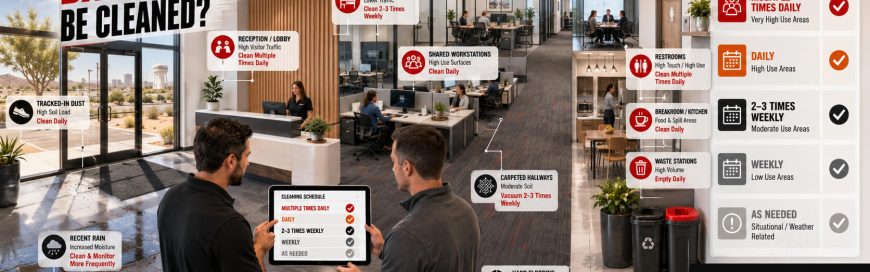
The best office cleaning schedule follows the way people use the workplace, not a fixed formula based only on square footage.
Bakersfield Offices Need Schedules Built Around Daily Use
A clean office supports comfort, protects building materials, and helps the workplace look ready for employees and visitors. Yet there isn’t one cleaning frequency that works for every Bakersfield business.
A quiet professional office with ten employees has different needs from a busy office with fifty employees, several restrooms, a shared kitchen, and steady customer traffic. Even two offices with the same square footage may require very different service schedules.
Local conditions matter too. Dust, dry soil, seasonal pollen, wind, rain, and heavy entrance traffic can change how quickly floors and interior surfaces begin to look worn.
The right schedule accounts for each part of the workplace separately. Restrooms, breakrooms, entryways, private offices, conference rooms, and floors rarely need the same level of attention.
Quick Answer: How Often Should an Office Be Cleaned?
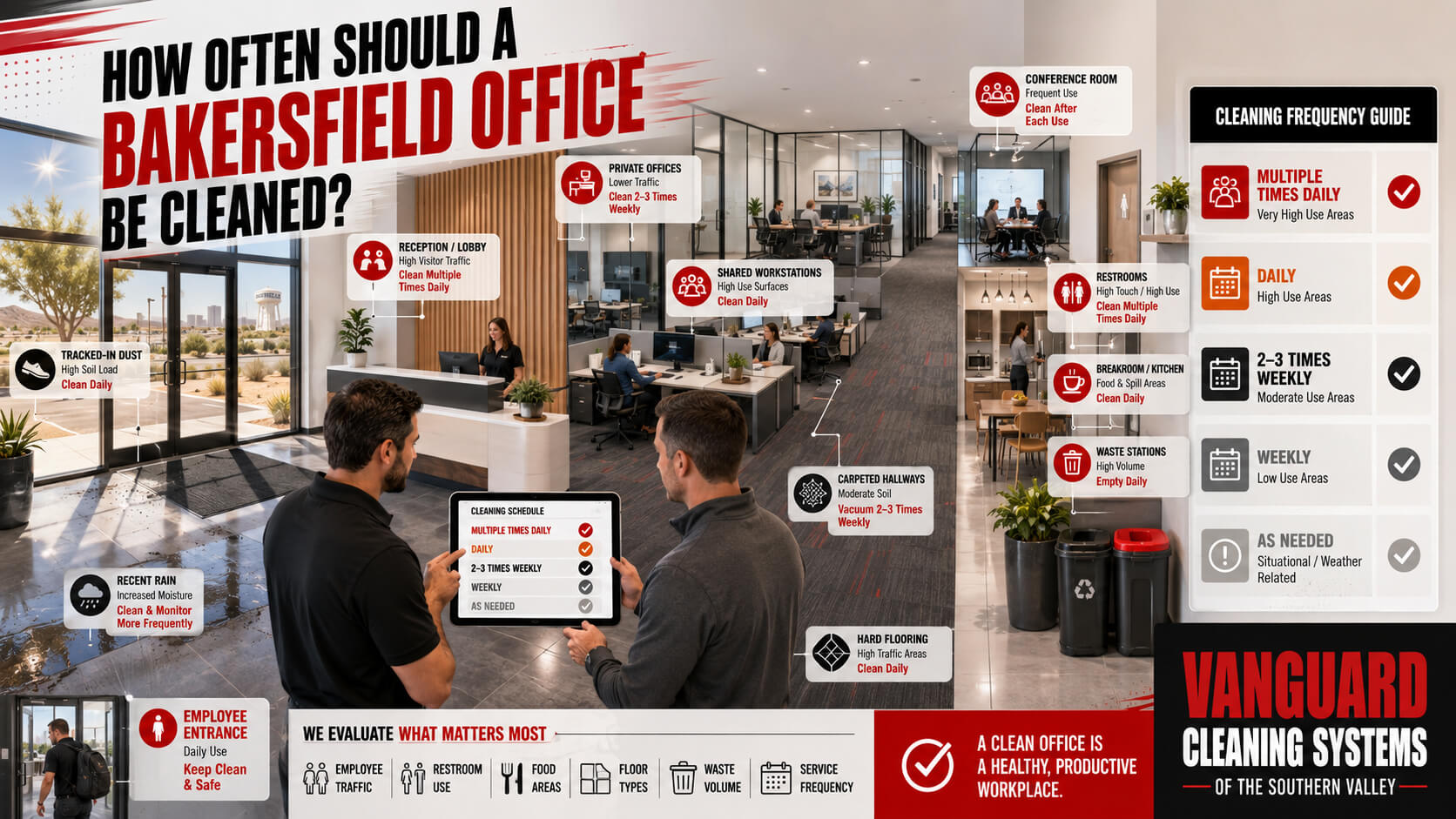
Most Bakersfield offices benefit from a layered cleaning schedule:
- Daily: Restrooms, breakrooms, waste removal, shared touchpoints, entrance areas, and heavily used floors
- Two or three times per week: Lower-traffic offices, private work areas, light dusting, vacuuming, and routine floor care
- Weekly: Detailed dusting, interior glass, conference rooms, furniture, low-traffic floors, and overlooked corners
- Monthly: Baseboards, vents, high surfaces, upholstery, appliance interiors, and hard-to-reach areas
- Seasonally: Carpet extraction, hard-floor maintenance, mat review, exterior-facing glass, and added soil control
A small office may need professional service only two or three evenings per week. A busy office may need daily service, restroom checks during business hours, or a midday breakroom reset.
The better question is not simply, “How often should the office be cleaned?” Ask, “How quickly does each area decline between service visits?”
For a task-by-task breakdown, review these daily, weekly, and monthly cleaning tasks.
What Is an Office Cleaning Schedule?
An office cleaning schedule is a written plan that assigns tasks according to area, use, condition, and frequency.
It should explain:
- Which rooms receive service
- What work is performed in each room
- How often each task is completed
- Which tasks rotate weekly or monthly
- When periodic floor and carpet work occurs
- How supply shortages, spills, and service concerns are reported
- Whether daytime checks are needed
- How the plan changes when workplace conditions change
A useful schedule goes beyond labels such as “basic service” or “general cleaning.” Those phrases leave too much room for different expectations.
For example, “clean the breakroom” could mean wiping the counter and emptying one waste container. It could also include tables, sinks, appliance exteriors, cabinet fronts, floors, food debris, and supply checks.
The scope should state what is included.
A clear schedule also helps separate cleaning frequency from cleaning quality. If a restroom looks good after service but declines by noon, the work may be completed properly but performed too infrequently.
How Office Cleaning Frequency Works
Cleaning frequency should match the rate at which soil, waste, marks, and supplies change within each part of the office.
The process starts with a walkthrough.
During the walkthrough, the facility representative and service provider should review:
- Employee count
- Visitor volume
- Business hours
- Number and size of restrooms
- Breakroom use
- Floor types
- Entrance conditions
- Waste volume
- Shared equipment
- Conference room activity
- Sensitive or restricted areas
- Current complaints
- Seasonal changes
This information helps determine which tasks belong on the daily, weekly, monthly, and periodic schedules.
The schedule should then be reviewed after service begins. Buildings change. A company may add employees, return workers to the office, open a second shift, remodel a breakroom, or begin receiving more visitors.
A cleaning plan that worked six months ago may no longer match current use.
Employee Count Influences Cleaning Frequency
More employees usually create more frequent cleaning needs.
Each person adds daily use to:
- Restrooms
- Waste containers
- Breakrooms
- Conference rooms
- Entrances
- Shared printers
- Door handles
- Hallways
- Parking-lot entrances
Employee count alone doesn’t provide the full answer. Workspace layout and employee habits also matter.
Twenty employees working in private offices may create less visible soil than twenty employees sharing open workstations, meeting rooms, and one small breakroom. Hybrid schedules may produce very busy days followed by lightly occupied days.
Offices With Fewer Than 20 Employees
A small, low-traffic office may be adequately served two or three times per week.
A typical schedule could include:
- Waste removal during each visit
- Restroom service during each visit
- Breakroom care during each visit
- Vacuuming or mopping based on floor condition
- Weekly dusting
- Rotating detail work
Daily service may still be needed when the office receives customers, prepares food, operates long hours, or has a restroom that sees heavy use.
Offices With 20 to 75 Employees
Many midsized offices benefit from weekday service.
Common priorities include:
- Daily restroom care
- Daily waste removal
- Daily breakroom service
- High-traffic floor care
- Entrance maintenance
- Weekly detailed dusting
- Rotating monthly tasks
The schedule may need adjustments on the busiest in-office days.
Larger and High-Occupancy Offices
Larger offices usually need daily service and may need attention during business hours.
Possible needs include:
- More than one restroom check per day
- Ongoing supply monitoring
- Midday waste removal
- Conference room resets
- Spill response
- Breakroom touchups
- Entrance care
- Separate schedules by floor or department
The goal is to prevent heavily used areas from declining long before the next full service visit.
Shared Spaces Need More Frequent Care
Shared spaces usually show wear before private offices.
These areas collect more fingerprints, crumbs, waste, tracked-in soil, and furniture movement. They are also more visible to employees and visitors.
Priority shared areas often include:
- Reception areas
- Waiting rooms
- Conference rooms
- Copy rooms
- Shared workstations
- Training rooms
- Hallways
- Elevator lobbies
- Beverage stations
- Employee breakrooms
A private office occupied by one person may need waste removal and vacuuming a few times per week. A conference room used by several groups each day may need daily attention or a reset after major meetings.
Usage should guide the schedule.
Business Hours Can Change the Entire Plan
An office operating from 8 a.m. to 5 p.m. may be maintained with evening service. A building that opens early, closes late, or runs several shifts has a much shorter recovery window.
Extended hours can create problems such as:
- Restrooms running low on supplies
- Waste containers filling before evening
- Breakroom spills remaining for hours
- Entry floors becoming visibly soiled
- Conference rooms staying untidy between meetings
- Moisture remaining on floors after a spill
Some workplaces need a combination of evening service and scheduled daytime checks.
A daytime service visit may focus on restrooms, supplies, waste, spills, entrance floors, and shared food areas. More detailed work can then be completed after the office becomes less occupied.
How Often Should Office Restrooms Be Cleaned?
Most office restrooms need service each day the building is occupied.
Daily restroom tasks may include:
- Cleaning toilets and urinals
- Cleaning sinks and counters
- Polishing mirrors
- Wiping partitions and fixtures
- Emptying waste containers
- Mopping floors
- Refilling soap
- Refilling paper towels
- Refilling toilet tissue
- Checking for leaks or damaged fixtures
A small restroom used by a limited number of employees may remain presentable throughout the day after one complete service.
A busy restroom may require checks every few hours.
Signs Restrooms Need More Frequent Attention
Watch for:
- Supplies running out before closing
- Full waste containers
- Water collecting on counters or floors
- Odors returning during business hours
- Marks building up around fixtures
- Repeated employee complaints
- Paper debris appearing soon after opening
These conditions may call for an added daytime check rather than a larger nighttime scope.
Learn more about planning routine restroom cleaning around occupancy and supply use.
How Often Should an Office Breakroom Be Cleaned?
Shared breakrooms generally need daily service.
Food, drinks, sinks, appliances, and waste can cause the room to decline quickly. A breakroom used by dozens of employees may need a midday reset in addition to evening service.
Daily breakroom work may include:
- Wiping tables and counters
- Cleaning the sink
- Removing crumbs and food debris
- Wiping appliance exteriors
- Emptying waste and recycling containers
- Replacing liners
- Cleaning visible spills
- Sweeping or vacuuming
- Mopping hard floors
- Checking paper products and soap
Microwave interiors, refrigerator interiors, cabinet fronts, chair legs, and other detailed areas may follow a weekly or monthly rotation, depending on the agreed scope.
Employee Policies Still Matter
A janitorial schedule works better when employees handle immediate food spills, remove expired personal food, and place waste in the correct containers.
Professional service shouldn’t be expected to resolve every issue caused during the next business day. Clear breakroom rules help keep conditions manageable between visits.
Review these common breakroom cleaning problems when assessing your current schedule.
Floor Type Affects Cleaning Frequency
Flooring needs depend on material, traffic, weather, entrance control, and appearance standards.
A plan based only on total floor area may overlook the places that receive the most wear.
Carpeted Offices
Carpet can hold dry soil, crumbs, fibers, and tracked-in debris.
High-traffic carpeted areas may need vacuuming each day, including:
- Main entrances
- Reception areas
- Central hallways
- Paths to restrooms
- Paths to breakrooms
- Conference room entrances
- Areas around shared printers
Private offices and low-use rooms may need vacuuming only a few times per week.
Spot treatment should occur when spills are found. Periodic carpet extraction should be scheduled according to traffic, manufacturer guidance, appearance, and soil buildup.
Waiting until the entire carpet looks dirty can make recovery more difficult.
Hard Floors
Hard floors often show dust, grit, footprints, and spills faster than carpet.
Routine care may include:
- Dust mopping
- Vacuuming edges
- Damp mopping
- Spot cleaning
- Cleaning corners
- Removing residue
- Checking entrances for loose grit
High-traffic hard floors may need daily care. Areas near beverage stations, restrooms, and entrances may need additional attention.
Periodic maintenance depends on the floor material and finish. A walkthrough should identify tile, vinyl, polished concrete, laminate, stone, and other surfaces so the correct methods can be planned.
Bakersfield Conditions Can Increase Indoor Soil
Bakersfield offices often deal with dry conditions and outdoor dust. Wind, construction activity, parking-lot soil, landscaping, and nearby roads can all affect what enters a building.
Employees and visitors carry soil inside on footwear. Some material settles near the entrance. Fine particles may move farther into hallways, carpeted areas, and offices.
Local conditions can increase the need for:
- Entrance mat care
- Lobby floor cleaning
- High-traffic vacuuming
- Dusting around window ledges
- Cleaning lower glass panels
- Vent and grille inspection
- Periodic carpet care
Dust that returns quickly doesn’t always mean surfaces were missed. It may indicate that the office needs more frequent entryway and floor service or that building-maintenance conditions should be reviewed.
Rain Changes the Problem
Dry soil can become mud during wet weather.
Rainy periods may require:
- More frequent mat checks
- Damp floor attention near doors
- Added caution around smooth flooring
- Faster response to tracked-in moisture
- More frequent entrance glass care
- Temporary changes to floor-service frequency
A fixed year-round schedule may not provide enough entrance care during changing weather.
Read more about maintaining high-traffic entryways before soil spreads into the rest of the office.
Daily Office Cleaning Tasks
Daily tasks should focus on conditions that change quickly or directly affect workplace use.
A daily schedule may include:
- Emptying waste containers
- Replacing liners
- Servicing restrooms
- Restocking restroom supplies
- Cleaning breakroom counters and tables
- Cleaning sinks
- Wiping shared touchpoints
- Vacuuming high-traffic carpet
- Cleaning hard floors as needed
- Spot cleaning entrance glass
- Removing visible spills
- Straightening shared areas
Daily doesn’t always mean every task is completed in every room. The scope may assign daily work only to high-use areas while lower-use rooms follow a rotating plan.
Weekly Office Cleaning Tasks
Weekly tasks provide more detailed care without placing every item on the nightly schedule.
Common weekly tasks include:
- Full surface dusting
- Detailed vacuuming
- Edge vacuuming
- Interior glass cleaning
- Partition cleaning
- Conference room detailing
- Low-use office cleaning
- Furniture dusting
- Window ledge cleaning
- Spot cleaning doors and frames
- Detailed mopping
- Cleaning waste-container exteriors
The exact rotation should be written into the scope so tasks don’t depend on memory.
Monthly Office Cleaning Tasks
Monthly work reaches areas that collect soil slowly.
Examples include:
- Baseboards
- High ledges
- Accessible vents and grilles
- Furniture legs
- Upholstered seating
- Cabinet fronts
- Appliance interiors when included
- Corners behind movable items
- Doorframes
- Low-use storage areas
- Detailed wall spot cleaning
- Hard-to-reach floor edges
Some offices divide these tasks across the month. One group may be completed each week instead of saving every detail for one service visit.
This keeps the workload balanced and makes progress easier to review.
Seasonal and Periodic Cleaning Tasks
Some work shouldn’t be placed on a daily, weekly, or monthly schedule.
Periodic services may include:
- Carpet extraction
- Hard-floor refinishing
- Upholstery cleaning
- Exterior-facing window care
- High dusting
- Entry-mat replacement or deep cleaning
- Detailed storage-room cleaning
- Post-construction cleanup
- Added service after office events
The schedule should identify when these services will be evaluated. Waiting until flooring or fabric looks heavily soiled can shorten its useful appearance and raise the amount of work required.
Environmental Factors That Affect Cleaning Frequency
Every office has conditions that speed up or slow down soil buildup.
Visitor Traffic
Customer-facing offices usually need more frequent entrance, lobby, glass, restroom, and waiting-area care.
Parking and Landscaping
Unpaved areas, active landscaping, nearby construction, and exposed soil can increase what reaches the entrance.
Workspace Density
Open offices and shared desks place more people in the same area. This often raises waste, floor traffic, and shared-surface use.
Food and Beverage Use
Coffee stations, snack areas, catered meetings, and full kitchens increase spill and waste volume.
HVAC and Building Maintenance
Dust that returns quickly may be linked to filtration, outdoor-air entry, remodeling, open doors, or maintenance activity. Cleaning can remove settled soil, but recurring sources may also need attention from building management.
Pets
Pet-friendly offices may need more frequent vacuuming, spot treatment, and waste management.
Office Events
Training days, open houses, employee lunches, and client meetings can create short-term service needs. The regular schedule may need a temporary adjustment before or after the event.
Workplace Conditions That Signal a Schedule Problem
A cleaning schedule should be reviewed when the office repeatedly declines before the next visit.
Waste Containers Fill Too Early
Overflowing waste can indicate:
- Service visits are too far apart
- Containers are too small
- High-volume areas need separate collection
- A daytime waste round is needed
Restroom Supplies Run Out
This may point to:
- Increased occupancy
- Higher visitor volume
- Too few daytime checks
- Storage or refill problems
- A supply quantity that no longer matches use
Breakroom Conditions Decline by Midday
Food debris, full containers, sticky counters, and odors may show that one evening visit isn’t enough for the room’s level of use.
Entry Floors Look Dirty Soon After Opening
The office may need better mat coverage, more frequent mat care, daytime spot cleaning, or a revised high-traffic floor plan.
Dust Returns Within Days
Rapid buildup may be tied to outdoor conditions, open doors, construction, filtration, or an insufficient dusting rotation.
Employees Handle Routine Cleaning Tasks
When office employees regularly empty waste, refill restroom supplies, clean floors, or manage recurring breakroom issues, the professional scope may no longer fit the workplace.
Complaints Follow a Pattern
Repeated complaints from the same area are useful data.
Record:
- Where the problem occurs
- What time it appears
- How often it happens
- Whether it follows busy days
- Whether it happens before or after service
- How long the correction lasts
Patterns help determine whether the issue involves frequency, scope, communication, access, supplies, or building conditions.
How to Build the Right Bakersfield Office Cleaning Schedule
A practical schedule can be built through a simple review process.
1. Count Daily Occupants and Visitors
Include employees, customers, contractors, delivery drivers, and people working different shifts.
2. Map High-Traffic Areas
Mark the routes from entrances to reception, restrooms, breakrooms, meeting rooms, and shared equipment.
3. Review Each Floor Type
Document the flooring in every area and note where visible soil appears first.
4. Measure Restroom and Breakroom Use
Look at supply use, waste volume, peak periods, and the time when conditions begin to decline.
5. List Current Complaints
Separate recurring issues from one-time problems.
6. Assign Tasks by Frequency
Place fast-changing conditions on the daily schedule. Rotate slower-changing detail work weekly or monthly.
7. Plan for Local Weather
Allow seasonal adjustments for dry soil, wind, rain, pollen, and entrance moisture.
8. Review Results After Service Begins
Compare the schedule with actual building conditions. Adjust tasks or frequency where needed.
For a more detailed planning tool, use this janitorial services checklist.
How Often Should Different Bakersfield Offices Be Cleaned?
These examples provide starting points. The final schedule should follow actual use.
Small Professional Office
Possible frequency: Two or three visits per week
Typical priorities:
- Waste removal
- Restrooms
- Breakroom care
- Vacuuming
- Hard-floor care
- Weekly dusting
- Monthly detail rotation
Busy Administrative Office
Possible frequency: Daily weekday service
Typical priorities:
- Daily restrooms
- Daily waste removal
- Daily breakroom cleaning
- High-traffic floors
- Shared spaces
- Entrance care
- Weekly detailed dusting
- Rotating monthly work
Customer-Facing Office
Possible frequency: Daily service with daytime checks
Typical priorities:
- Reception
- Waiting rooms
- Public restrooms
- Entry glass
- Entrance floors
- Shared counters
- Waste removal
- Conference or interview rooms
Office With Several Shifts
Possible frequency: Daily service plus scheduled checks
Typical priorities:
- Restroom supplies
- Breakroom resets
- Waste rounds
- Spill response
- Floor care
- Communication between service periods
People Also Ask
Should an office be cleaned every day?
Many offices need daily service in restrooms, breakrooms, entrance areas, waste stations, and heavily used floors. Small, low-traffic offices may be adequately served two or three times per week.
Is cleaning an office once per week enough?
Once-weekly service may work for a very small office with limited use and no shared kitchen or customer traffic. It is usually too infrequent for busy restrooms, food areas, and high-traffic floors.
How often should office carpets be vacuumed?
High-traffic carpet should often be vacuumed daily. Private offices and lightly used rooms may be placed on a two- or three-times-per-week schedule.
How often should office restrooms be checked?
A lightly used restroom may need one complete daily service. Busy restrooms may need checks every few hours for supplies, waste, moisture, and visible soil.
How often should an office kitchen be cleaned?
Shared office kitchens and breakrooms should usually receive daily care. Heavily used spaces may also need a midday reset.
Does a large office always need more cleaning?
Larger offices often require more labor, but size alone doesn’t determine frequency. Occupancy, visitors, layout, restroom use, food areas, floors, and operating hours matter more.
Can office cleaning frequency change by season?
Yes. Bakersfield offices may need added entrance, mat, floor, and dust control during dry or windy periods. Wet weather can increase tracked-in soil and moisture.
Review Whether Your Current Schedule Still Fits
The right cleaning frequency should keep the workplace in acceptable condition between service visits.
A schedule may need to change when:
- The company adds employees
- More people return to the office
- Business hours expand
- Customer traffic rises
- A new breakroom opens
- Restroom use increases
- Flooring is replaced
- Complaints become more frequent
- Seasonal soil begins entering the building
Vanguard Cleaning Systems of the Southern Valley can help businesses review their current needs and develop a service plan based on the way the building is used. Janitorial services are performed by independently owned and operated janitorial franchise businesses.
Explore office cleaning services in Bakersfield or learn more about routine commercial cleaning.
Service information is also available for businesses in:
To discuss your facility, contact Vanguard Cleaning Systems of the Southern Valley or request a quote.
Frequently Asked Questions
What is included in routine office cleaning?
A routine scope may include waste removal, restroom care, breakroom cleaning, dusting, vacuuming, mopping, entrance care, and shared-surface cleaning. The exact tasks should be listed in the service agreement.
How can I tell whether my office needs daily service?
Daily service may be appropriate when restrooms decline before closing, waste fills quickly, breakrooms receive heavy use, visitors enter throughout the day, or high-traffic floors need attention every evening.
Can different rooms follow different schedules?
Yes. Restrooms and breakrooms may require daily service while private offices, storage rooms, and low-use spaces follow a rotating schedule.
Should square footage determine cleaning frequency?
Square footage helps estimate labor, but it shouldn’t be the only factor. Occupancy, room use, flooring, hours, visitor traffic, and waste volume provide better guidance.
When should a cleaning schedule be reviewed?
Review it after occupancy changes, remodeling, new shifts, recurring complaints, seasonal changes, or any major change in how the office is used. A yearly review is also useful when conditions appear stable.
Are periodic floor services part of regular office cleaning?
They may be included as scheduled services or priced separately. Carpet extraction, hard-floor refinishing, and other periodic work should be clearly identified in the scope.
Who performs the janitorial services?
Commercial janitorial services are performed by independently owned and operated janitorial franchise businesses. Vanguard Cleaning Systems of the Southern Valley supports the regional franchise system and customer account process.
References
California Department of Public Health. (2026). Kern Valley fever. https://www.cdph.ca.gov/Programs/RPHO/Pages/FoPH-Impact/Central-California/Kern-Valley-Fever.aspx
Occupational Safety and Health Administration. (n.d.). Cleaning industry. U.S. Department of Labor. https://www.osha.gov/cleaning-industry
Occupational Safety and Health Administration. (n.d.). Sanitation: 29 C.F.R. § 1910.141. U.S. Department of Labor. https://www.osha.gov/laws-regs/regulations/standardnumber/1910/1910.141
U.S. Environmental Protection Agency. (2026). An office building occupant’s guide to indoor air quality. https://www.epa.gov/indoor-air-quality-iaq/office-building-occupants-guide-indoor-air-quality
Vanguard Cleaning Systems of the Southern Valley. (2025, May 20). Janitorial services checklist: Daily, weekly, and monthly tasks. https://www.vanguardsv.com/2025/05/janitorial-services-checklist-daily-weekly-and-monthly-tasks/
Vanguard Cleaning Systems of the Southern Valley. (2026). Commercial cleaning. https://www.vanguardsv.com/essential-services/commercial-cleaning/
Vanguard Cleaning Systems of the Southern Valley. (2026). Janitorial services Bakersfield, CA. https://www.vanguardsv.com/location/janitorial-services-bakersfield/
Vanguard Cleaning Systems of the Southern Valley. (2026, July). Office cleaning frequency: Daily, weekly, and monthly tasks. https://www.vanguardsv.com/2026/07/office-cleaning-frequency-daily-weekly-and-monthly-tasks/
