
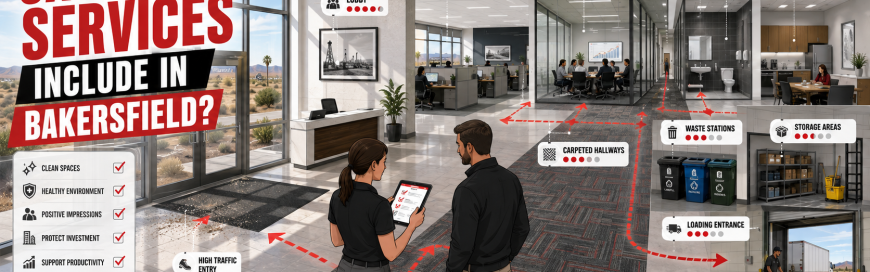
A useful janitorial service plan clearly defines the areas, tasks, frequencies, responsibilities, and quality expectations for a specific building.
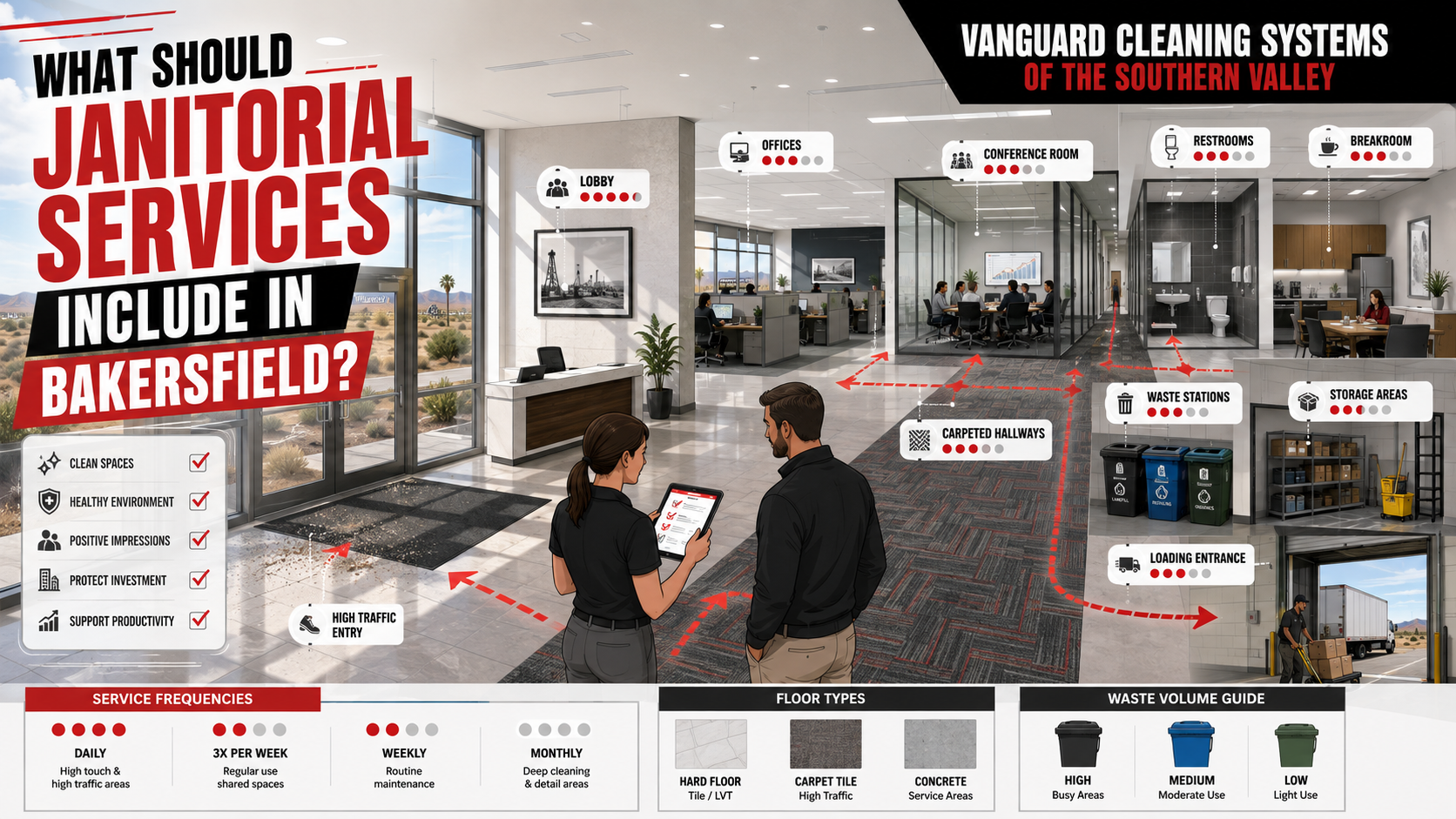
Bakersfield Buildings Need More Than a Generic Task List
A commercial building can look simple from the outside. Inside, its janitorial needs may change from one room to the next.
A busy medical office may have crowded waiting areas, heavily used restrooms, exam rooms, staff breakrooms, and hard floors that show soil quickly. A professional office may have lower daytime traffic but more carpet, glass, workstations, and private rooms. Warehouses may deal with loading areas, concrete floors, production dust, employee locker rooms, and waste that moves through the building at a different pace.
Bakersfield also has long dry periods, seasonal dust, agricultural activity, construction, and heavy vehicle traffic. Soil can enter through doors, loading areas, shoes, equipment, and open service entrances. Once inside, it collects on mats, floors, ledges, baseboards, furniture, and surfaces near air returns.
That is why a janitorial proposal should be based on how the facility works each day. Square footage matters, but it does not tell the whole story. Room types, occupancy, traffic, floor materials, operating hours, waste volume, restroom use, and service frequency all influence the scope.
Quick Answer
Janitorial services for a Bakersfield facility may include:
- Restroom cleaning and supply checks
- Breakroom and shared-kitchen care
- Waste and recycling removal
- Carpet vacuuming and spot cleaning
- Hard-floor sweeping, mopping, and scheduled maintenance
- Dusting of accessible surfaces
- Cleaning of entrance glass and interior glass
- Care for lobbies, hallways, offices, and shared spaces
- High-touch surface cleaning
- Periodic detail work
- Supply restocking when included in the agreement
- Quality inspections and service communication
A complete proposal should state where each task will be performed, how often it will happen, which services cost extra, and who is responsible for supplies.
What Are Janitorial Services?
Janitorial services are recurring building-care tasks performed according to an agreed schedule and written scope of work.
The service may take place during the day, after business hours, or through a mix of scheduled visits and daytime checks. The plan can cover an entire building or selected areas based on the customer’s needs.
Routine janitorial work often includes waste removal, restroom care, floor cleaning, breakroom cleaning, dusting, vacuuming, and the upkeep of common areas. Some facilities also need periodic services such as carpet extraction, hard-floor finishing, interior window cleaning, upholstery care, or detailed cleaning around edges and fixtures.
A janitorial program should provide a shared definition of the work being purchased. General phrases such as “clean the office” or “provide routine service” do not give either party enough detail.
A stronger scope answers practical questions:
- Which rooms are included?
- What tasks will be performed in each room?
- How often will each task be completed?
- Which areas receive priority?
- Are paper products and liners included?
- Who monitors supply inventory?
- Which periodic services are part of the monthly price?
- How are missed tasks reported?
- Who responds to a service concern?
- How are changes to the scope approved?
These details make it easier to compare proposals and review performance after service begins.
How a Janitorial Scope of Work Is Created
A janitorial scope usually begins with a facility walkthrough.
During the walkthrough, the building representative can explain how the facility is used, point out recurring concerns, identify restricted areas, and discuss current service problems. The prospective service provider can review room types, flooring, fixtures, access requirements, storage, equipment needs, and service conditions.
The written proposal should turn those observations into clear tasks and frequencies.
Building Use
The building’s purpose affects almost every part of the cleaning plan.
An office, school, clinic, distribution center, financial institution, auto dealership, manufacturing facility, and government building may have similar rooms. The way those rooms are used can be very different.
Building-use questions may include:
- What work takes place inside?
- How many people use the building?
- Are visitors present throughout the day?
- Are evening or weekend shifts active?
- Are there public and restricted areas?
- Is food prepared or stored?
- Are there locker rooms or showers?
- Does the facility have a warehouse or loading area?
- Are there spaces with special access rules?
- Does the building host meetings, classes, or events?
A facility with 30 employees may need a different plan than a similarly sized building with 150 employees, daily visitors, and extended operating hours.
Occupancy and Traffic
Foot traffic affects how quickly a building begins to look soiled.
The front entrance may receive hundreds of daily crossings. A private office may be entered only a few times. A hallway near a restroom may need more attention than a low-use storage corridor.
Areas that commonly receive heavy traffic include:
- Main entrances
- Lobbies
- Reception areas
- Elevators
- Stairwells
- Main corridors
- Restroom approaches
- Breakroom entrances
- Time-clock areas
- Shipping and receiving zones
- Customer service counters
- Conference rooms
High-traffic areas may need more frequent vacuuming, spot cleaning, mat care, glass cleaning, and waste removal. They may also need daytime attention even when the main janitorial visit occurs after hours.
Traffic patterns can change. Seasonal staffing, construction, office attendance, customer volume, special events, and new departments can increase the work needed in certain areas.
Room Types
Every space should be identified by function.
A proposal that treats every square foot the same may overlook major differences between offices, restrooms, breakrooms, corridors, and production areas.
Common room categories include:
- Private offices
- Open work areas
- Conference rooms
- Training rooms
- Lobbies
- Reception areas
- Restrooms
- Breakrooms
- Kitchens
- Copy rooms
- Storage rooms
- Locker rooms
- Hallways
- Stairwells
- Warehouses
- Shipping areas
- Medical waiting rooms
- Exam rooms
- Classrooms
Each category can have its own task list. For example, an office may need waste removal, carpet care, accessible-surface dusting, and spot cleaning. A restroom requires fixture care, floor cleaning, waste removal, dispenser checks, mirror cleaning, and supply monitoring.
Restroom Services
Restrooms often require some of the most detailed work in a commercial facility.
Usage can rise quickly during busy periods. A restroom that looks acceptable early in the morning may need attention again by midday.
A written restroom scope may address:
- Toilets and urinals
- Sinks and counters
- Faucets and handles
- Mirrors
- Stall doors and partitions
- Dispensers
- Waste containers
- Floors
- Corners and edges
- Floor drains
- Accessible ledges
- Door handles and push plates
- Soap, tissue, towels, and seat-cover supplies
The scope should also identify how often the restroom is serviced. A small employee restroom may be included in an evening schedule. A public restroom in a busy building may need multiple daily checks.
Supply responsibilities need to be clear. Some agreements include restocking from products supplied by the customer. Others include supply management or ordering as a separate service.
The proposal should state:
- Who purchases the supplies
- Who stores them
- Who monitors inventory
- Who approves orders
- Whether restocking is included
- What happens when inventory runs low
Learn more about commercial restroom cleaning and the details that may be considered when building a restroom service plan.
Breakrooms and Shared Kitchens
Breakrooms can create complaints even when the rest of a building looks well maintained.
Food spills, appliance residue, full trash containers, crumbs, sink buildup, and neglected floor edges can make the room feel uncared for. The problem can become more noticeable in warm weather.
A breakroom scope may include:
- Cleaning counters
- Wiping tables
- Cleaning sinks and faucets
- Wiping appliance exteriors
- Removing microwave spills
- Cleaning refrigerator handles
- Emptying waste and recycling
- Replacing liners
- Sweeping and mopping floors
- Cleaning chair touchpoints
- Addressing visible cabinet residue
- Spot cleaning doors and walls
- Detailing corners and edges
Interior refrigerator cleaning should be listed separately. It may require a customer policy for removing food, labeling personal items, or choosing a scheduled cleanout day.
Dishwashing is another responsibility that should not be assumed. Some facilities expect employees to manage personal dishes. Others request additional kitchen support. The agreement should state what is included.
For more detail, review these breakroom and kitchen cleaning best practices.
Waste and Recycling
Waste removal can require a large share of the service time in a commercial building.
The scope should identify the number, type, and location of waste containers. It should also explain where collected waste is taken.
Questions may include:
- Are individual desk containers serviced?
- Does the building use centralized waste stations?
- Is recycling collected separately?
- Are conference-room containers included?
- Are breakroom containers checked more often?
- Are exterior containers included?
- Does waste need to be transported a long distance?
- Are liners replaced every visit or only when needed?
- Are large boxes handled by building staff?
- Are any waste types excluded?
Special waste should be clearly addressed. A regular janitorial agreement may exclude medical waste, chemicals, construction debris, confidential documents, manufacturing byproducts, electronic waste, and other regulated materials.
The building representative should confirm who manages excluded waste and how it is stored.
Carpet Care
Carpet needs can vary across the same building.
A main walkway may show soil quickly while carpet under desks remains relatively clean. Entry areas may collect sand and dry soil. Breakroom approaches may develop spots. Rolling chairs can create worn traffic patterns.
Routine carpet service may include:
- Vacuuming high-traffic paths
- Vacuuming open areas
- Edge vacuuming
- Spot cleaning
- Cleaning entrance mats
- Addressing accessible areas under furniture
Periodic carpet work may include:
- Carpet extraction
- Low-moisture cleaning
- Bonnet cleaning when appropriate
- Detailed edge cleaning
- Upholstery cleaning
- Walk-off mat cleaning
The proposal should state whether periodic carpet care is included in the monthly price, scheduled separately, or provided only after approval.
It should also clarify how furniture is handled. Moving lightweight chairs is different from relocating desks, file cabinets, electronics, or conference tables.
Hard-Floor Care
Hard floors require a plan based on the floor material, finish, traffic, and desired appearance.
Common commercial flooring includes:
- Luxury vinyl tile
- Vinyl composition tile
- Ceramic tile
- Porcelain tile
- Sealed concrete
- Polished concrete
- Epoxy
- Rubber
- Sheet vinyl
- Laminate
- Wood or wood-look surfaces
Routine care may involve:
- Sweeping
- Dust mopping
- Damp mopping
- Auto scrubbing
- Spot cleaning
- Edge cleaning
- Cleaning around mats
- Removing visible marks when the floor allows
Periodic services may involve:
- Machine scrubbing
- Burnishing
- Spray buffing
- Floor-finish application
- Floor-finish removal
- Grout detailing
- Concrete maintenance
- Restorative floor care
The phrase “clean floors” does not explain which methods will be used. It also does not tell the customer whether scheduled floor maintenance is included.
A detailed proposal should identify the floor types and assign a service method and frequency to each area.
Dusting and Accessible Surface Care
Dust can become a persistent concern in Bakersfield buildings.
Outdoor soil may enter through doors, windows, loading areas, clothing, and equipment. Dry conditions can make fine particles more visible on dark furniture, ledges, vents, electronics, and baseboards.
Routine dusting may include accessible:
- Desks without personal items in the way
- Tables
- Counters
- Shelves
- Window ledges
- Cabinet tops
- Chair rails
- Baseboards
- Door frames
- Picture frames
- Partition tops
- Vent exteriors
- Air-return covers
The agreement should explain what “accessible” means. Janitorial service may not include moving paperwork, personal items, electronics, sensitive equipment, or fragile objects.
High dusting should also be listed separately. Surfaces above normal reach may require ladders, special tools, additional safety steps, and a different schedule.
Entrances, Lobbies, and Reception Areas
The entrance often shapes a visitor’s first impression before anyone speaks to them.
Bakersfield entrances may collect dry soil, parking-lot debris, landscaping material, pollen, and dust. Weak mat coverage can allow that material to spread into the lobby and nearby hallways.
Entrance and lobby work may include:
- Vacuuming or cleaning mats
- Sweeping exterior approach areas when included
- Mopping hard floors
- Cleaning entrance glass
- Wiping handles and push plates
- Emptying lobby waste
- Dusting reception surfaces
- Spot cleaning doors and walls
- Cleaning corners and thresholds
- Straightening approved furniture
- Removing visible fingerprints
- Cleaning interior glass partitions
Exterior windows, pressure washing, high glass, and large-scale window service may be priced separately.
The proposal should distinguish routine entrance-glass care from full window cleaning.
Offices, Workstations, and Conference Rooms
Office cleaning requires clear boundaries around personal items, confidential material, and electronics.
A typical office scope may include:
- Emptying waste
- Replacing liners when needed
- Vacuuming carpet
- Mopping hard flooring
- Dusting clear, accessible surfaces
- Wiping approved touchpoints
- Spot cleaning interior glass
- Cleaning door handles
- Straightening chairs when requested
- Addressing visible wall marks
- Cleaning around accessible furniture
Workstations can take longer when floors are crowded with cords, boxes, bags, equipment, or personal items. Employees should understand which surfaces must remain clear for service.
Conference rooms may need extra attention after meetings. Tables, chair placement, glass, waste, and floors can change quickly during a busy day.
The scope should state whether conference rooms are serviced after every scheduled visit, on selected days, or by request.
High-Touch Surface Cleaning
High-touch surfaces are areas that many people contact throughout the day.
Examples include:
- Door handles
- Push plates
- Light switches
- Elevator buttons
- Railings
- Shared counters
- Appliance handles
- Drinking-fountain controls
- Conference-room controls
- Shared cabinet pulls
- Restroom latches
- Time clocks
The proposal should identify which touchpoints are included and how often they are cleaned.
A building with high visitor volume may need daytime touchpoint attention. A small private office may handle the task during scheduled evening service.
Periodic Detail Work
Some tasks do not need to happen during every visit. They still need a defined schedule.
Periodic work may include:
- High dusting
- Baseboard detailing
- Carpet extraction
- Hard-floor restoration
- Interior window cleaning
- Upholstery cleaning
- Grout detailing
- Deep breakroom cleaning
- Detailed restroom floor care
- Wall spot cleaning
- Vent-area dust removal
- Storage-room cleaning
- Cleaning beneath accessible furniture
- Light-fixture exterior cleaning
A good proposal separates routine, detail, and project work. That prevents a customer from assuming an annual or quarterly service is part of the nightly task list.
For a sample frequency structure, review this janitorial services checklist.
How Service Frequency Should Be Set
Service frequency should match the pace at which an area becomes soiled, depleted, or uncomfortable.
Common frequencies include:
- Several times per day
- Once per business day
- Each scheduled service visit
- Three times per week
- Twice per week
- Weekly
- Twice monthly
- Monthly
- Quarterly
- Semiannually
- Annually
- Upon request
The word “daily” can be unclear. It may mean Monday through Friday, every calendar day, or every scheduled service day. The agreement should define it.
Frequency may also vary by area.
A proposal could call for:
- Restroom service five days per week
- Breakroom cleaning five days per week
- Office waste removal three days per week
- High-traffic carpet vacuuming five days per week
- Low-traffic carpet vacuuming twice per week
- Baseboard detail work monthly
- Carpet extraction twice per year
A building does not need the same frequency everywhere. Matching frequency to use can keep priority areas from falling behind while controlling unnecessary work in low-use rooms.
Environmental Factors That Affect Bakersfield Facilities
Local conditions can influence how quickly janitorial needs change.
Dry Soil and Dust
Dry outdoor conditions allow fine soil to enter through doors, dock areas, shoes, equipment, and air movement. It may become visible around baseboards, entry mats, window ledges, furniture, and floor edges.
Entrance matting and routine floor care can help control how far that material travels.
Heat
Warm weather can make waste and food-related odors noticeable sooner. Breakroom trash, restroom waste, exterior containers, and floor drains may need more attention during hot periods.
Service frequency should be reviewed when odor complaints increase.
Seasonal Pollen and Landscaping Debris
Pollen, leaves, grass, and landscaping material can collect near entrances. Once tracked indoors, they may spread through lobbies and main walkways.
Mat condition, entrance cleaning, and high-traffic vacuuming become more important during these periods.
Construction and Agricultural Activity
Nearby construction, roadwork, agricultural operations, and heavy vehicle movement can increase soil around some properties.
Facilities near open lots, industrial areas, highways, or active construction may need added entrance and dust-control work.
Building Age and Condition
Older grout, worn floor finish, damaged dispensers, leaking plumbing, poor mat placement, and aging surfaces can affect results.
Janitorial service can maintain a surface, but it cannot repair damaged flooring, plumbing, broken dispensers, failed seals, or building-envelope problems. A good communication process helps the service provider report those concerns.
Workplace Relevance
Employees and visitors tend to notice a building through everyday details.
They notice empty paper dispensers. They see fingerprints on entrance glass. They smell breakroom trash. They recognize when floors are dull, corners have buildup, or restroom conditions change during the day.
These issues affect more than appearance. They can create repeated complaints and take time away from managers who must report the same concerns.
A clear janitorial scope gives the facility representative a practical way to review service. Instead of saying, “The building does not feel clean,” the representative can refer to a specific area, task, or frequency.
That makes communication easier.
For example:
- A full restroom waste container may point to a missed visit or low frequency.
- Repeated carpet spots may show a need for added spot cleaning.
- Dust near vents may be a periodic-task issue.
- Breakroom odors may result from waste frequency or hidden food residue.
- Worn floor appearance may require scheduled floor maintenance.
- Empty supplies may show an inventory or restocking problem.
A detailed scope helps separate service concerns from repairs, supply shortages, employee responsibilities, and tasks that were never included.
Warning Signs of an Incomplete Janitorial Proposal
Some proposals provide a price without enough detail to understand what the customer is buying.
Watch for vague phrases such as:
- General cleaning
- Routine janitorial service
- Maintain all areas
- Clean floors
- Service restrooms
- Dust as needed
- Standard office cleaning
- Perform normal duties
These phrases need supporting details.
No Room-by-Room Task List
The proposal should identify the spaces included in service. Restrooms, offices, breakrooms, entrances, and warehouses have different needs.
No Task Frequencies
A task name alone is not enough. Vacuuming once per week and vacuuming five times per week are very different service plans.
No Supply Responsibilities
The proposal should explain who purchases, stores, orders, and restocks consumable products.
No Periodic-Service Schedule
Carpet cleaning, hard-floor maintenance, high dusting, and interior windows may be excluded from the monthly fee. That should be visible before the agreement is signed.
Too Much Dependence on “As Needed”
“As needed” should have a clear meaning. It may refer to visible soil, customer requests, inspection findings, or work approved outside the regular scope.
No Exclusions
A complete proposal should explain what is not included. This may include exterior windows, regulated waste, pest control, plumbing, dishwashing, construction cleanup, moving heavy furniture, or services above normal reach.
No Communication Process
The customer should know who receives routine requests, how urgent concerns are handled, and how changes are documented.
No Quality Review
The proposal should explain how service is checked. Quality reviews may include inspections, customer feedback, account communication, documented corrections, and periodic scope reviews.
For more guidance, read about reviewing a janitorial service proposal.
Questions to Ask During a Facility Walkthrough
A productive walkthrough should cover the building’s actual conditions and expectations.
Consider asking:
- Which rooms are included in the quoted price?
- How many service visits are proposed?
- Which tasks happen during every visit?
- Which tasks happen weekly or monthly?
- How are heavily used restrooms handled?
- Are breakroom appliances included?
- Who monitors restroom and breakroom supplies?
- Is floor maintenance included?
- How are carpet spots handled?
- Are entrance glass and interior glass included?
- What services require separate approval?
- How are restricted areas managed?
- Who is the main service contact?
- How are complaints documented?
- How are recurring problems reviewed?
- How will changes in occupancy be handled?
- What happens when the building hosts a special event?
- Are daytime service options available?
- How are keys, alarms, and access codes managed?
- What should employees clear before service?
The walkthrough is also a good time to discuss the current provider. Specific examples are more useful than broad complaints.
Instead of saying the service is inconsistent, explain what happens:
- Restroom supplies run out by afternoon.
- Waste is missed in a certain department.
- Entry mats stay full of soil.
- The breakroom floor remains sticky.
- Carpet edges are rarely vacuumed.
- Communication takes several days.
- The same concern returns after being corrected.
These details help shape a proposal around the building’s real priorities.
How to Compare Janitorial Quotes
Compare each quote using the same categories.
Start with:
- Service days
- Service hours
- Rooms included
- Routine tasks
- Weekly tasks
- Monthly tasks
- Periodic services
- Supply responsibilities
- Equipment responsibilities
- Quality reviews
- Communication process
- Complaint response
- Exclusions
- Optional services
- Monthly price
Price should be reviewed after confirming that each company is proposing the same work.
One quote may include five weekly visits while another includes three. One may include carpet extraction. Another may price it separately. A lower price can come from fewer tasks, lower frequencies, more exclusions, or a shorter service window.
The written scope gives the price context.
Commercial Cleaning Services in the Southern Valley
Vanguard Cleaning Systems of the Southern Valley supports the development of customized janitorial programs for facilities across its regional service area. Commercial cleaning services are performed by independently owned and operated janitorial franchise businesses.
Learn more about available commercial cleaning services and local service information for:
- Janitorial services in Bakersfield
- Janitorial services in Fresno
- Janitorial services for Visalia and surrounding areas
- Janitorial services in Valencia
- Janitorial services in Lancaster
- Janitorial services in Palmdale
The service plan should still begin with the facility itself. Two Bakersfield buildings can need different task lists even when they have similar square footage.
People Also Ask
What is normally included in commercial janitorial services?
Commercial janitorial services may include restroom cleaning, breakroom cleaning, waste removal, vacuuming, mopping, dusting, entrance-glass care, high-touch surface cleaning, and upkeep of common areas. The exact tasks depend on the written scope.
How often should a commercial building receive janitorial service?
Frequency depends on occupancy, traffic, restroom use, waste volume, operating hours, and the type of work performed inside. Busy facilities may need daily service or daytime checks. Smaller offices may use service two or three times per week.
Are floor services included in a janitorial contract?
Routine sweeping, vacuuming, and mopping may be included. Carpet extraction, burnishing, floor-finish work, grout detailing, and other periodic services may be priced separately. The proposal should identify each service.
Does janitorial service include restroom supplies?
Some agreements include restocking products supplied by the customer. Others include inventory management or supply purchasing. The contract should explain who purchases, stores, monitors, and restocks each item.
Are breakroom appliances cleaned by a janitorial provider?
Exterior appliance wiping may be included. Microwave interiors, refrigerator interiors, ovens, dishes, and food removal should be listed specifically because they may require added time or customer policies.
What should a janitorial proposal say about frequency?
It should assign a frequency to each major task. Examples include each service visit, daily, three times per week, weekly, monthly, quarterly, or upon request.
Why do two janitorial quotes have different prices?
The proposals may include different service days, task frequencies, periodic services, staffing assumptions, supply responsibilities, equipment, or exclusions. Compare the scopes line by line before comparing totals.
Can a janitorial scope change after service begins?
Yes. Occupancy, operating hours, building use, traffic, and customer expectations can change. Scope changes should be documented along with any adjustment to frequency or price.
Frequently Asked Questions
What is the difference between janitorial and commercial cleaning services?
Janitorial service usually refers to recurring scheduled tasks. Commercial cleaning is a broader term that may include janitorial work and periodic or specialized services.
Is square footage enough to estimate janitorial service?
No. Square footage is one factor. Room types, occupancy, floor materials, traffic, restroom fixtures, waste volume, and frequency also affect the work.
Should every room be cleaned during every visit?
Not always. High-use areas may require attention during each visit. Low-use rooms may follow a different schedule.
What does a facility walkthrough involve?
The walkthrough reviews room types, use patterns, floors, restrooms, waste, access, supplies, current concerns, service frequency, and expected results.
Should the proposal list exclusions?
Yes. Exclusions help prevent confusion about periodic work, special waste, exterior services, repairs, and tasks that need separate approval.
Who should handle janitorial complaints?
The agreement should identify a primary contact and a process for reporting, correcting, and reviewing service concerns.
How often should a janitorial scope be reviewed?
Review it when occupancy, operating hours, room use, traffic, or service expectations change. A periodic account review can also identify tasks that need adjustment.
Can daytime janitorial service be included?
Yes. Daytime service may help with busy restrooms, high-volume waste, spills, lobby appearance, supply checks, and shared spaces.
What information should be ready before requesting a quote?
Prepare the building address, approximate square footage, operating hours, number of occupants, requested service days, restroom count, floor types, access details, and a list of current concerns.
Request a Facility Walkthrough
A janitorial proposal should describe the service clearly enough that both parties understand the priorities, tasks, frequencies, and responsibilities.
A facility walkthrough provides an opportunity to review:
- How the building is used
- Where traffic is highest
- Which restrooms need the most attention
- How breakrooms and shared areas are maintained
- Which floor materials are present
- How waste moves through the facility
- Which periodic services may be needed
- How service concerns should be communicated
Request a facility walkthrough to discuss the building’s priorities and service scope.
You may also request a janitorial service quote for a Bakersfield-area commercial facility.
Each Vanguard Cleaning Systems® business is independently owned and operated.
© 2026 Prestige Worldwide, Inc. dba Vanguard Cleaning Systems of the Southern Valley.
References
APPA. (n.d.). Cleaning operations. https://www.appa.org/cleaning-operations
APPA. (2023). Operational guidelines for educational facilities: Custodial (4th ed.). APPA.
ISSA. (n.d.). The official ISSA cleaning times: Tasks, tools, and workloading resource. https://store.issa.com/shop/handbook/the-official-issa-cleaning-times-tasks-tools-workloading-resource/
ISSA. (2017, December 18). Workloading: Finding the right balance. https://www.issa.com/articles/workloading-finding-the-right-balance/
Schreck, J. H., Lashaki, M. J., Hashemi, J., Dhanak, M., & Verma, S. (2021). Aerosol generation in public restrooms. Physics of Fluids, 33(3), Article 033320. https://doi.org/10.1063/5.0040310
