
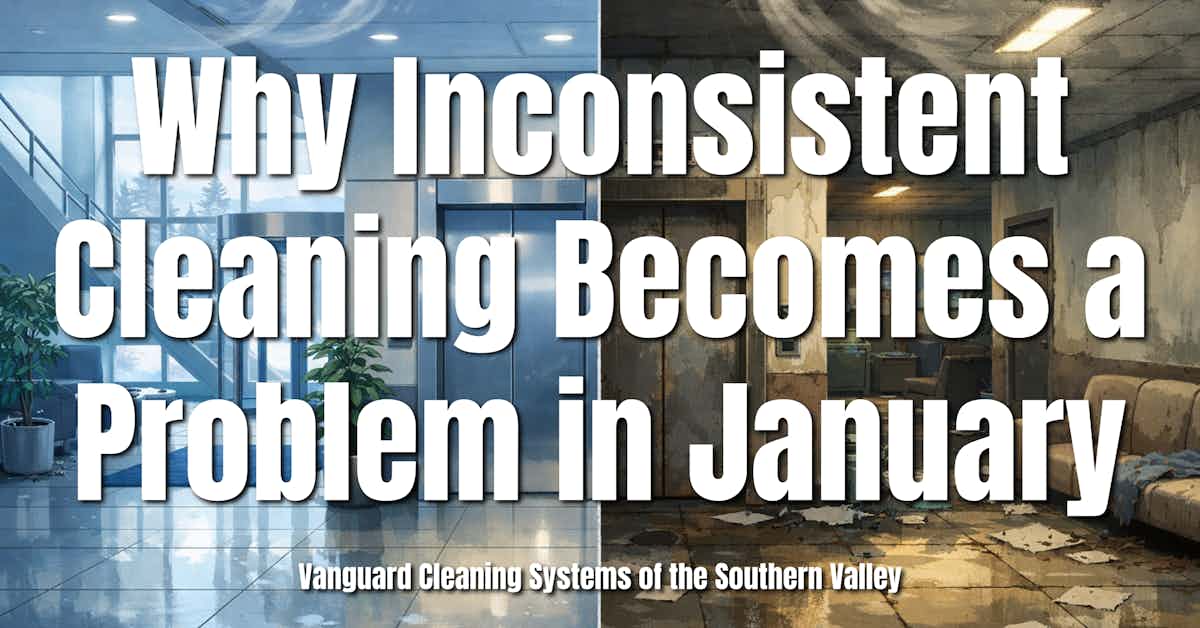
January is when inconsistent cleaning habits stop being invisible and start affecting health, morale, and productivity.
Why January Exposes Cleaning Gaps More Than Any Other Month
Inconsistent cleaning practices rarely fail all at once. Instead, they accumulate quietly over time—until January brings the perfect conditions for those gaps to surface. The combination of winter weather, reduced ventilation, increased indoor activity, and a cultural reset makes this month uniquely revealing for both residential and commercial environments.
What went unnoticed in the final weeks of the year becomes harder to ignore once normal operations resume. Dust, residue, clutter, stale air, and deferred maintenance all become more visible and more impactful at the same time.
The Holiday Disruption Effect
December disrupts routines. Extended breaks, altered schedules, higher foot traffic, and temporary staffing changes all interfere with consistency. In commercial environments, this often means:
- Missed or shortened cleaning cycles
- Deferred maintenance tasks
- Reduced inspections
- Temporary fixes replacing routine care
When operations normalize in January, the accumulated effects of these disruptions become apparent. Floors show wear, air feels heavier, and high-use areas reveal uneven attention.
Winter Light Makes Dirt More Visible
Seasonal lighting plays an underappreciated role. Lower sun angles and harsher winter light highlight:
- Dust on horizontal surfaces
- Smudges on glass and metal
- Residue on floors and fixtures
Spaces that appeared acceptable under softer or decorative lighting suddenly look neglected. This visual clarity exposes inconsistencies that may have been present for months.
January Triggers a Psychological Reset
January carries a strong cultural association with order, routine, and fresh starts. In workplaces, this mindset sharpens awareness. Employees and managers returning from time off are more likely to notice:
- Cluttered areas
- Lingering odors
- Uneven cleanliness between spaces
- Maintenance issues that feel overdue
What was tolerated noticed in December becomes unacceptable in January because expectations reset.
Indoor Air Quality Declines Quickly in Winter
Winter forces people indoors and limits fresh air exchange. With windows closed and ventilation systems operating differently, airborne particles accumulate faster. Without consistent environmental maintenance, this leads to:
- Stale or heavy air
- Increased respiratory irritation
- Higher illness rates
- Reduced comfort and focus
Inconsistent cleaning compounds this problem by allowing dust, debris, and biological material to remain suspended or recirculated.
Deferred Maintenance Becomes Impossible to Ignore
When cleaning routines are inconsistent, larger issues are often postponed as well. By January, skipped tasks reveal themselves through:
- Worn or stained flooring
- Upholstery buildup
- Dirty vents and returns
- Unsafe entryways from tracked-in moisture
- Slippery or damaged walking surfaces
These issues directly affect safety, attendance, and employee confidence in the workplace.
Why Inconsistency Hits Commercial Facilities Harder
In commercial and industrial environments, the consequences of inconsistent cleaning extend beyond appearance. Research across facilities management, asset maintenance, and workforce studies consistently shows that poor environmental conditions lead to:
- Increased absenteeism
- Lower morale
- Reduced operational efficiency
- Higher injury risk
- Declining user satisfaction
Unlike residential settings, commercial facilities must manage shared spaces, higher occupancy, and stricter performance expectations. Small lapses compound quickly.
Attendance and Morale Are Closely Linked to Environment
Poor winter conditions create a feedback loop. Environmental discomfort increases illness and absenteeism. Absenteeism increases workload and stress for those present. Stress reduces morale and performance. Over time, this loop lowers overall efficiency.
Consistent cleaning and maintenance act as stabilizers during winter by reducing environmental stressors that contribute to this cycle.
Why Structure Matters More Than Effort
The issue is rarely a lack of effort. It is usually a lack of structure. Facilities that rely on informal routines or visual checks struggle to maintain consistency through seasonal disruptions.
Structured programs—those with defined schedules, accountability, and environmental monitoring—are better equipped to maintain standards when conditions change.
What January Teaches About Cleaning Programs
January acts as a stress test. It reveals whether cleaning and maintenance programs are:
- Routine-based or condition-aware
- Consistent or reactive
- Structured or improvised
- Designed for year-round performance or fair-weather operation
The patterns that emerge in January often predict outcomes for the rest of the year.
Conclusion
Inconsistent cleaning does not fail loudly. It fails quietly, then becomes visible all at once—most often in January. Seasonal disruption, winter lighting, reduced ventilation, and renewed attention combine to expose the cumulative effects of neglected routines.
For commercial facilities, January is not just a fresh start. It is a diagnostic month that reveals whether cleaning and maintenance systems are resilient enough to support health, safety, and productivity when conditions are least forgiving.
People Also Ask (PAA)
Why does cleaning seem worse in January?
Holiday disruptions, winter lighting, and renewed attention make existing issues more visible.
Does winter affect indoor air quality at work?
Yes. Reduced ventilation and higher indoor occupancy accelerate air quality decline.
Can inconsistent cleaning affect attendance?
Yes. Environmental discomfort and illness contribute directly to absenteeism.
Why do maintenance issues show up after the holidays?
Deferred tasks accumulate during December and become noticeable once routines resume.
Frequently Asked Questions (FAQ)
Is January actually dirtier than other months?
Not necessarily. It is when accumulated inconsistencies become most visible.
Why does morale drop in poorly maintained workplaces during winter?
Environmental stress, illness, and safety concerns increase during winter months.
Do structured cleaning programs perform better in winter?
Yes. Structure and consistency reduce seasonal performance gaps.
Does air quality matter as much as surface cleanliness?
Yes. Air quality plays a major role in comfort, health, and productivity.
Can January cleaning issues predict long-term problems?
Often, yes. January reveals whether systems are sustainable year-round.
References
- Bafanda, R., Khandi, S., & Choudhary, F. (2017). A study on the evaluation of physical facilities and processing operational units of slaughterhouses and meat retail shops. Asian Journal of Agricultural Extension, Economics and Sociology, 18, 1–13. https://doi.org/10.9734/ajaees/2017/35203
- Bhimanatham, A., & Iyer, S. (2024). Impact of absenteeism and attendance metrics on employee morale and organizational efficiency. ShodhKosh: Journal of Visual and Performing Arts. https://doi.org/10.29121/shodhkosh.v5.i7.2024.4875
- Doffana, Z., & Worku, M. (2023). Public sector greenness and cleanliness in Ethiopia. Journal of African Development Studies. https://doi.org/10.56302/jads.v10i2.9697
- Durickovic, I. (2019). NaCl material for winter maintenance and its environmental effect. Salt in the Earth. https://doi.org/10.5772/intechopen.86907
- Kumar, P., Vimala, M., Ramasamy, S., et al. (2025). Automatic water tank cleaning using digital twin technology for industrial application. Proceedings of ICIMA 2025. https://doi.org/10.1109/icima64861.2025.11073895
- Lokman, A., Ramasamy, S., Ting, C., & Ramasamy, R. (2023). Scheduling and predictive maintenance for smart toilet systems. IEEE Access, 11, 17983–17999. https://doi.org/10.1109/access.2023.3241942
- Mohamed, H. (2019). The implementation of QMS ISO 9001:2015 as a key to improved performance. IARJSET. https://doi.org/10.17148/iarjset.2019.6509
- Nurlena, N., Sumarsih, U., & Dianita, I. (2024). Evaluating hygiene and sanitation practices in pastry equipment. Journal of Business on Hospitality and Tourism. https://doi.org/10.22334/jbhost.v9i2.394
- White, F., & Getman, R. (1990). Indoor air quality: What managers can do. Employment Relations Today, 17(2), 93–101. https://doi.org/10.1002/ert.3910170202
- West, J., Evangelista, A., Siddhpura, M., & Haddad, A. (2024). Asset maintenance in Australian commercial buildings. Frontiers in Built Environment. https://doi.org/10.3389/fbuil.2024.1404934
