

One overlooked cleaning issue can quietly drain productivity, increase risk, and cost far more than it saves.
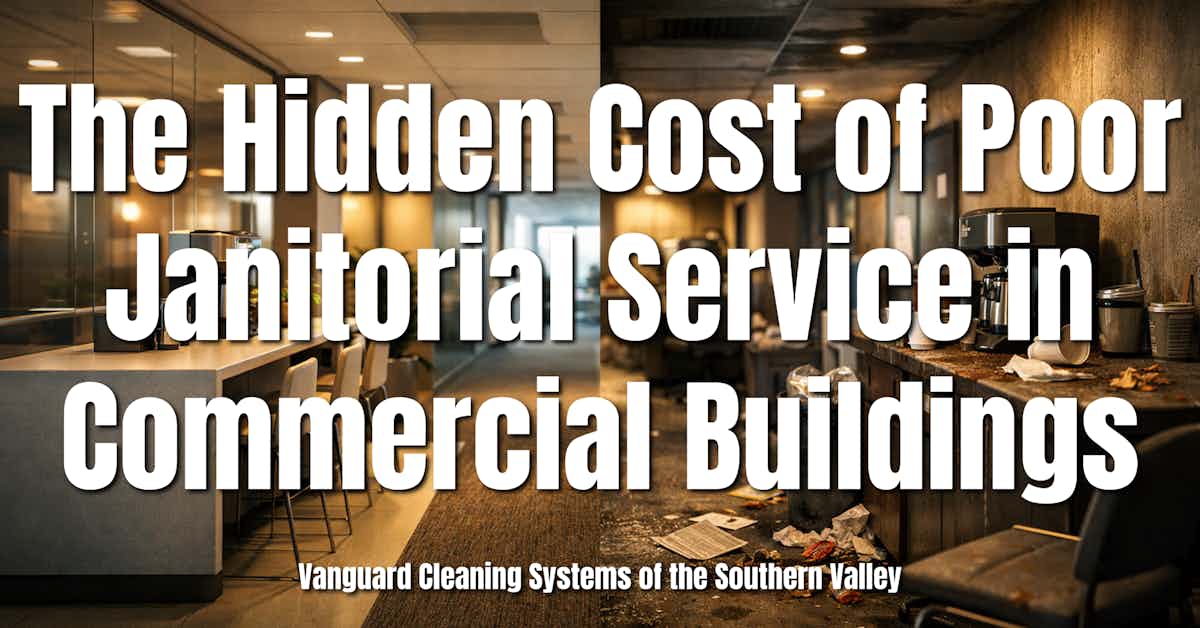
Why Cleaning Quality Impacts More Than Appearance
Cleaning is often treated as a basic line item—something to minimize rather than manage. That mindset creates blind spots. What looks like a cost-saving decision can ripple through operations, affecting people, property, and long-term financial performance.
When shared spaces feel neglected, it changes how people behave inside them. Small frustrations build. Standards slip. Complaints increase. Over time, those signals turn into measurable business impact.
Poor janitorial service does not fail loudly at first. It fails quietly, then compounds.
Quick Answer
Poor janitorial service increases hidden costs through:
- Lower employee productivity
- Higher absenteeism from illness
- Reduced tenant satisfaction and retention
- Faster deterioration of building assets
- Increased reactive maintenance expenses
What Is Poor Janitorial Service?
Poor janitorial service is not just visible dirt or missed trash pickup. It includes:
- Inconsistent cleaning schedules
- Lack of attention to high-touch surfaces
- Poor quality control
- Reactive instead of proactive service
- Lack of communication with property management
It often shows up as “almost clean” environments—spaces that technically look maintained but feel neglected in daily use.
How Poor Cleaning Creates Financial Impact
The cost is not in the cleaning itself. It is in what happens because of it.
Productivity Loss Builds Daily
Employees notice their environment constantly, even if they don’t say it.
Common friction points:
- Dirty or poorly stocked restrooms
- Dust accumulation on desks and equipment
- Overflowing trash in shared areas
- Sticky or unclean breakroom surfaces
These issues:
- Interrupt workflow
- Reduce focus
- Lower morale
- Increase dissatisfaction with the workplace
Even small distractions repeated across dozens or hundreds of employees create measurable output loss.
Illness and Absenteeism Increase
High-touch surfaces act as transfer points:
- Door handles
- Keyboards
- Breakroom appliances
- Elevator buttons
When these are not consistently maintained, exposure risk increases. That leads to:
- More sick days
- Reduced staffing levels
- Workflow disruptions
- Higher indirect labor costs
One outbreak in a workplace can impact operations for weeks.
Tenant Retention Becomes Unstable
Tenants judge a building within seconds of walking in.
They notice:
- Lobby condition
- Restroom cleanliness
- Odors
- General upkeep
Poor cleaning signals:
- Lack of attention to detail
- Weak property management
- Reduced perceived value
Over time, this affects:
- Lease renewals
- Referrals
- Reputation in the market
Tenants rarely cite cleaning as the only issue—but it is often a deciding factor.
Asset Wear Accelerates
Surfaces break down faster without proper care.
Examples:
- Carpet fibers degrade from embedded soil
- Floor finishes wear unevenly
- Fixtures accumulate buildup
- Restrooms develop staining and corrosion
This leads to:
- Premature replacement
- Higher repair costs
- More frequent capital expenditures
What appears as savings in service cost becomes loss in asset lifespan.
Reactive Maintenance Costs More
Poor cleaning creates avoidable problems:
- Stains that require deep restoration
- Odor issues that spread
- Equipment damage from neglect
- Increased pest activity
Reactive fixes are:
- More expensive
- More disruptive
- Less predictable
Proactive service prevents these issues before they require escalation.
Environmental Factors That Influence Outcomes
Cleaning effectiveness is not just about effort. It depends on conditions.
Surface Type
Different materials behave differently:
- Porous surfaces hold contaminants longer
- Smooth surfaces transfer more easily
- High-gloss finishes show wear faster
Each requires specific methods and frequency.
Traffic Levels
Higher traffic areas need:
- More frequent attention
- Better monitoring
- Faster response to issues
Ignoring traffic patterns leads to uneven quality.
Building Layout
Complex layouts increase risk:
- Shared amenities
- Multi-tenant restrooms
- Breakrooms and kitchens
- High-touch transition points
These areas amplify the impact of inconsistent service.
Occupant Behavior
Cleaning must account for how people actually use spaces:
- Food consumption patterns
- Peak usage times
- Shared equipment usage
A static cleaning plan rarely matches real-world behavior.
Workplace Relevance
Cleaning quality directly affects how a building operates day to day.
It Shapes Daily Experience
People do not separate environment from performance.
A clean space:
- Feels organized
- Supports focus
- Reinforces professionalism
A poorly maintained space does the opposite.
It Influences Perception of Leadership
Employees and tenants associate building conditions with management quality.
Cleanliness communicates:
- Attention to detail
- Standards
- Accountability
Neglect communicates risk.
It Affects Operational Stability
Consistent cleaning supports:
- Predictable workflows
- Fewer disruptions
- Lower complaint volume
Inconsistent service introduces variability into daily operations.
Where Cheap Service Becomes Expensive
Low-cost vendors often reduce cost by:
- Cutting labor time
- Reducing frequency
- Skipping detail work
- Limiting supervision
This creates:
- Inconsistent results
- Increased complaints
- More oversight required from management
Hidden costs include:
- Time spent managing issues
- Tenant dissatisfaction
- Emergency service calls
- Accelerated asset wear
Short-term savings rarely hold up over time.
Signs Your Cleaning Program Is Costing You
Look for patterns:
- Repeated complaints about the same areas
- Visible inconsistency between days or shifts
- Odor issues that return quickly
- High-touch surfaces frequently missed
- Increased maintenance tickets tied to cleanliness
These are early indicators of larger operational impact.
How to Fix the Problem
Set Clear Standards
Define:
- What “clean” looks like
- Frequency expectations
- Priority areas
Vague expectations create inconsistent results.
Focus on High-Touch Areas
Prioritize:
- Entry points
- Shared equipment
- Restrooms
- Breakrooms
These drive most of the risk and perception.
Implement Quality Control
Regular inspections should:
- Be structured
- Be documented
- Lead to corrective action
Without accountability, quality drifts.
Align Cleaning With Building Use
Adjust based on:
- Traffic patterns
- Occupancy levels
- Seasonal changes
Static plans fail in dynamic environments.
Choose Reliability Over Price
Evaluate vendors on:
- Consistency
- Communication
- Responsiveness
- Ability to adapt
Cost matters, but stability matters more.
People Also Ask
How does poor cleaning affect employee productivity?
It creates distractions, discomfort, and dissatisfaction, which reduce focus and output over time.
Can cleaning really impact absenteeism?
Yes. Inconsistent maintenance of shared surfaces increases exposure risk, which can lead to more sick days.
Do tenants actually leave because of cleanliness?
Not always directly, but poor conditions contribute to overall dissatisfaction and influence renewal decisions.
Is cheaper janitorial service worth it?
Short-term savings often lead to higher long-term costs through maintenance, complaints, and lost retention.
What areas matter most in a building?
High-touch and shared spaces—restrooms, lobbies, breakrooms, and entry points—have the greatest impact.
FAQ
What is the biggest hidden cost of poor cleaning?
Lost productivity and increased absenteeism tend to outweigh the cost of the service itself.
How often should high-touch surfaces be cleaned?
Frequency should match usage, but high-traffic areas typically require daily or multiple daily attention.
What should property managers monitor?
Consistency, complaint trends, and condition of high-use areas.
How can cleaning improve tenant satisfaction?
By maintaining consistent standards that support comfort, safety, and professional appearance.
Is cleaning an operational expense or an investment?
It functions as both, but its impact aligns more closely with operational performance and asset protection.
References
On’gonge, H. O., & Ng’eno, W. (2022). Influence of sanitation on employee performance at National Social and Security Fund, Kenya. International Journal of Health Sciences. https://doi.org/10.47941/ijhs.1126
Kuhenga, M. M. (2025). The link between physical environment and secretarial performance in higher education institutions in Tanzania. African Quarterly Social Science Review. https://doi.org/10.51867/aqssr.2.3.33
Anonymous. (2023). The impacts of physical workplace environment (PWE) on employees' productivity. International Journal of Business and Technology Management. https://doi.org/10.55057/ijbtm.2023.5.4.33
Lee, Y. (2019). Workplace health and its impact on human capital: Seven key performance indicators of workplace health. Indoor Environment and Health. https://doi.org/10.5772/intechopen.85936
Arbogast, J., Moore-Schiltz, L., Jarvis, W., Harpster-Hagen, A., Hughes, J., & Parker, A. (2016). Impact of a comprehensive workplace hand hygiene program on employer health care insurance claims and costs. Journal of Occupational and Environmental Medicine, 58, e231–e240. https://doi.org/10.1097/JOM.0000000000000738
Kurgat, E. K., et al. (2019). Impact of a hygiene intervention on virus spread in an office building. International Journal of Hygiene and Environmental Health, 222(3), 479–485. https://doi.org/10.1016/j.ijheh.2019.01.001
Allen, J. G., et al. (2015). Green buildings and health. Current Environmental Health Reports, 2, 250–258. https://doi.org/10.1007/s40572-015-0063-y
Licina, D., & Yildirim, S. (2021). Occupant satisfaction with indoor environmental quality. Building and Environment, 204, 108183. https://doi.org/10.1016/j.buildenv.2021.108183
Ildiri, N., et al. (2022). Impact of WELL certification on occupant satisfaction. Building and Environment. https://doi.org/10.1016/j.buildenv.2022.109539
