

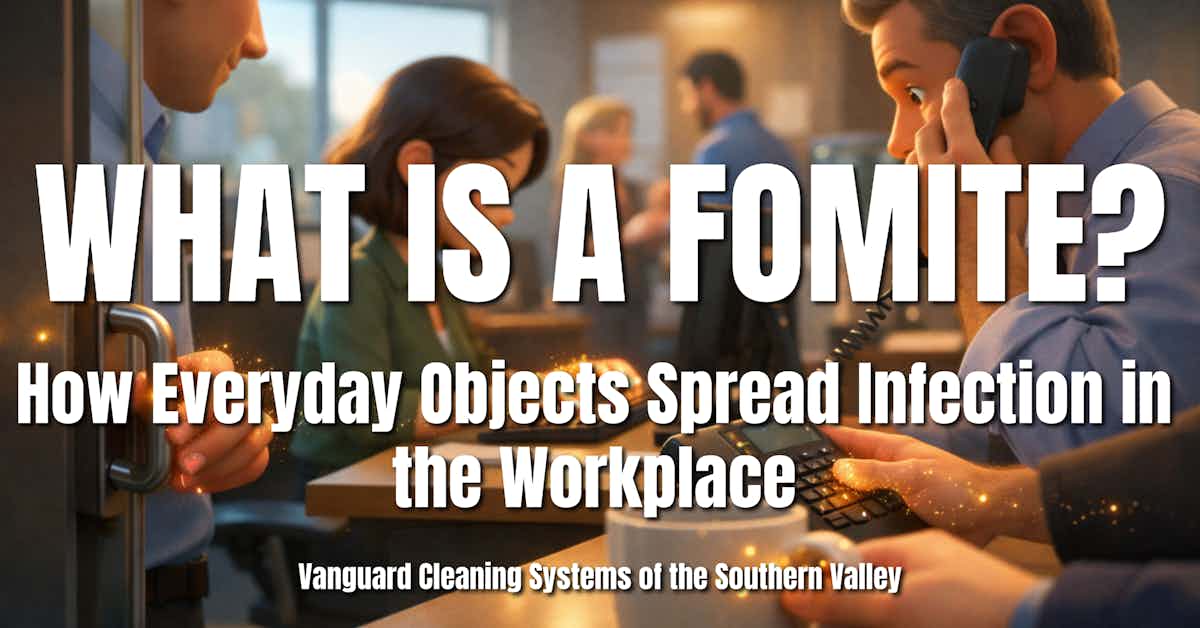
A fomite is an overlooked driver of infection risk in everyday environments—especially in shared workplaces.
Why Fomites Matter More Than You Think
Most people think about illness spreading through the air or direct contact. What often gets missed is the role of everyday objects. These are the surfaces people touch dozens or even hundreds of times per day without thinking about it.
In offices, schools, gyms, and commercial buildings, shared contact points create invisible pathways for microbes to move from person to person. This happens quietly, without obvious signs, which is why it is often underestimated.
Understanding fomites changes how you think about cleaning, hygiene, and risk management. It shifts the focus from “what looks clean” to “what is touched frequently.”
Quick Answer
A fomite is any non-living object that can carry and transfer germs from one person to another through indirect contact.
What Is a Fomite?
A fomite is:
- A non-living object
- Contaminated with microorganisms
- Capable of transferring those microorganisms to another person
Common characteristics:
- Frequently touched
- Shared between multiple people
- Not regularly cleaned or maintained
Simple way to think about it:
- A person leaves germs on a surface
- Another person touches that surface
- The germs transfer
That object becomes a bridge between individuals.
How Fomite Transmission Works
Fomite transmission follows a clear chain of events:
Step 1: Contamination
- An infected person deposits microbes onto a surface
- This can happen through:
- Touch
- Coughing or sneezing
- Handling shared items
Step 2: Survival
- Microorganisms remain on the surface
- Survival time depends on:
- Surface material
- Environmental conditions
- Type of pathogen
Step 3: Transfer
- Another person touches the contaminated surface
- Microbes transfer to the hands
Step 4: Entry
- The person touches:
- Eyes
- Nose
- Mouth
This completes the transmission pathway.
How Seasonal Changes Impact Workplace Cleanliness
Discover how shifts in weather and foot traffic affect cleanliness levels in your facility, and what practical steps you can take to stay ahead of seasonal risks.
Why High-Touch Surfaces Drive Risk
Not all surfaces carry the same level of risk.
High-touch surfaces create repeated exposure cycles:
- Doorknobs
- Light switches
- Elevator buttons
- Shared desks
- Breakroom appliances
These surfaces act as traffic hubs for microbial movement.
The more frequently a surface is touched:
- The more contamination accumulates
- The higher the chance of transfer
- The harder it is to control without a system
Common Examples of Fomites in the Workplace
Most workplaces contain dozens of high-risk fomites.
Office Environments
- Keyboards and mice
- Phones and headsets
- Desk surfaces
- Conference room tables
Shared Spaces
- Breakroom counters
- Coffee machines
- Refrigerators
- Water dispensers
Building Infrastructure
- Door handles
- Elevator buttons
- Handrails
- Restroom fixtures
Soft Surfaces
- Upholstered chairs
- Carpets
- Curtains
- Towels
Each category behaves differently in terms of microbial retention and transfer.
Environmental Factors That Affect Fomite Transmission
Transmission risk is not fixed. It changes based on environmental conditions.
Surface Type
Different materials affect survival and transfer:
- Non-porous surfaces (metal, plastic)
- Higher transfer efficiency
- Longer survival for many pathogens
- Porous surfaces (fabric, paper)
- Lower transfer rates
- May trap microbes but reduce spread
Temperature
- Cooler temperatures often allow longer survival
- Warmer environments can reduce viability for some organisms
Humidity
- Low humidity can increase persistence for certain viruses
- High humidity can affect transfer dynamics
Frequency of Contact
- More contact = more opportunities for spread
- Shared surfaces multiply risk
Pathogen Load
- Higher concentration increases the chance of infection
- Small amounts may not always result in transmission
Human Behavior
- Hand hygiene habits
- Face-touching frequency
- Cleaning consistency
Workplace Relevance: Why This Matters for Facility Management
Fomites are directly tied to operational outcomes.
Health Impact
- Increased illness transmission
- Higher absenteeism
- More frequent outbreaks in shared environments
Productivity Impact
- Sick employees reduce output
- Workflow disruptions increase
- Team performance declines
Perception Impact
Employees notice when surfaces are:
- Sticky
- Dusty
- Visibly unmaintained
This affects:
- Morale
- Trust in management
- Perception of workplace standards
Risk Management
Ignoring fomite transmission creates gaps in:
- Cleaning protocols
- Workplace safety strategies
- Infection control planning
How to Reduce Fomite Transmission in Real Environments
Effective control requires a system, not random effort.
Focus on High-Touch Surfaces
Prioritize:
- Entry points
- Shared equipment
- Common areas
Increase Cleaning Frequency
- Daily cleaning is often not enough for high-traffic areas
- High-touch points may require multiple passes per day
Standardize Procedures
Create repeatable processes:
- Defined cleaning zones
- Clear responsibilities
- Consistent schedules
Improve Accessibility
Make hygiene easier:
- Place hand hygiene stations in visible locations
- Reduce friction for employees to maintain habits
Reduce Shared Contact Where Possible
- Assign equipment to individuals
- Encourage personal devices over shared ones
- Limit unnecessary touchpoints
Train for Awareness
People change behavior when they understand risk:
- Explain how transmission works
- Show where risk exists
- Reinforce simple habits
Where Most Cleaning Programs Fall Short
Many environments rely on visual cleanliness.
This creates a gap between:
- What looks clean
- What actually carries risk
Common issues:
- Ignoring high-touch surfaces
- Inconsistent cleaning schedules
- No defined priorities
- Over-reliance on appearance
A surface can look clean and still contribute to transmission.
What Is Surface Transmission?
Find out how germs spread through shared surfaces and objects, and what businesses need to know to reduce risk.
People Also Ask
Can fomites really spread disease on their own?
Yes. Some infections can spread through contaminated surfaces without direct person-to-person contact.
How long can germs survive on surfaces?
It varies widely:
- Some last hours
- Others persist for days
- Conditions and materials play a major role
Are soft surfaces safer than hard surfaces?
They often transfer microbes less efficiently, but they can still contribute to spread.
What surfaces are the highest risk?
Anything that is:
- Frequently touched
- Shared between people
- Rarely cleaned
Does cleaning eliminate all risk?
No. It reduces risk significantly but must be combined with:
- Hand hygiene
- Behavioral changes
- Consistent processes
FAQ
What is the simplest definition of a fomite?
An object that carries germs and spreads them through touch.
Are phones considered fomites?
Yes. Phones are one of the most common high-touch objects.
Do all surfaces carry the same risk?
No. Risk depends on material, usage, and cleaning frequency.
Is indirect transmission common in workplaces?
Yes, especially in shared environments with high contact rates.
What is the most effective way to reduce risk?
Focus on high-touch surfaces and maintain consistent cleaning routines.
Key Takeaway
Fomites are part of everyday environments, not exceptions. Any shared surface can become a transmission point when touched repeatedly.
The real risk comes from:
- Frequency of contact
- Lack of consistent cleaning
- Limited awareness of indirect transmission
Managing that risk starts with recognizing where it exists.
References
González, T., Laguna, M., & Abramson, G. (2024). A mean field analysis of the role of indirect transmission in emergent infection events. Physica A: Statistical Mechanics and its Applications. https://doi.org/10.1016/j.physa.2024.129933
Kraay, A. N. M., Hayashi, M. A. L., Hernández-Cerón, N., Spicknall, I. H., Eisenberg, M. C., Meza, R., & Eisenberg, J. N. S. (2018). Fomite-mediated transmission as a sufficient pathway: A comparative analysis across three viral pathogens. BMC Infectious Diseases, 18. https://doi.org/10.1186/s12879-018-3425-x
Li, S., Eisenberg, J. N. S., Spicknall, I. H., & Koopman, J. S. (2009). Dynamics and control of infections transmitted from person to person through the environment. American Journal of Epidemiology, 170(2), 257–265. https://doi.org/10.1093/aje/kwp116
Singh, D., Sahu, M., Pagdhune, A., et al. (2021). Viral load could be an important determinant for fomites based transmission of viral infections. Journal of Family Medicine and Primary Care, 10, 929–932. https://doi.org/10.4103/jfmpc.jfmpc_1314_20
Stephens, B., Azimi, P., Thoemmes, M. S., et al. (2019). Microbial exchange via fomites and implications for human health. Current Pollution Reports, 5, 198–213. https://doi.org/10.1007/s40726-019-00123-6
Tharayil, A., Rajakumari, R., Mozetič, M., et al. (2021). Contact transmission of SARS-CoV-2 on fomite surfaces. Interface Focus, 12. https://doi.org/10.1098/rsfs.2021.0042
Zhao, J., Eisenberg, J. N. S., Spicknall, I. H., et al. (2012). Model analysis of fomite-mediated influenza transmission. PLoS ONE, 7. https://doi.org/10.1371/journal.pone.0051984
