

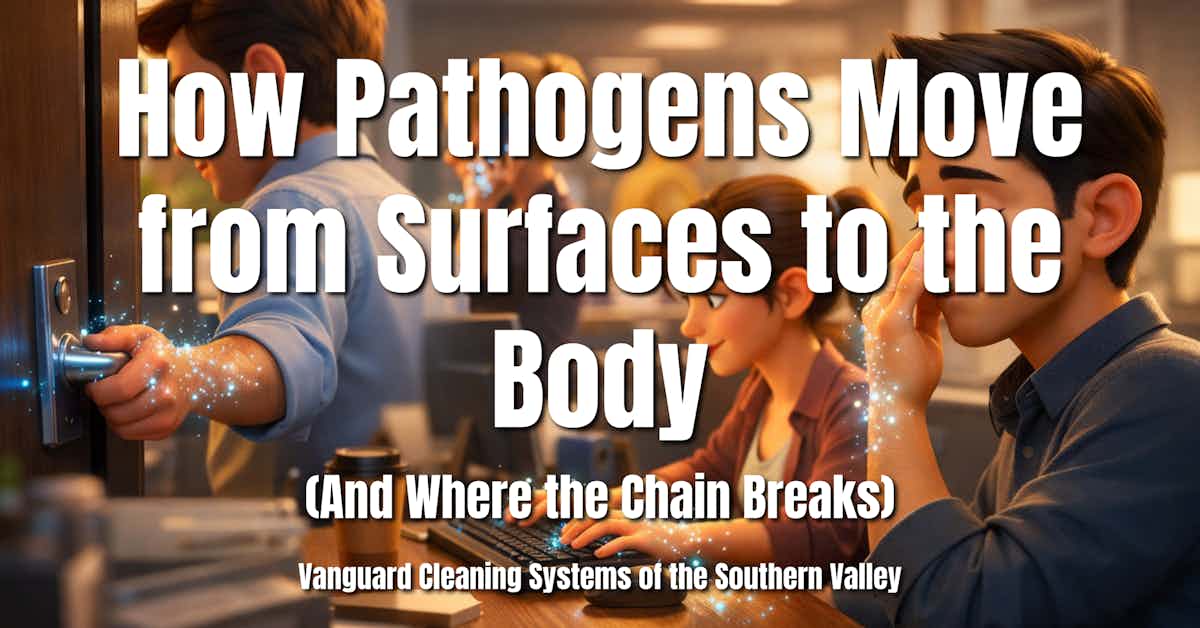
Most surface-related infections follow a simple path: surface → hand → face → entry into the body—but every step in that chain can be interrupted.
Why This Pathway Still Matters in Modern Workplaces
Walk through any office, school, or shared facility and you’ll see the same pattern: people touching doors, keyboards, phones, breakroom appliances, and shared equipment. These interactions create a constant exchange between people and surfaces.
What often gets missed is not just that surfaces can carry microbes, but how those microbes actually make their way into the body. The process is not instant. It requires a sequence of events to happen in order, and each step depends on environmental conditions, human behavior, and the specific organism involved.
This matters because risk is not evenly distributed. Some pathogens move easily through this pathway, while others rarely do. Understanding the chain helps clarify where cleaning, hand hygiene, and behavior changes have the greatest impact.
Quick Answer
Pathogens spread from surfaces through a stepwise process: they survive on a surface, transfer to hands during contact, and then enter the body when a person touches their eyes, nose, or mouth. Breaking any step in this chain reduces risk.
What Is Surface-to-Hand Transmission?
Surface-to-hand transmission is the movement of microbes from a contaminated object to a person’s hands during contact.
These objects are often called fomites, and they include:
- Doorknobs
- Light switches
- Keyboards and mice
- Phones and tablets
- Shared equipment
- Breakroom surfaces
A surface becomes a source of exposure when it holds viable microbes long enough for someone else to pick them up.
How the Surface → Hand → Body Process Works
This pathway is not a single event. It is a chain of dependent steps.
Step 1: Pathogens survive on a surface
For transmission to begin, microbes must remain viable on a surface.
Survival depends on:
- Surface material (plastic, metal, fabric)
- Moisture levels
- Temperature
- UV exposure
- Frequency of contact
Some organisms persist for hours, while others can remain for days under the right conditions.
Step 2: Contact transfers microbes to the hands
When a person touches a contaminated surface:
- A portion of microbes transfers to the skin
- The amount transferred varies widely
- Wet contamination transfers more efficiently than dry
- Smooth surfaces often allow higher transfer rates
This step is highly variable, which is why two people can touch the same surface and experience very different levels of exposure.
Step 3: Hands act as a transport system
Hands do not just receive microbes—they move them.
After contact, hands can:
- Transfer microbes to other surfaces
- Spread contamination across multiple objects
- Carry microbes for minutes to hours
This creates a network effect where one contaminated surface can quickly impact many others.
Step 4: Self-contact introduces microbes to entry points
The most critical step is self-contact.
People frequently touch:
- Eyes
- Nose
- Mouth
These areas contain mucous membranes, which allow microbes to enter the body.
This is often called self-inoculation, and it is the key bridge between environmental contamination and infection.
Step 5: Pathogens enter and establish infection
Once microbes reach entry points:
- Respiratory pathogens can enter through the nose or eyes
- Others may be ingested through the mouth
- Infection depends on dose and organism characteristics
Not every exposure leads to infection, but repeated exposure increases probability.
What Is a Fomite?
Learn how everyday objects in your workplace can carry and spread infections, and why proper cleaning protocols matter more than most businesses realize.
Environmental Factors That Change the Risk
Not all environments support this pathway equally. Several conditions increase or decrease the likelihood of transmission.
Surface Material
- Non-porous surfaces (metal, plastic): longer survival, easier transfer
- Porous surfaces (fabric, paper): lower transfer efficiency
Moisture and Humidity
- Higher moisture supports survival and transfer
- Dry conditions can reduce viability but may increase skin irritation, affecting behavior
Temperature
- Moderate temperatures often support longer survival
- Extreme heat reduces viability
Touch Frequency
- High-touch surfaces create repeated exposure opportunities
- Shared equipment increases cumulative risk
Cleaning Frequency
- Regular removal of contaminants reduces available microbes
- Inconsistent cleaning allows buildup over time
Human Behavior
- Frequency of face touching
- Hand hygiene habits
- Awareness of contamination
Behavior often determines whether exposure actually leads to infection.
Workplace Relevance
This pathway is most relevant in environments where people share space and objects.
Common high-risk zones include:
- Entry points (doors, handles)
- Workstations (keyboards, desks)
- Breakrooms (microwaves, refrigerators)
- Restrooms (fixtures, dispensers)
- Shared tools and equipment
In these environments, the chain becomes continuous:
- One person deposits microbes
- Another person picks them up
- The cycle repeats throughout the day
This is why even low levels of contamination can persist and spread over time.
Where the Chain Breaks (And Why That Matters)
The most practical takeaway is this: the pathway only works if every step holds together.
Breaking any step reduces risk.
Interrupting Surface Survival
- Routine cleaning removes contaminants before transfer
- Targeting high-touch points is more effective than broad, infrequent cleaning
Reducing Transfer to Hands
- Barriers like gloves in specific settings
- Reducing unnecessary surface contact
Limiting Hand Transport
- Hand hygiene at key moments
- Avoiding unnecessary touching of shared objects
Preventing Self-Inoculation
- Reducing face touching
- Using tissues or barriers when needed
Lowering Exposure Dose
- Frequent cleaning
- Hand hygiene
- Environmental controls
Even partial disruption of the chain can significantly reduce overall exposure.
Why Some Pathogens Spread Easily This Way
Not all organisms rely equally on surfaces.
More likely to spread via surfaces
- Norovirus
- Rhinovirus (common cold)
These pathogens:
- Survive well on surfaces
- Transfer efficiently
- Require relatively low exposure to cause infection
Less reliant on surfaces
- SARS-CoV-2 (COVID-19)
- Many respiratory viruses that spread primarily through air
These pathogens:
- Can transfer via surfaces
- But are more efficiently transmitted through airborne routes
This distinction matters for prioritizing control strategies.
How Seasonal Changes Impact Workplace Cleanliness
Discover how shifts in weather and foot traffic affect cleanliness levels in your facility, and what practical steps you can take to stay ahead of seasonal risks.
People Also Ask
Can you get sick just from touching a surface?
Not directly. Infection usually requires touching your face afterward, allowing microbes to enter the body.
How often do people touch their face?
Studies show frequent, often unconscious face touching throughout the day, making this a key step in transmission.
Are all surfaces equally risky?
No. High-touch, non-porous surfaces present the highest risk due to repeated contact and efficient transfer.
Does cleaning eliminate all risk?
No, but it reduces the number of microbes available for transfer, lowering overall exposure.
Is hand hygiene or surface cleaning more important?
They work together. Hand hygiene interrupts transfer to the body, while cleaning reduces the source of contamination.
FAQ
What is the most critical step in surface transmission?
Self-contact with the eyes, nose, or mouth. Without this step, infection is unlikely.
How long can microbes stay on surfaces?
It varies widely—from minutes to days—depending on the organism and environment.
Do dry surfaces reduce risk?
They can reduce survival and transfer, but not eliminate it.
Why are shared spaces higher risk?
Because multiple people interact with the same surfaces, increasing the chance of transfer.
What reduces risk the fastest?
- Targeted cleaning of high-touch surfaces
- Consistent hand hygiene
- Reducing face touching
Final Takeaway
The surface-to-body pathway is not automatic. It depends on a chain of events that must all occur in sequence. That makes it both a real risk and a controllable one.
When you understand the steps—survival, transfer, transport, and entry—you can identify exactly where to intervene. The most effective strategies are not broad or random. They focus on breaking the chain at key points where transmission is most likely to occur.
References
Butot, S., Zuber, S., Moser, M., & Baert, L. (2022). Data on transfer of human coronavirus SARS-CoV-2 from foods and packaging materials to gloves indicate that fomite transmission is of minor importance. Applied and Environmental Microbiology, 88. https://doi.org/10.1128/aem.02338-21
Cheng, P., Luo, K., Xiao, S., et al. (2021). Predominant airborne transmission and insignificant fomite transmission of SARS-CoV-2 in a two-bus outbreak. Journal of Hazardous Materials, 425, 128051. https://doi.org/10.1016/j.jhazmat.2021.128051
Gerba, C., Leija, B., Ikner, L., Gundy, P., & Rutala, W. (2021). Transfer efficiency of an enveloped virus from surfaces to hands. Infection Control & Hospital Epidemiology, 44, 335–337. https://doi.org/10.1017/ice.2021.428
Greene, C., Vadlamudi, G., Eisenberg, M., et al. (2015). Fomite-fingerpad transfer efficiency. American Journal of Infection Control, 43(9), 928–934. https://doi.org/10.1016/j.ajic.2015.05.008
Kraay, A., Hayashi, M., Hernández-Cerón, N., et al. (2018). Fomite-mediated transmission as a sufficient pathway. BMC Infectious Diseases, 18. https://doi.org/10.1186/s12879-018-3425-x
Pitol, A., & Julian, T. (2020). Community transmission of SARS-CoV-2 by fomites. https://doi.org/10.1101/2020.11.20.20220749
Stephens, B., Azimi, P., Thoemmes, M., et al. (2019). Microbial exchange via fomites. Current Pollution Reports, 5, 198–213. https://doi.org/10.1007/s40726-019-00123-6
Tharayil, A., Rajakumari, R., Mozetič, M., et al. (2021). Contact transmission of SARS-CoV-2 on surfaces. Interface Focus, 12. https://doi.org/10.1098/rsfs.2021.0042
Zhao, J., Eisenberg, J., Spicknall, I., et al. (2012). Model analysis of fomite-mediated influenza transmission. PLoS ONE, 7. https://doi.org/10.1371/journal.pone.0051984
Zhuang, L., Ding, Y., Zhou, L., et al. (2023). Fomite transmission in airports based on real human behavior. https://doi.org/10.3390/buildings13102582
