

A workplace that looks clean one day and neglected the next creates the perfect conditions for illnesses to circulate quietly and repeatedly.
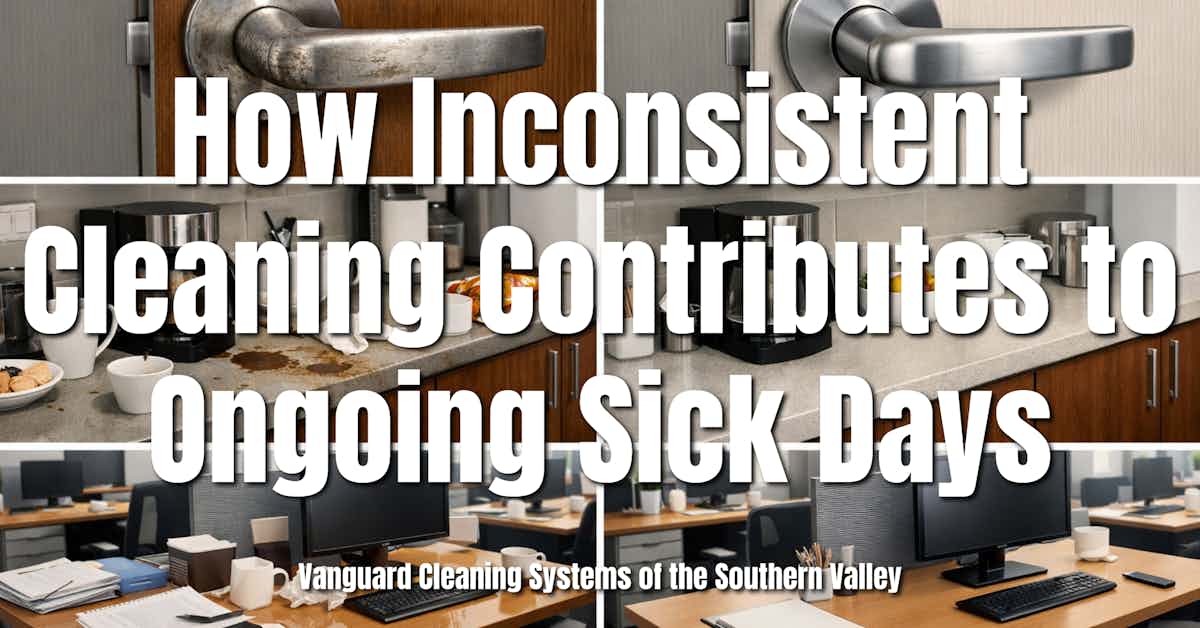
Why Inconsistent Cleaning Creates a Persistent Health Problem
Illness-related absenteeism rarely comes from a single exposure. In shared indoor environments, sickness tends to persist when conditions allow viruses and bacteria to remain viable on surfaces long enough to infect multiple people over time. Inconsistent cleaning creates exactly that condition.
When cleaning schedules fluctuate, high-touch surfaces are left untreated for extended periods. Pathogens accumulate, transfer between surfaces and hands, and re-enter the body through routine contact. The result is not a dramatic outbreak, but a steady pattern of sick days that feels unavoidable.
Research across offices, schools, and shared facilities shows a consistent pattern: environments with irregular cleaning experience higher rates of recurring illness, while those with structured, repeatable cleaning programs reduce both contamination and absenteeism (Bright et al., 2010; Arbogast et al., 2016).
How Germs Persist When Cleaning Is Irregular
Viruses and bacteria do not disappear simply because a space looks tidy. Many organisms can survive on nonporous surfaces for hours or days, depending on conditions such as humidity, temperature, and surface material.
When cleaning is inconsistent, several things happen at once:
- Pathogens remain viable on frequently touched surfaces
- Transfer between hands and objects continues uninterrupted
- Newly cleaned areas are quickly recontaminated by untreated ones
Studies of office environments show that shared surfaces act as interconnected networks. A single contaminated surface can spread organisms across an entire workspace through routine movement and touch (Kurgat et al., 2019).
Without consistent cleaning intervals, these networks are never fully interrupted.
High-Touch Surfaces and Repeated Exposure
High-touch surfaces are the primary drivers of ongoing exposure. These surfaces are touched by many people, often multiple times per hour, making them ideal reservoirs for pathogens.
Common examples include:
- Door handles and push plates
- Break room tables and appliance handles
- Restroom fixtures
- Shared office equipment
Research in both educational and workplace settings confirms that these surfaces frequently harbor bacteria and viruses associated with respiratory and gastrointestinal illness when cleaning is irregular (Bright et al., 2010).
When these areas are cleaned sporadically, exposure becomes cyclical rather than occasional. People recover, return to the space, and are exposed again.
The Difference Between Occasional and Consistent Cleaning
One of the most common misconceptions is that periodic deep cleaning offsets inconsistent daily cleaning. Evidence does not support this assumption.
Studies comparing structured hygiene programs with ad-hoc approaches show clear differences:
- Consistent cleaning reduces surface contamination over time
- Irregular cleaning allows contamination levels to rebound quickly
- Absenteeism decreases only when hygiene practices are maintained consistently
In a controlled office study, a structured hygiene intervention significantly reduced virus spread compared to baseline conditions, demonstrating that consistency—not intensity alone—was the key factor (Kurgat et al., 2019).
Why Sick Days Become a Pattern Instead of an Event
When cleaning is inconsistent, illness behaves less like an outbreak and more like background noise. Employees call out sick on different days for similar symptoms, often without an obvious connection.
This happens because:
- Exposure occurs repeatedly, not all at once
- Pathogens circulate at low but persistent levels
- Reinfection becomes possible shortly after recovery
National data from influenza seasons show that workplace conditions play a measurable role in health-related absenteeism, particularly when environmental controls are weak or inconsistent (Groenewold et al., 2019).
Shared Spaces Multiply the Risk
Shared spaces amplify the effects of inconsistent cleaning. Break rooms, restrooms, and meeting areas concentrate traffic and surface contact into smaller zones.
When these areas are not cleaned on a predictable schedule:
- Contamination spreads faster than it can be removed
- Cleaning gaps compound across days
- New exposures occur even after partial cleaning
Research shows that improving hygiene practices in shared areas leads to measurable reductions in virus transmission, reinforcing the role these spaces play in ongoing illness (Kurgat et al., 2019).
Behavioral Factors That Reinforce the Problem
Human behavior interacts with inconsistent cleaning in ways that increase risk:
- People assume surfaces are clean if they look clean
- Hand hygiene declines when environmental hygiene is inconsistent
- Shared items are used more casually
Studies of comprehensive workplace hygiene programs show that consistency improves both environmental conditions and individual hygiene behaviors, creating a reinforcing effect that reduces absenteeism (Arbogast et al., 2016).
When cleaning is irregular, that reinforcement disappears.
Why Visual Cleanliness Is Not Enough
Visual inspection alone is a poor indicator of health risk. Many pathogens are invisible and odorless, persisting even on surfaces that appear spotless.
Research sampling classroom and office surfaces found pathogens present despite routine visual cleanliness, particularly when cleaning schedules varied (Bright et al., 2010).
This gap between appearance and reality is one reason inconsistent cleaning is so effective at sustaining illness cycles.
Economic and Operational Consequences of Ongoing Sick Days
Repeated sick days carry costs beyond lost productivity:
- Increased overtime and staffing adjustments
- Disrupted workflows
- Reduced morale and engagement
Studies examining employer health claims show that consistent hygiene programs are associated with lower healthcare costs and fewer absence-related disruptions (Arbogast et al., 2016).
These benefits do not appear when cleaning efforts are irregular or reactive.
What Research Says About Breaking the Cycle
Across multiple studies and settings, the evidence points to the same conclusion:
- Regular, predictable cleaning reduces contamination
- Inconsistent cleaning allows pathogens to persist
- Sustained hygiene programs reduce absenteeism
The reduction in illness-related absences is not immediate, but it is measurable over time when consistency is maintained (Hansen et al., 2018; Arbogast et al., 2016).
Frequently Asked Questions
Can occasional deep cleaning prevent ongoing illness?
No. Research shows that contamination rebounds quickly when daily and high-touch cleaning is inconsistent. Long-term reductions require regular schedules.
Are shared surfaces really that important?
Yes. High-touch surfaces are repeatedly identified as reservoirs for pathogens linked to respiratory and gastrointestinal illness (Bright et al., 2010).
Does consistency matter more than cleaning frequency?
Consistency determines whether contamination levels stay low or rebound. Frequency supports consistency but cannot replace it.
Do hygiene programs actually reduce sick days?
Multiple studies show associations between structured hygiene programs and reduced absenteeism (Arbogast et al., 2016; Groenewold et al., 2019).
People Also Ask
How does inconsistent cleaning lead to more sick days?
Inconsistent cleaning allows viruses and bacteria to remain on shared surfaces long enough to infect multiple people over time, creating repeated exposure and ongoing absenteeism.
What surfaces contribute most to illness spread?
Door handles, break room surfaces, restroom fixtures, and shared equipment are the most commonly identified sources.
Why don’t illnesses stop after people recover?
When environmental contamination persists, people can be exposed again shortly after returning, sustaining the cycle.
Is workplace cleaning linked to absenteeism?
Yes. Studies consistently show fewer illness-related absences in workplaces with consistent hygiene programs.
Conclusion
Inconsistent cleaning does not cause dramatic outbreaks. Instead, it sustains quiet, ongoing illness that shows up as repeated sick days over time. Research across workplaces and schools consistently demonstrates that regular, systematic cleaning disrupts this cycle by reducing surface contamination and limiting repeated exposure. When cleaning lacks consistency, illness becomes part of the environment rather than an exception.
References
Arbogast, J. W., Moore-Schiltz, L., Jarvis, W. R., Harpster-Hagen, A., Hughes, J., & Parker, A. (2016). Impact of a comprehensive workplace hand hygiene program on employer health care insurance claims and costs, absenteeism, and employee perceptions and practices. Journal of Occupational and Environmental Medicine, 58(6), e231–e240. https://doi.org/10.1097/JOM.0000000000000738
Bright, K. R., Boone, S. A., & Gerba, C. P. (2010). Occurrence of bacteria and viruses on elementary classroom surfaces and the potential role of classroom hygiene in the spread of infectious diseases. The Journal of School Nursing, 26(1), 33–41. https://doi.org/10.1177/1059840509354383
Groenewold, M. R., Burrer, S. L., Ahmed, F., Uzicanin, A., & Luckhaupt, S. E. (2019). Health-related workplace absenteeism among full-time workers—United States, 2017–18 influenza season. Morbidity and Mortality Weekly Report, 68, 577–582. https://doi.org/10.15585/mmwr.mm6826a1
Hansen, S., Zimmerman, S., van de Mortel, T., & Dalziel, K. (2018). Infectious illness prevention and control methods and their effectiveness in non-healthcare workplaces. American Journal of Infection Control, 46(4), 448–454.
Kurgat, E. K., Sexton, J. D., Garavito, F., Reynolds, A., Contreras, R., Gerba, C. P., Leslie, R. A., Edmonds-Wilson, S. L., & Reynolds, K. A. (2019). Impact of a hygiene intervention on virus spread in an office building. International Journal of Hygiene and Environmental Health, 222(3), 479–485. https://doi.org/10.1016/j.ijheh.2019.01.001
