

Though a year-round issue, norovirus outbreaks are especially challenging during the winter months, coinciding with the annual influenza season and, this year, the ongoing SARS-CoV-2 pandemic, potentially overwhelming certain institutions if not dealt with professionally.

Combatting Norovirus Outbreaks With Enhanced Cleaning and sanitization Services
Norovirus outbreaks can occur anywhere at any time.
However, the outbreaks are more common during the winter months.
While the exact reason for the increase is unknown, several reasons are suspected, including:
- Biological factors - Increased survival rates during winter months.
- Environmental factors - Colder temperatures, specifically water temperatures, correlate to virus prevalency, and;
- Human behavioral factors - People spend more time indoors closer to each other than in warmer months.
According to Science Direct;
The wintertime seasonality of noroviruses may be attributable to increased viral durability in cold water.
The abundance of seasonally varying norovirus in surface waters and in sewage runoff has been demonstrated in northern European countries.
[A study] found that fluctuations in Lake Ontario harbor temperatures (that lake being both the source of drinking water and the destination of sewage outflow from the city of Toronto) were strongly predictive of outbreaks of norovirus gastroenteritis in the population.
[Reporting] that a threshold in risk was reached when the lake temperature reached 4°C a temperature at which the integrity of viral particles is well maintained.
Given the small size of noroviruses and related agents (approximately an order of magnitude smaller than pores in the sand filters commonly used to process drinking water), this study suggests a possible mechanism for wintertime norovirus seasonality via ‘recycling’ of viral particles from sewage into drinking water.
The Burden of Norovirus Outbreaks in the U.S.
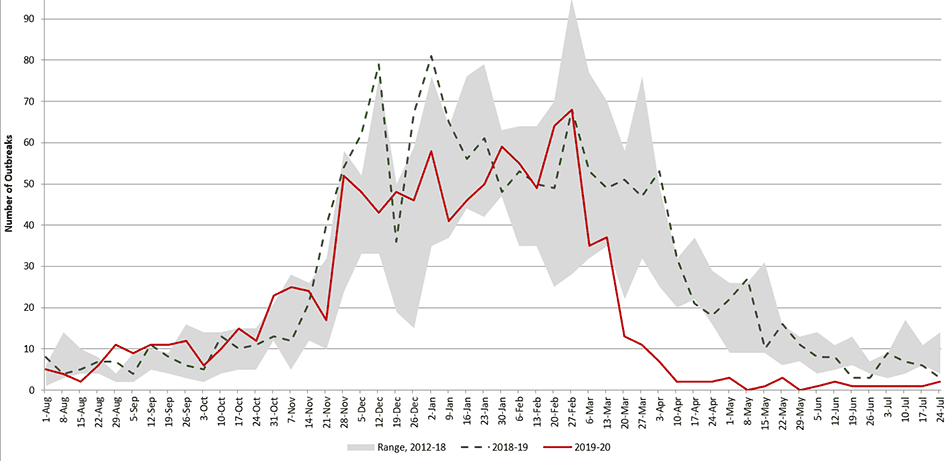
As we have demonstrated, norovirus outbreaks trend upward during the winter months, likely due to increased survivability in cold weather.
However, as previously mentioned, outbreaks can occur all year long and increase by as much as 50% when a new strain is introduced.
According to the U.S. Centers for Disease Control and Prevention (CDC);
Each year, there are about 2,500 reported norovirus outbreaks in the United States.
Norovirus outbreaks occur throughout the year but are most common from November to April.
The virus extracts a heavy toll on the elderly, especially those over 85, resulting in;
- 900 deaths, mostly among adults aged 65 and older.
- 109,000 hospitalizations.
- 465,000 emergency department visits, mostly in young children.
- 2,270,000 outpatient clinic visits annually, mostly in young children.
- 19 to 21 million cases of vomiting and diarrhea illnesses.
However, in the U.S., by the time children reach the age of 5;
- 1 in 110,000 will die from norovirus.
- 1 in 160 will be hospitalized.
- 1 in 40 will go to the emergency department.
- 1 in 7 will go to an outpatient clinic.
Source:
Cleaning Up After a Norovirus Outbreak
Norovirus outbreaks occur everywhere, but most commonly appear in:
- Healthcare Facilities - Typically introduced by sick patients, visitors, or common food, and can last for months.
- Restaurants and at Catered Events - Approximately 50% of norovirus outbreaks are food-related, especially leafy greens, fresh fruits, and shellfish.
- Schools and Childcare Facilities - Outbreaks in daycares, schools, and universities typically occur as a result of a combination of close quarters and increased fomites, and;
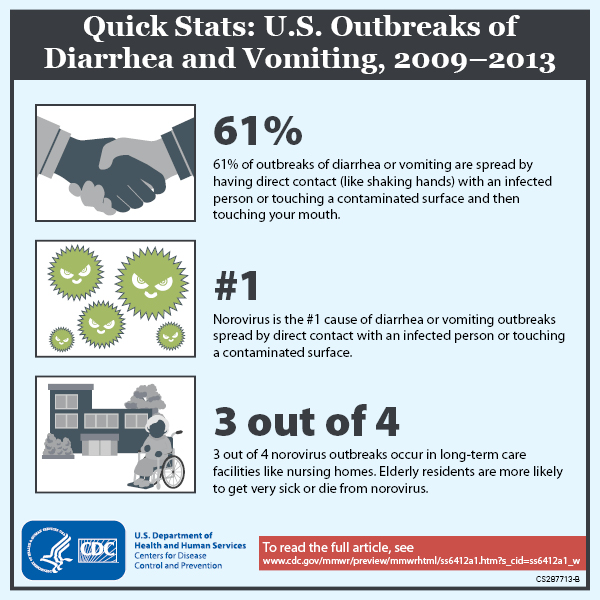
- Cruise Ships - Though constituting only 1% of norovirus outbreaks, the virus is responsible for 90% of diarrheal illness on these vacations, much of which is attributed to rapid crew and passenger turnover, the constant influx of large amounts of food, and the close living conditions while aboard.
Cleaning to eliminate the virus and prevent its spread can be challenging and requires the services of highly trained professionals.
As always, the first step is to quarantine off any known contaminated spaces, especially in the event of vomiting, which can aerosolize the virus and spread it up to 25 feet from the point of origin.
Next, ensure all cleaning services' personnel wear appropriate protective equipment, including gloves, masks, and goggles.
Remove any furniture adjacent to the exposure for later cleaning and disinfection.
Do NOT mop the floor.
Instead, clean the floor with a scrubber-vacuum and an all-purpose cleaner and disinfectant.
Repeat as necessary, then vaccum with a HEPA filtred vaccum when you are finished.
Use smart-microfiber towels combined with an all-purpose cleaner and disinfectant product to clean the walls and any furniture.
Make certain to clean and sanitize the cleaning tools, and dispose of any one-time use PPE when the job is done.
References & Resources
- Norovirus is Seasonal and Other Strange Facts About Norovirus
- Common Settings of Norovirus Outbreaks
- Cleaning Up After a Norovirus Outbreak
Takeaway
Norovirus season is set to rise in a few weeks.
Unlike influenza, there is no vaccine.
For healthy adults, exposure is typically a non-issue.
However, among the very young and especially the very old, who are at an increased risk of infection from influenza and SARS-CoV-2, the threat is very real and dangerous, especially given the prevalence of the infection in healthcare settings.
In the event of an outbreak, a trained cleaning service provider's rapid response can profoundly impact a positive outcome.
A proven and cost-effective method for ensuring the highest cleanliness and safety standards is outsourcing daily and specialized custodial services to an experienced service provider.
If you would like more information regarding the effectiveness of high-performance infection prevention and control measures, or if you would like to schedule a free, no-obligation onsite assessment of your facility's custodial needs, contact us today for a free quote!
In Bakersfield CA, call (661) 437-3253
In Fresno CA, call (559) 206-1059
In Valencia CA, or Santa Clarita CA, call (661) 437-3253
In Palmdale CA, or Lancaster CA, call (661) 371-4756

You must be logged in to post a comment.